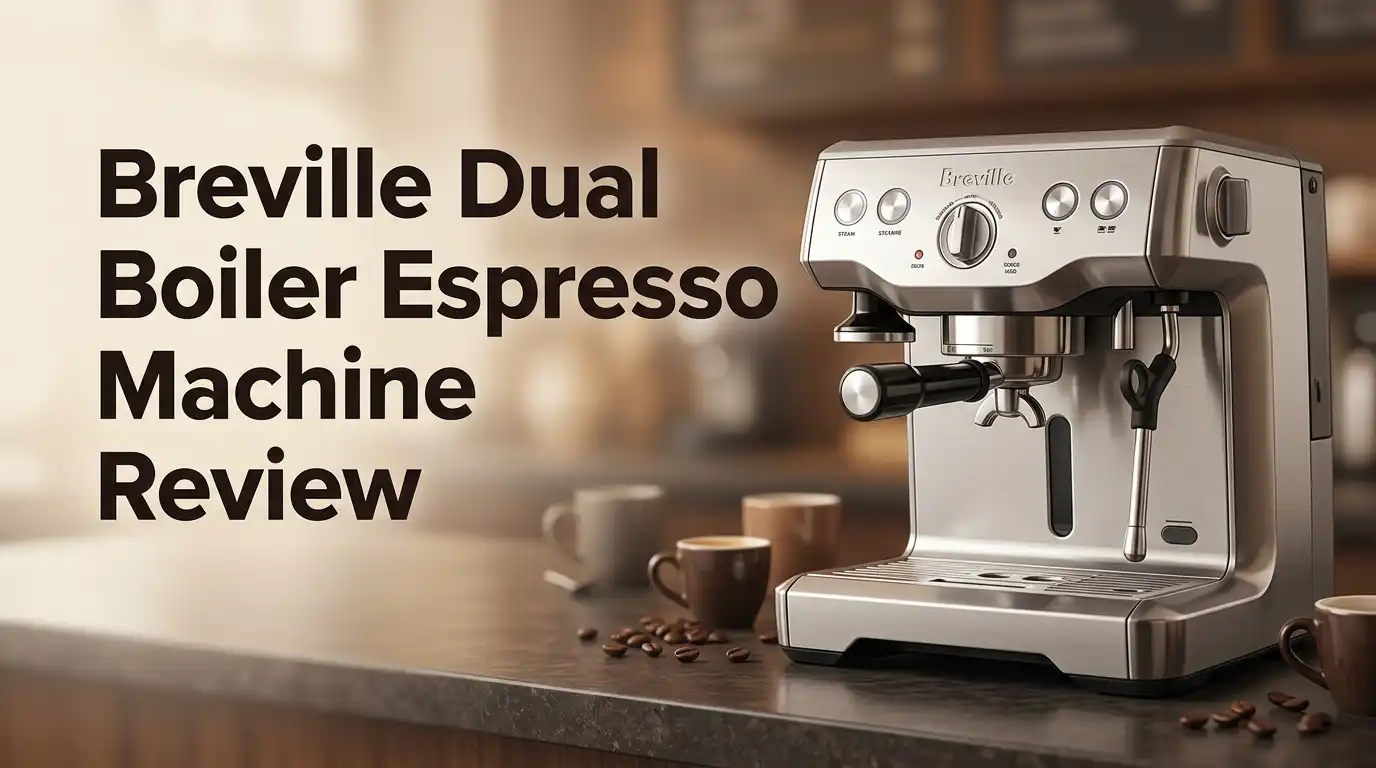
Breville Dual Boiler Espresso Machine Review 2026: Still Worth It?
Espresso lovers keep asking the same question. Does a machine released over a decade ago still deserve a spot on your kitchen counter in 2026? The Breville Dual Boiler, known to fans as the BDB, refuses to fade away.
It sits in a strange sweet spot between kitchen appliance and café equipment. It gives you temperature control, programmable preinfusion, and a steam boiler that never makes you wait.
I spent weeks pulling shots, steaming milk, cleaning baskets, and pushing this machine past its comfort zone. This review covers the unboxing, the daily workflow, the real weaknesses, and the alternatives worth your money.
In a Nutshell:
- Two separate stainless steel boilers run at the same time. You brew espresso and steam milk together. No waiting. No temperature flush. This single feature changes your entire morning routine.
- PID temperature control keeps shots consistent. You set the brew temperature on the LCD screen. The machine holds it. The group head is heated too, so the first shot tastes like the fifth shot.
- Programmable preinfusion is the hidden gem. You control pressure, duration, and ramp speed. Most machines under $3,000 give you nothing close to this level of adjustment.
- The 58 mm portafilter accepts a 22 gram dose. This is the industry standard size. Third party baskets, tampers, and distribution tools all fit without adapters.
- Build quality trails Italian prosumer machines. The BDB weighs around 12 kg. Traditional E61 machines weigh twice that. You get plastic in places where you might expect metal.
- The design looks dated in 2026. Breville refreshed almost every other model. The Dual Boiler still wears a chassis introduced over ten years ago.
- Repairs are possible but awkward. Many parts use standard sizes. Breville still leans toward replacement over service. Plan for that reality.
What Is the Breville Dual Boiler Espresso Machine?

Last update on 2026-10-21 / Affiliate links / Images from Amazon Product Advertising API
The Breville Dual Boiler, model BES920XL, is a semi automatic espresso machine built for home baristas who want control. Breville sells it as Sage in Europe, so you may see the same machine under a different badge.
Two independent stainless steel boilers sit inside the housing. One handles brew water. One handles steam. Each boiler has its own heating element and its own PID controller.
The machine measures roughly 37.9 x 40.3 x 37.1 cm. It needs real counter space and clearance above for the water tank. The front panel holds an LCD screen and a pressure gauge.
You see what the machine is doing at every second of the shot. That transparency is rare at this price. The BDB does not grind beans. You supply your own grinder.
The Unboxing Experience
The box arrives heavy and tightly packed. Breville uses molded foam and cardboard inserts, so nothing rattles. Lifting the machine out takes two hands and a bit of care.
The brushed stainless steel panels feel cool and solid under your fingers. Fingerprints show up immediately, so keep a cloth nearby.
Inside the accessory tray you find a 58 mm stainless steel portafilter, four filter baskets covering single and double shots in dual wall and single wall versions, a razor dosing tool, an integrated tamper, a 16 oz stainless milk jug, a cleaning kit, a water hardness test strip, and a water filter with holder.
Breville includes more in the box than most competitors at double the price. Setup takes about twenty minutes. You rinse the boilers, run the water filter cycle, and dial in your grinder. First shot lands within the hour.
Build Quality and Design in 2026
Let us be honest here. The Dual Boiler is an appliance wearing prosumer clothing. The exterior uses brushed stainless steel. The boilers use stainless steel too. Behind those panels you find plastic housings, plastic water tank components, and a drip tray that flexes under pressure.
Compare this to a Profitec or Lelit machine. Those weigh 20 to 30 kg and feel like small industrial equipment. The BDB weighs about 12 kg.
You can actually move it alone, which some owners consider a feature rather than a flaw. Hidden wheels under the drip tray let you slide the machine across the counter for cleaning. That thoughtful touch shows Breville understood home kitchens.
The styling follows the same language as the Barista Express from over a decade ago. Next to a Bambino Plus or an Oracle Jet, it looks old. Function beats fashion here, but the gap keeps widening.
Top 3 Alternatives for Breville Dual Boiler


Last update on 2026-10-21 / Affiliate links / Images from Amazon Product Advertising API
Breville Barista Pro Espresso Machine

Last update on 2026-10-22 / Affiliate links / Images from Amazon Product Advertising API
Breville Bambino Plus Espresso Machine

Last update on 2026-10-22 / Affiliate links / Images from Amazon Product Advertising API
Breville Oracle Jet Espresso Machine
How the Dual Boiler Heating System Works
Single boiler machines force you to choose. You brew, then you wait for the boiler to climb to steam temperature. Then you wait again for it to cool down. That cycle wastes minutes and ruins consistency.
The BDB removes that problem completely. The brew boiler holds water at your chosen extraction temperature, usually somewhere between 198°F and 204°F. The steam boiler sits separately at a much higher temperature and builds pressure up to 3 bars. Both run at once.
You can pull a shot while steaming milk in the same breath. For anyone making two or three milk drinks each morning, this saves serious time.
The group head carries its own heating element too. Cold metal steals heat from brew water and drops your actual extraction temperature. Breville solved that by heating the group itself. Your tenth shot tastes exactly like your first.
Preinfusion Control Explained
This feature separates the Dual Boiler from almost everything in its price class. Preinfusion means soaking the coffee puck at low pressure before the pump ramps to full force. Wet coffee resists channeling, and even extraction tastes sweeter.
Breville lets you program two variables. You set the preinfusion duration anywhere up to 60 seconds. You also set the pressure level as a percentage, roughly 60 to 90 percent of full pump power. That combination opens the door to real experimentation.
Want a classic profile? Use five seconds of gentle soak, then nine bars. Want something closer to a lever machine? Stretch preinfusion to forty seconds at low pressure and watch the gauge. Light roasts respond beautifully to longer, softer starts. Most owners say this one feature justifies the upgrade from any thermoblock machine.
Steam Wand and Milk Texture
The steam performance surprises people. You pull a lever on the right side rather than twisting a knob. The action feels mechanical and satisfying. Steam arrives instantly because the boiler already sits at pressure.
The wand swivels a full 360 degrees. You position the pitcher wherever your hand feels natural. Power is more than adequate for a 16 oz jug of whole milk. You create a tight vortex within seconds and hit microfoam without fighting the machine.
Oat milk and other plant milks also texture well here, which matters more every year. You can adjust steam output up to 3 bars through the menu. Honestly, the factory setting works fine for most people. Latte art becomes a skill problem, not an equipment problem. That is exactly what you want from a machine at this level.
The 58 mm Portafilter and Accessories
Breville chose the 58 mm commercial standard instead of a proprietary size. That decision pays off for years. Every aftermarket basket, bottomless portafilter, distribution tool, puck screen, and tamper on the market fits your machine.
The included portafilter is stainless steel with a comfortable handle. It holds a 22 gram dose in the double basket, which suits modern recipes well. Breville ships both single wall and dual wall baskets. Use single wall with fresh beans and a decent grinder. Use dual wall only with pre ground supermarket coffee.
The razor dosing tool trims excess grounds to a repeatable level. Beginners find it useful. Experienced users abandon it once they weigh doses on a scale. The integrated tamper works, but a standalone 58 mm tamper improves your consistency immediately. Budget for that small upgrade.
Daily Use and Real Workflow
Morning routine looks like this. The programmable timer wakes the machine before you reach the kitchen, so it sits fully heated. No fifteen minute warmup stare. From cold, the BDB needs roughly fifteen to twenty minutes for full thermal stability, which matches traditional machines.
You grind, distribute, tamp, lock in, and press start. The LCD counts your shot time. The pressure gauge shows the ramp. Watching both at once teaches you more about espresso than any article can. You adjust grind size based on what you saw, not what you guessed.
The water tank holds enough for a busy morning and slides out from the top. Refilling is easy. The drip tray fills faster than you expect because of the automatic purge. Empty it daily or you will mop your counter. That is the single most common complaint from owners.
What the Breville Dual Boiler Does Not Do Well
Authentic reviews cover failures, so here they are. The machine is noisy. The vibratory pump buzzes loudly during extraction and the automatic purge startles people at 6 am.
Plastic components inside create long term worry. Solenoid valves, o rings, and tubing wear out. Owners on espresso forums report failures around the three to five year mark under daily use. Breville customer service leans toward replacement, and out of warranty repair quotes can feel steep.
The steam boiler needs descaling attention. Hard water shortens its life dramatically. Skip the water filter and you will regret it.
The LCD interface, while informative, uses a menu system that feels clunky in 2026. No app. No connectivity. No shot profiling beyond preinfusion. Finally, the machine does not grind. Budget another $300 to $600 for a grinder that matches this quality, or your shots will disappoint you.
Maintenance and Cleaning Requirements
This machine demands attention. Backflush with water daily and with detergent weekly. The included cleaning tablets and rubber disc make this simple. The LCD prompts you when a cleaning cycle is due.
Descaling schedule depends entirely on your water. Use the included test strip. Soft filtered water can stretch intervals to several months. Hard water may require descaling every few weeks. Many experienced owners skip tap water entirely and mix their own brewing water from distilled water and mineral packets. That habit alone can double the machine’s lifespan.
Wipe the steam wand immediately after every use and purge it. Dried milk inside the tip creates blockages that are painful to clear. Remove and rinse the shower screen monthly. Treat the BDB like equipment, not an appliance, and it rewards you. Neglect it and it fails early.
Repairs, Mods, and Long Term Ownership
Here is where the Dual Boiler earns respect. Unlike most Breville products, this machine has an active repair community. Many internal parts use standard sizes, so replacement o rings and seals cost a few dollars.
Owners document common fixes online, including solenoid replacement, pressure switch service, and steam valve rebuilds. A moderately handy person with a screwdriver can handle most of these jobs. That community knowledge extends the machine’s useful life well past warranty.
Modding is also popular. The most famous modification adds manual flow control, turning the BDB into something resembling a lever profiling machine. You gain full control over pressure throughout the shot. Other owners install upgraded shower screens, bottomless portafilters, and improved steam tips. The machine tolerates tinkering better than its reputation suggests.
Pros and Cons
Pros
- Two independent boilers let you brew and steam at the same time with zero waiting
- PID control on both boilers plus a heated group head delivers excellent temperature stability
- Programmable preinfusion offers pressure and duration control rarely found at this price
- Standard 58 mm portafilter opens access to all aftermarket accessories
- Generous accessory bundle includes baskets, razor tool, milk jug, and water filter
- Programmable wake timer means the machine is hot before you walk into the kitchen
- Hidden wheels under the drip tray make counter cleaning effortless
- Active community support for repairs, parts, and performance mods
Cons
- Plastic internals reduce long term durability compared to Italian prosumer machines
- Design looks dated next to newer Breville models
- Vibratory pump runs loud during extraction and purging
- Drip tray fills quickly and needs daily emptying
- Out of warranty repair costs can be high and Breville prefers replacement over service
- No grinder included, so total setup cost climbs significantly
- Menu navigation on the LCD feels slow and dated
- Hard water causes scale problems faster than many owners expect
Price and Value in 2026

Last update on 2026-10-20 / Affiliate links / Images from Amazon Product Advertising API
The Dual Boiler typically lands between $1,400 and $1,800 depending on sales and finish. Discounts appear regularly, especially around major shopping events, and patient buyers often save a few hundred dollars.
At full price the value argument gets tighter every year. Newer Breville machines like the Oracle Jet offer faster heating, better screens, and integrated grinders. The BDB counters with something they lack, which is genuine manual control over every brewing variable.
Compare it against E61 machines in the same bracket. Those win on build and resale value. The BDB wins on features and precision. You are choosing between metal and brains. For someone who enjoys dialing in shots, reading pressure curves, and chasing extraction, the Breville delivers more usable capability per dollar. For someone who wants a machine their grandchildren inherit, look elsewhere.
Who Should Buy the Breville Dual Boiler?
Buy this machine if you already own a quality burr grinder and feel limited by a single boiler setup. If you make two or more milk drinks daily, the time savings alone justify the purchase.
Buy it if you enjoy the process. People who weigh doses, time shots, and adjust variables get the most from the BDB. The preinfusion controls reward curiosity.
Skip it if you want convenience above all else. A Barista Touch Impress or Oracle Jet handles grinding, dosing, and tamping for you. Skip it if you want a machine that looks like a showpiece. Skip it if you drink one americano a week, because the capability goes to waste.
Skip it if your water is very hard and you refuse to filter. That combination kills these machines faster than anything else.
Final Verdict
The Breville Dual Boiler remains one of the smartest espresso machines you can buy for home use. Its technology still beats machines costing twice as much. Temperature stability is genuinely excellent. Preinfusion control is genuinely rare. Steam power is genuinely strong.
The weaknesses are real though. Plastic internals, dated looks, pump noise, and repair uncertainty all deserve your consideration. This is not a lifetime machine in the way an Italian prosumer unit might be.
My honest take after extended use is simple. If espresso is a hobby rather than a habit, the BDB gives you more to play with than almost any competitor at this price. Pair it with a good grinder, filter your water, clean it religiously, and it will produce café quality shots for years. Rating: 4.3 out of 5.
Frequently Asked Questions
Does the Breville Dual Boiler come with a grinder?
No. The BES920XL is a standalone espresso machine. You need a separate burr grinder capable of espresso fineness. Budget between $300 and $600 for a grinder that matches the machine’s quality. A weak grinder will bottleneck your results no matter how good the machine is.
How long does the Breville Dual Boiler take to heat up?
From cold, the machine reaches operating temperature in about fifteen to twenty minutes for full thermal stability. The programmable timer solves this completely. Set it to wake thirty minutes before your alarm and the machine is ready when you walk into the kitchen.
Can you brew espresso and steam milk at the same time?
Yes. That is the main reason to buy this machine. Two independent boilers run simultaneously at different temperatures. You never purge, flush, or wait between brewing and steaming.
Is the Breville Dual Boiler worth it in 2026?
It remains worth it for hobbyist baristas who want manual control. The feature set still competes well. Buyers who prefer automation or premium build materials should consider newer models or Italian alternatives instead.
How often should you descale the Breville Dual Boiler?
Descaling frequency depends on water hardness. Use the included test strip to check. With filtered or softened water, every three to six months works. With hard water, you may need to descale monthly. Many owners use remineralized distilled water to avoid scale entirely.
What portafilter size does the Breville Dual Boiler use?
It uses the 58 mm commercial standard. This means almost every aftermarket basket, bottomless portafilter, puck screen, and tamper on the market will fit your machine without adapters.
Can you repair the Breville Dual Boiler yourself?
Yes, to a degree. Many internal parts use standard sizes, and the espresso community documents common repairs in detail. Seal replacements, solenoid service, and steam valve rebuilds are achievable at home. Complex electrical faults still require professional service.

Hi, I’m Emma Lee — the coffee-obsessed creator behind Morning Drip Vault. I spend my days testing coffee machines, exploring brewing techniques, and reviewing the latest coffee gear. My mission is simple: helping you find the perfect machine to brew your best cup, every single morning.