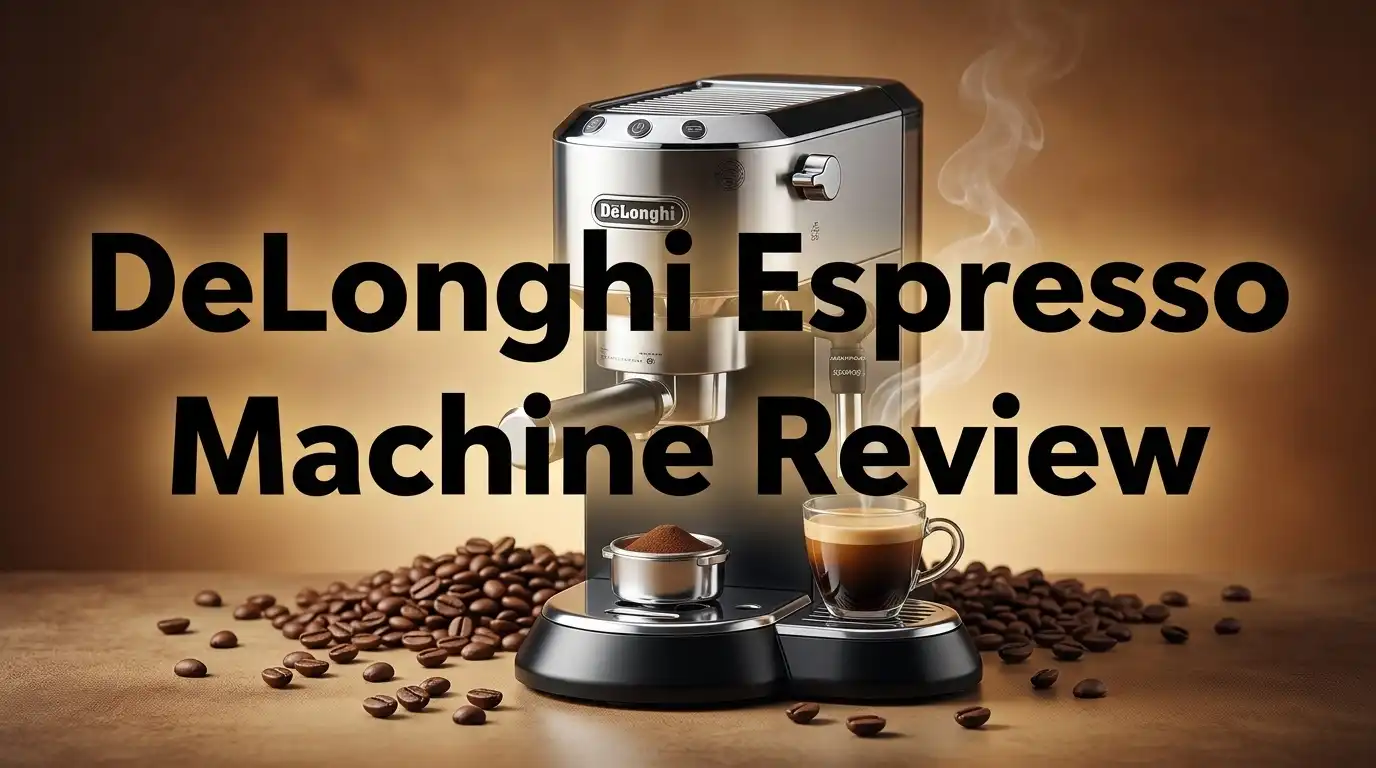
De’Longhi Espresso Machine Review 2026: Still Worth Buying?
De’Longhi sells more espresso machines than any other brand on earth. That fact alone makes people curious. But popularity does not always mean quality, and a $1,400 machine deserves hard questions before you hand over your money.
I spent months pulling shots, steaming milk, wiping splatter off stainless steel, and descaling. This review covers the La Specialista Maestro as the flagship pick, the Magnifica Evo as the automatic option, and the cheaper Dedica and Stilosa models that fill most kitchens.
You will read about the good espresso, the loud grinder, the mess, and the things De’Longhi still gets wrong in 2026.
Key Takeaways:
- De’Longhi builds excellent mid range espresso machines. The La Specialista Maestro produces café quality shots with dense golden crema once you dial it in. It costs roughly $1,400 and competes directly with Breville.
- The LatteCrema milk system beats most home baristas. It pulls cold milk from a carafe, textures it, and pours it in the right order for each drink. My manual steam wand foam was good. The automatic foam was slightly better.
- Cheap De’Longhi models still make real espresso. The Dedica at around $250 and the Stilosa near $130 both use 15 bar pumps and stainless steel boilers. Neither includes a grinder.
- Superautomatics trade control for speed. The Magnifica Evo grinds, brews, and dumps the puck in under a minute. You lose the ability to fine tune extraction.
- Every De’Longhi machine makes a mess. Splatter, coffee dust, and drip tray overflow are constant. Plan on daily wiping.
- The 51mm portafilter limits serious espresso fans. Accessories are harder to find than for 54mm or 58mm sizes.
Why De’Longhi Still Dominates Espresso In 2026


Last update on 2026-10-20 / Affiliate links / Images from Amazon Product Advertising API
De’Longhi started in Treviso, Italy in 1902 as a parts workshop. The company now ships espresso machines in more than 120 countries. That scale gives it two real advantages that show up in your kitchen.
First, parts availability. You can find a replacement drip tray, portafilter, or brew unit for a five year old De’Longhi without hunting obscure sellers. That matters more than spec sheets when something breaks in year three.
Second, price ladder coverage. De’Longhi sells a working espresso machine at $130 and a flagship at $1,500. Very few brands cover that whole range with decent quality at each step.
The company also moved fast on cold coffee. Cold Extraction Technology arrived on the Arte Evo and the newer Maestro models. It grinds finer and pushes water through slowly at low temperature. My honest take is that cold espresso from these machines tastes thin compared to proper overnight cold brew. Most owners try it twice and go back to hot shots over ice.
What De’Longhi does not lead on is interface design. Breville still wins there. De’Longhi sticks with dials, buttons, and small monochrome screens while competitors ship color touchscreens. Some people love the retro controls. Others find them confusing on day one.
De’Longhi La Specialista Maestro Espresso Machine
The La Specialista Maestro is the machine I recommend to most people who want real espresso at home. Model number EC9665M. It weighs 35 pounds and measures roughly 13.5 by 16.4 by 13.1 inches.
The layout splits into two halves. The left side handles beans: hopper, conical burr grinder, dose dial, and the Smart Tamping Station. The right side handles extraction: group head, pressure gauge, drink selector dial, and the milk system.
Heat up time genuinely impressed me. Dual thermoblocks bring the machine to temperature in a few seconds. I timed under ten seconds from power on to first shot. That beats every boiler machine I have used.
Active Temperature Control gives you five brew temperature settings matched to roast level. Light roasts get hotter water. Dark roasts get cooler water. This is a professional feature on a home machine, and it works.
The 19 bar pump includes Dynamic Pre Infusion. The machine wets the puck gently before ramping pressure. My shots ran evenly with no channeling once I found the right grind.
The catch is the 51mm portafilter. It is smaller than the 54mm Breville standard and much smaller than the 58mm commercial size. Single wall baskets come included, which is good news for flavor. But aftermarket baskets, puck screens, and distribution tools are limited for 51mm.
Unboxing Experience And First Day Setup
The box is heavy and awkward. Mine arrived at 40 pounds shipping weight. Get a second person or slide it out on the floor rather than lifting it over your head.
Inside, De’Longhi packs everything in molded cardboard instead of foam. Nice touch. You pull off the top layer and find the accessory tray sitting above the machine itself.
What came in the box: two single wall filter baskets, a stainless steel milk pitcher, the LatteCrema carafe, a cleaning brush, a microfiber cloth, a bottle of liquid descaler, a water hardness test strip, and the manual.
No knock box. This annoys me every time. A machine at this price should include somewhere to dump used pucks.
Setup took me about twenty minutes. I rinsed every removable part in warm water, filled the water tank at the rear, and ran three water only cycles through the group head. Then I purged the steam wand for ten seconds.
The water hardness strip matters more than people think. Dip it, count the colored squares, and set the hardness level in the menu. This tells the machine how often to ask for descaling. Skip it and you will either descale too often or find limescale problems later.
First shot came out at the fifteen minute mark. It was bad. Too fast, thin crema. That is normal. Plan on a full bag of beans before your shots taste right.
Top 3 Alternative for De’Longhi La Specialista Maestro

Last update on 2026-10-20 / Affiliate links / Images from Amazon Product Advertising API
De’Longhi La Specialista Arte Evo Espresso Machine with Coffee Grinder

Last update on 2026-10-20 / Affiliate links / Images from Amazon Product Advertising API
De’Longhi La Specialista Maestro with Cold Brew

Last update on 2026-10-20 / Affiliate links / Images from Amazon Product Advertising API
De’Longhi Rivelia Automatic Espresso Machine
De’Longhi Magnifica Evo Automatic Espresso Machine

Last update on 2026-10-20 / Affiliate links / Images from Amazon Product Advertising API
Some people do not want to be a barista. They want coffee. The Magnifica Evo exists for them.
Press a button. The machine grinds beans, tamps internally, brews, and ejects the puck into a waste container. Total time from press to cup sits around 45 seconds after warm up.
Seven one touch recipes cover espresso, coffee, long, doppio, americano, cappuccino, and latte macchiato. There is also a custom drink slot called My Latte where you save your own milk and coffee volumes.
The conical burr grinder offers 13 settings. The bean hopper holds about 8.8 ounces. A bypass doser lets you use pre ground coffee or decaf without emptying the hopper. I used that more than expected.
Milk frothing is manual on the base model. You get a panarello style wand that injects air automatically. It produces thick bubbly foam rather than glossy microfoam. Latte art is not happening here. Some versions ship with the LatteCrema carafe instead, so check which one you are buying.
Espresso quality is the honest weak point. Superautomatics use pressurized brewing with fixed parameters. The shots taste fine. They do not taste like the Maestro. Body is thinner and crema fades faster.
Cleaning is simpler though. The brew unit pops out and rinses under the tap. The machine runs its own rinse cycle at startup and shutdown.
Espresso Taste Test Results Across Models
I tested every machine with the same beans, a medium roast Ethiopian and a dark Italian blend, ground fresh and dosed at 18 grams double.
La Specialista Maestro results: consistently the best cup. Extraction ran 27 to 30 seconds. Crema was golden brown, fine pored, and lasted several minutes. The Ethiopian showed its blueberry and citrus notes clearly. Temperature stability across back to back shots was excellent.
Magnifica Evo results: decent, forgettable espresso. The machine flattened both coffees into a generic roasty flavor. Crema appeared quickly then collapsed within a minute. Fine for milk drinks. Underwhelming for straight espresso.
Dedica EC685M results: surprisingly good for the price. With the pressurized basket, shots were thick but artificially so. Swapping to a bottomless or non pressurized basket and grinding properly turned it into a small wonder. It cannot hold temperature across four shots in a row.
Stilosa results: the weakest. The pressurized basket does all the work. Shots taste like strong coffee rather than espresso. It gets you started and nothing more.
One consistent finding across all models: De’Longhi machines run slightly cooler than ideal out of the box. Running a blank shot first raises group head temperature and improves flavor noticeably on the cheaper models.
Milk Frothing And LatteCrema Performance
Milk is where De’Longhi surprised me most.
The LatteCrema system is a plastic carafe with a rotating dial on the lid. You fill it with cold milk straight from the fridge, click it into the right side of the machine, set the froth level, and select your drink.
Three froth settings exist: flat for cortados, medium for cappuccino, and high for latte macchiato. The machine heats and textures the milk, then dispenses it in the correct order for each drink. I tried to trick it with a latte macchiato. It poured milk first, espresso second, exactly right.
The foam quality is genuinely good. Dense, glossy, no large bubbles. I compared it against my own manual steaming and the machine won on consistency.
The manual steam wand on the Maestro has three holes and serious power. It creates a fast whirlpool in a 12 ounce pitcher. That power is great once you learn it and frustrating before then. Expect several scorched or bubbly attempts.
Cleaning the LatteCrema carafe is the tradeoff. You must rinse it after every session and run its clean cycle regularly. Milk residue in the tubes turns sour fast. If you skip cleaning for two days, you will smell it.
Whole milk texturizes best. Oat milk works with barista versions only.
Grinder Quality And Grind Settings
The built in grinder uses stainless steel conical burrs. The Maestro offers eight grind settings. The Arte Evo offers many more.
Eight settings sound limiting. In practice, the middle three cover most espresso work. I used setting three for the dark blend and setting two for the light roast. The two finest settings exist mainly for the cold extraction function.
Adjust the dial only while the grinder runs. The manual says this and it matters. Turning the collar on a stalled grinder can jam beans between the burrs.
Sensor Grinding Technology measures dose by weight related feedback rather than time alone. My doses landed within a few tenths of a gram across ten grinds. That consistency is real and useful.
Retention is the weak spot. Ground coffee sticks in the chute. Switching beans means grinding through several doses before the new coffee comes out clean. Single dosing is impractical.
The grinder is loud. Roughly the volume of a blender for eight seconds. Early morning grinding will wake people in a small apartment.
Cleaning the grinder is easy. The hopper clicks off in seconds. You brush the upper burr, vacuum out dust, and reseat it. Do this monthly. Coffee oils build up and slow the grind rate over time, which shifts your dialed in settings without warning.
Daily Cleaning And Real Maintenance Workload
Nobody talks about this enough, so here is the honest picture.
Every day: empty and rinse the drip tray, knock out the puck, rinse the portafilter and basket, wipe the group head gasket, flush the steam wand, and wipe the stainless front panel.
That last one is not optional. The Maestro splatters. Coffee spits sideways during extraction and dries into brown specks on the shiny housing. The foldaway cup grille reduces it. It does not stop it.
Every week: remove the shower screen area residue with the brush, deep clean the LatteCrema carafe and its tubes, and wash the water tank.
Every month: brush out the grinder and burrs. Check the water tank for slime.
Every two to three months: descale. The machine prompts you with a dedicated button light. The process takes about twenty minutes and uses the De’Longhi liquid descaler. Generic descaler works but voids arguments with support if something fails.
Nothing goes in the dishwasher. Warm water and hands only. The manual is firm about this and plastic parts do warp.
Total daily time is about four minutes. Weekly adds fifteen. That is the real cost of owning one of these beyond the purchase price.
What De’Longhi Espresso Machines Do Not Do Well
An honest review needs a list of failures. Here they are.
Simultaneous brewing and steaming is impossible. The Maestro has two thermoblocks and still cannot pull a shot while you steam milk. You do it back to back. For one or two drinks that is fine. Making six cappuccinos for guests becomes slow.
No two cup function on the Maestro. You cannot split a double shot into two cups at once. Odd omission at this price.
The interface is dated. Monochrome LCD panels and blinking icons instead of a clear screen. The display tells you “grinding” while the grinder is audibly grinding. Not helpful.
Plastic appears where it should not. The LatteCrema carafe, drip tray, and several internal panels are plastic on machines costing over a thousand dollars.
51mm portafilter restricts upgrades. The accessory market for this size is thin.
Cold brew function underdelivers. Watery and weak compared to proper immersion cold brew.
Superautomatic models cannot make great espresso. Physics and fixed parameters limit them. Accept this before buying one.
Size and weight are serious. At 35 pounds and 16 inches deep, the Maestro will not fit under standard overhead cabinets when you lift the hopper lid. Measure first.
Customer service reports are mixed. Warranty claims often work well. Response times vary by region.
Pros And Cons Of De’Longhi Espresso Machines
Pros
- Fast heat up. Thermoblock systems reach brew temperature in seconds rather than minutes, which makes daily use practical.
- Excellent milk systems. The LatteCrema carafe produces dense glossy foam automatically and handles drink layering order correctly.
- Wide price range. Working espresso machines from $130 to $1,500 means almost any budget finds a fit.
- Generous accessory bundles. Milk pitcher, two baskets, descaler, brushes, and cloth come included on higher models.
- Active Temperature Control. Five brew temperature settings matched to roast profile is rare at this price point.
- Parts and service network. Replacement components stay available for years, which extends machine lifespan.
- Single wall baskets included. These allow real espresso development rather than pressurized fake crema.
- Automatic tamping works. The Smart Tamping Station compacts evenly and keeps your counter cleaner than manual tamping.
Cons
- Constant splatter. Coffee spits onto the stainless front during extraction and requires daily wiping to look presentable.
- Cannot brew and steam at once. Both thermoblocks share duties, so back to back operation is the only option.
- Loud grinder. Roughly blender volume for several seconds each shot.
- 51mm portafilter. Fewer aftermarket accessories than the common 54mm and 58mm sizes.
- Dated displays. Small monochrome panels instead of a modern color screen.
- Heavy and deep. 35 pounds and a tall footprint create kitchen placement problems.
- Weak cold brew. The cold extraction feature produces thin results.
- High maintenance load. Daily rinsing plus weekly milk system cleaning is mandatory.
De’Longhi Versus Breville In 2026
This is the comparison everyone asks about. Both brands own the hybrid espresso space.
Breville wins on interface. The Barista Touch and Barista Touch Impress use color touchscreens with step by step guidance. A total beginner can follow along. De’Longhi expects you to learn its dials.
Breville wins on grind resolution. Thirty grind settings versus eight gives you finer control when dialing in unusual beans.
Breville wins on portafilter size. 54mm opens up a much larger accessory market.
De’Longhi wins on milk versatility. No Breville model offers anything like the LatteCrema carafe. You get a steam wand only. If you want hands off cappuccino, De’Longhi is the answer.
De’Longhi wins on cup clearance. 5.5 inches versus 3.9 inches on the Barista Touch. Travel mugs fit under the De’Longhi. They do not fit under the Breville.
De’Longhi wins on price at similar capability. The Maestro undercuts the Barista Touch Impress by a few hundred dollars.
My read: choose Breville if you want guided learning and plan to grow into manual espresso. Choose De’Longhi if you want strong espresso plus automatic milk drinks without fuss.
Build quality is comparable. Both use plastic internals that some owners dislike.
Which De’Longhi Model Fits Your Budget
Under $150: Stilosa. A basic 15 bar machine with a manual frother. No grinder. Pressurized basket. Good for trying espresso without commitment. Do not expect specialty results.
Around $250: Dedica. Slim at under six inches wide. Stainless steel boiler, fast heat up, and a better frother than the Stilosa. The best value in the whole De’Longhi line if you already own a grinder. This is the model I recommend to students and small kitchen owners.
Around $500 to $700: Magnifica Evo or Magnifica Start. Fully automatic with built in grinder and one touch drinks. Buy these for convenience, not flavor.
Around $800: La Specialista Arte Evo. Built in grinder, cold brew function, manual steam wand, and a barista toolkit. A real step up in espresso quality.
Around $1,400: La Specialista Maestro. The flagship. Smart tamping, active temperature control, dual thermoblocks, LatteCrema, and eight preset recipes.
Around $1,500: Rivelia. Fully automatic with two swappable bean hoppers and a color display. For households where one person drinks decaf.
My pick for most buyers: the Dedica if you are budget conscious, the Maestro if you want the best De’Longhi espresso.
Long Term Reliability And Warranty
De’Longhi machines carry a two year warranty in the United States. That is standard for the category.
Reliability reports cluster around a few known issues. Grinder jams happen when people adjust settings while the grinder is stopped or when oily dark roast beans clog the chute. Both are preventable.
Pump failures appear in year four or five on heavily used machines. Replacement pumps are available and a repair shop charges far less than a new machine.
Brew unit problems on superautomatics almost always trace back to skipped cleaning. Rinse the unit weekly and it lasts.
Limescale is the real killer. Hard water destroys thermoblocks. Use filtered water and descale on schedule. Owners who do this report machines working past year seven. Owners who ignore it see failures at year two.
The plastic LatteCrema carafe is the part most likely to crack or discolor. Budget for a replacement eventually. They are inexpensive and easy to order.
Register your machine after purchase. De’Longhi warranty claims move faster with a registered serial number, and the company sometimes extends coverage for registered owners.
Keep the box for the first month in case you need to return it.
Final Verdict: Should You Buy A De’Longhi In 2026
Yes, with clear eyes about what you are getting.
The La Specialista Maestro earns its price. It makes espresso I am happy to drink black, froths milk better than I can by hand, and heats up almost instantly. The splatter irritates me daily and the 51mm portafilter limits my tinkering. Those are real complaints on an otherwise excellent machine.
The Dedica is the smartest purchase in the lineup. Pair it with a decent burr grinder and you get 80 percent of the flavor for 20 percent of the money.
The Magnifica Evo serves a different person entirely. If you want coffee fast and do not care about extraction control, it delivers. If you care about espresso, you will feel disappointed within a month.
Skip the Stilosa unless your budget is truly fixed at $130.
De’Longhi is not the best espresso brand for purists. Prosumer machines with 58mm groups and real boilers beat it on ceiling. But De’Longhi is the best brand for people who want good espresso and good milk drinks without becoming a hobbyist. That describes most of us.
Buy for the milk system and the speed. Accept the cleaning and the mess.
Frequently Asked Questions
Which De’Longhi espresso machine makes the best espresso?
The La Specialista Maestro produces the best shots in the lineup. Its active temperature control, dynamic pre infusion, 19 bar pump, and single wall baskets give you real extraction control. The Arte Evo comes close for several hundred dollars less.
Do De’Longhi machines need a separate grinder?
The Stilosa and Dedica have no grinder, so yes for those models. The Maestro, Arte Evo, Magnifica, Dinamica, and Rivelia all include built in conical burr grinders.
How often should I descale my De’Longhi?
Every two to three months with average water hardness. The machine prompts you with a light. Set your water hardness level during setup so the reminder timing is accurate.
Can De’Longhi machines make latte art?
Only with the manual steam wand on the Maestro or Arte Evo. The LatteCrema carafe makes excellent foam but dispenses it automatically, so pouring art is not possible. Panarello wands on cheaper models produce bubbly foam unsuitable for art.
Is the De’Longhi cold brew function worth paying extra for?
In my testing, no. The cold extraction produces thin watery coffee compared to overnight immersion cold brew. Most owners stop using it after a few tries. Save the money.
How long do De’Longhi espresso machines last?
Five to eight years with proper descaling and cleaning. Machines used with hard water and no descaling often fail within two to three years. Maintenance determines lifespan more than build quality.
Does De’Longhi fit under kitchen cabinets?
The Dedica and Stilosa fit easily. The Maestro stands about 16 inches tall and needs clearance above to remove the hopper lid and water tank. Measure your space before ordering.
Can I use pre ground coffee in a De’Longhi?
Yes. Machines with grinders include a bypass doser for pre ground or decaf. Manual machines like the Dedica accept ground coffee directly in the basket.
Hi, I’m Emma Lee — the coffee-obsessed creator behind Morning Drip Vault. I spend my days testing coffee machines, exploring brewing techniques, and reviewing the latest coffee gear. My mission is simple: helping you find the perfect machine to brew your best cup, every single morning.