Smeg Espresso Machine Review 2026: Worth It?
Smeg makes the espresso machine that people photograph before they drink from it. You have seen it on kitchen counters in pastel blue, cream, and glossy black.
It looks like a 1950s Italian daydream. But a pretty machine still has to pull a decent shot, and that is where the real questions start.
I spent weeks with the Smeg lineup, including the newer ECF02 and the older ECF01, plus the grinder equipped EGF03.
In a Nutshell:
- The Smeg espresso machine is a style purchase first and a coffee purchase second. The retro shell, the six color options, and the chrome accents are the main draw. The espresso is good, not great, and you pay a premium for the badge rather than the brewing hardware.
- Heat up speed is genuinely impressive. The Thermoblock system gets the machine ready in roughly 35 to 40 seconds. You will spend longer grinding and tamping than waiting for the machine.
- The pressurized baskets make life easy but cap your ceiling. Beginners get thick looking crema with almost no effort. Experienced drinkers will notice the shots lack sweetness, depth, and that syrupy finish real espresso delivers.
- Milk steaming is the weakest area. The wand is short, its movement is limited, and silky microfoam takes real practice. Latte art fans will feel boxed in. A stainless steel milk jug is not even included.
- Value is the sticking point. The De’Longhi Dedica Style costs far less and performs similarly. The Breville Bambino Plus costs about the same and beats Smeg on espresso quality, steaming, and included accessories.
- Buy it if you love the look and drink one or two coffees a day. Skip it if you want to chase the perfect shot or tinker with pressure profiles and single wall baskets.
Smeg ECF02 Espresso Machine: The 2026 Model

Last update on 2026-10-22 / Affiliate links / Images from Amazon Product Advertising API
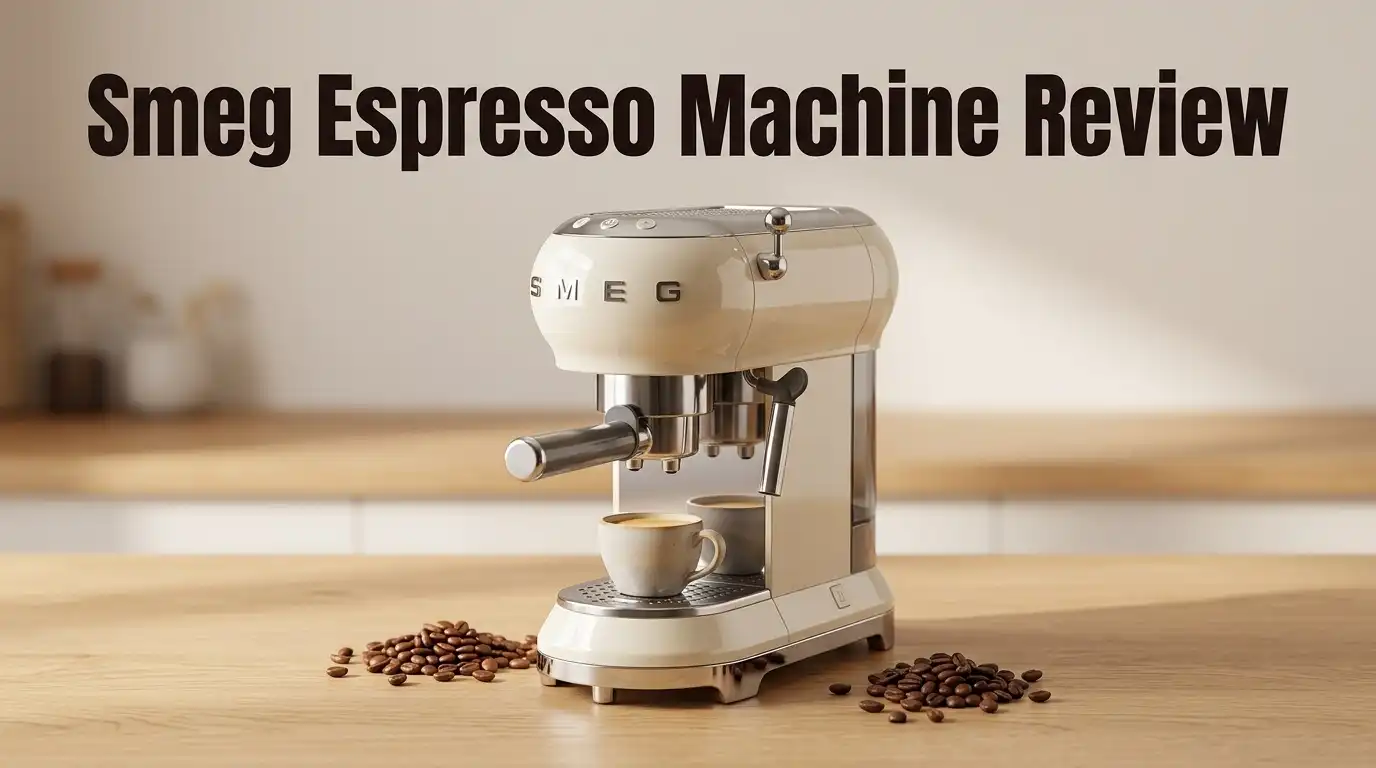
The ECF02 is Smeg’s current manual espresso machine and the model most buyers will see first. It replaced the long running ECF01 and arrived with a curvier, softer shape. Smeg designed and built it in Italy, and the brand leans hard into that fact.
The core specs stay familiar. You get a 15 bar pump, a Thermoblock heating system, a 51mm stainless steel portafilter, and a removable water tank holding roughly 1.1 liters. The machine measures about 13 by 5.9 by 13 inches and weighs close to 10.4 pounds.
The real upgrade sits on the control panel. The ECF01 gave you a single and a double espresso. The ECF02 adds a long single and a long double, so you now get four drink volumes from three buttons. A plus button switches the light rings from white to orange, which tells you that you are in the long coffee menu.
You can also adjust coffee temperature across three settings, change the dispensed volume, tweak the water hardness, and set the automatic shut off time. Smeg includes a water hardness test strip in the box, which is a small but thoughtful touch.
The filter holder accepts three baskets. One for single shots, one for doubles, and one for ESE paper pods. The pods work fine for lazy mornings, though the coffee tastes flat compared to fresh grounds. My honest advice is to treat that third basket as a backup, not a feature.
Unboxing Experience and First Impressions
Smeg understands packaging. The box is clean, heavy, and printed with that same retro typeface. Inside, the machine sits wrapped in molded protection with the portafilter and baskets tucked into their own compartment. Lifting it out feels like an event, and that matters to a lot of buyers.
Then you set it on the counter and the first surprise hits. The machine is lighter than it looks. The exterior is molded plastic with chrome and stainless accents, not the metal body the photos suggest. It looks expensive from three feet away and feels mid range in your hands.
The accessory pile is thin. You get the portafilter, three baskets, a combined plastic scoop and tamper, the hardness strip, and the manual. That plastic tamper is the cheapest feeling item in the box. It flexes under pressure and makes even tamping harder than it needs to be. Spend fifteen dollars on a proper stainless steel tamper on day one.
There is also no milk jug. At this price, that omission stings. Breville ships a stainless steel pitcher with machines costing the same or less.
Setup takes about ten minutes. You rinse the removable parts, fill the tank, run water through the group head and the wand, then dip the test strip to check your water. The manual is clear and uses simple diagrams. Nobody needs prior espresso experience to get through the first brew, which is exactly what Smeg intended.
Design, Colors, and Build Quality
This is the reason most people click buy. The ECF02 comes in six colors, including cream, black, pastel blue, pastel green, pink, and red. The curves, the chrome dispensing lever on the side, and the enamel style finish all read as deliberate 1950s revival.
The water tank lid blends into the body so the silhouette stays unbroken. The top panel doubles as a passive cup warmer and gets pleasantly hot within a couple of minutes. Warm cups keep espresso hotter for longer, and I used this every single day.
Build quality is a mixed story. The portafilter is heavy, well machined, and feels like a real espresso part. The shower screen unscrews easily for cleaning. The drip tray slides smoothly and includes a flat insert so your travel mug sits level once you remove the tray.
Now the complaint. The non slip feet do not grip. Twisting the portafilter into the group head takes a firm turn, and the machine slides across the counter unless you hold it steady with your free hand. I noticed this on the ECF01 and it persists on the ECF02. For a machine this expensive, that is an annoying daily reminder of the plastic body and low weight.
Cup clearance is another limit. You get about 3.15 inches under the spouts with the drip tray in place, or roughly 4.7 inches without it. Tall tumbler fans will need to remove the tray every time.
Top 3 Alternative for Smeg Espresso Machine

Last update on 2026-10-22 / Affiliate links / Images from Amazon Product Advertising API
Breville Bambino Plus

Last update on 2026-10-22 / Affiliate links / Images from Amazon Product Advertising API
De’Longhi EC685M Dedica Deluxe

Last update on 2026-10-22 / Affiliate links / Images from Amazon Product Advertising API
Breville BES870XL Barista Express
Smeg ECF01 Espresso Machine: Still Worth Buying?

Last update on 2026-10-22 / Affiliate links / Images from Amazon Product Advertising API
The ECF01 held the compact espresso machine crown for years and still sells widely, especially in the United States where stock lingers at good discounts. It shares the same DNA as the ECF02 but with a boxier, more angular body that some buyers actually prefer.
Specs are close. A 15 bar pump, a Thermoblock heater, a 1 liter removable tank, a 51mm portafilter, three baskets, and 1300 to 1350 watts of power. It weighs about 10 pounds and stands 13 inches tall.
The differences are worth knowing. The ECF01 offers only single and double espresso, so no long coffee presets. Its milk frother is a Pannarello style wand, which is a sleeve that injects air automatically. Pannarello wands produce foamy, bubbly milk very easily and are forgiving for beginners. They also make silky flat white texture nearly impossible.
The ECF02 swapped that sleeve for a more professional style wand. That change gives you better potential texture, though the short length still limits your angle.
So which one should you buy? If you find the ECF01 at a real discount and you mostly drink cappuccinos, it remains a sensible pick. If you want the extra drink volumes and better steaming potential, pay more for the ECF02. Either way, the shots taste broadly similar, because the pressurized baskets and the pump do the same work in both machines.
Thermoblock Heating and Warm Up Speed
The Thermoblock system is the quiet hero here. Instead of heating a large tank of water, it heats water on demand as it flows through a metal block. That design cuts warm up time dramatically.
From cold, the ECF02 reaches brew temperature in about 35 to 40 seconds. The button light rings flash while it heats, then hold steady when it is ready. In practice, I never once waited for the machine. I hit the power switch, ground my coffee, tamped, and the machine was already waiting for me.
Steam preheat is even faster at under 15 seconds. Press the steam button, wait for the light to settle, then pull the side lever and the wand starts working.
Temperature stability is where Thermoblock designs typically trail a proper boiler. My measured drink temperatures on the medium setting landed between roughly 140 and 170 degrees Fahrenheit at the cup, which varies with cup warmth and shot volume. That range is normal for this category but not tightly controlled.
There is one real workflow problem. After steaming milk, the block sits too hot to brew espresso immediately. You must either run hot water through to cool it down or follow the manual’s advice and brew all your shots first, then steam. Making three milk drinks in a row becomes a juggling act. Machines with dual heating systems or PID control avoid this entirely, and buyers upgrading from those will feel the step down.
How Does the Espresso Actually Taste?
Here is the part that matters. Using freshly roasted beans and a burr grinder, the Smeg produced espresso I happily drank every morning. The body was fuller than I expected. The mouthfeel was pleasant and slightly syrupy. The crema looked thick and generous.
Then the honesty arrives. That crema comes largely from the pressurized baskets, not from perfect extraction. Pressurized baskets use a double wall with one small exit hole, which builds artificial pressure and whips the coffee into foam. The result looks like great espresso in a photograph.
What you lose is sweetness, clarity, and complexity. My shots tasted a little flat in the middle and finished short. Fruity single origin beans lost most of their character. Chocolate heavy blends fared much better, so choose your beans accordingly.
Dosing guidance from Smeg is volumetric, using the included scoop. Ignore that. One scoop equals roughly 7 grams, and the double basket performs best with around 12 grams. A cheap coffee scale fixes this instantly.
My best result came from filling the double basket and pressing the single shot button, which gave just over 1 ounce of coffee in roughly 20 to 25 seconds. A long double dispenses around 3 ounces and takes closer to 50 seconds.
Consistency is genuinely strong. Shot after shot, the Smeg delivered the same drink. For most households, dependable and enjoyable beats spectacular and fussy.
Steam Wand and Milk Frothing Performance
Milk is the Smeg’s weakest department, and I want to be direct about it. The wand has plenty of steam power. It heats milk quickly and makes cappuccino foam without much skill. That part works.
The problem is control. The wand is short and its range of movement is limited. Angle matters enormously when texturing milk, because you need the tip just below the surface to pull in air, then submerged to create the whirlpool that breaks bubbles down. With a short wand, positioning the jug correctly becomes awkward.
I made good, thick cappuccino foam on my first attempt. Silky microfoam for a flat white took many tries, and I never quite reached the glossy paint texture my regular machine produces. Latte art enthusiasts will find this frustrating rather than fun.
There is no steam pressure dial either. The side lever is effectively full power or nothing, so you cannot dial back for small volumes of milk. Small jugs heat too fast to allow much stretching.
The wand does double as a hot water spout, which I used more than expected. Turn the lever without pressing steam and you get water at roughly 155 degrees Fahrenheit, which suits herbal tea nicely.
Cleaning the wand is non negotiable. Purge it immediately after every use and wipe it down. Once a week, take the tip apart and soak it. Neglect it for a fortnight and you will have a blocked, unpleasant mess.
Portafilter, Baskets, and Tamping
The 51mm portafilter is the best made part of the whole machine. It has real weight, a sturdy handle, and a satisfying click when locked in. Holding it, you briefly forget that the body is plastic.
Smeg supplies three baskets. The single and double are both pressurized, and the third accepts ESE paper pods. There is no single wall basket in the box, and Smeg does not sell an official one.
This is the defining limitation of the machine. Pressurized baskets forgive bad grinding, uneven tamping, and stale coffee. That is wonderful for a beginner. It means your first shot will look and taste acceptable. It also means you cannot progress beyond a certain quality ceiling, because the basket, not your technique, controls the pressure.
Enthusiasts do buy aftermarket 51mm single wall baskets from third party sellers, and this modification improves the espresso noticeably. You will then need a good grinder and real dialing in skills. Treat that as an optional project, not a promise.
Tamping is where the included tool lets you down. The plastic scoop and tamper combination is thin and flexes. It does not match the 51mm basket diameter well, so you get uneven pucks. A proper 51mm stainless steel tamper costs little and immediately improves your results.
Distribution tools also help. Give the grounds a gentle stir or tap before tamping, and channeling drops noticeably. Small habits matter more than expensive gear here.
Daily Use, Cleaning, and Maintenance
Living with the Smeg is easy. The three button layout means nobody in the house needs a tutorial. My partner, who has no interest in coffee gear, was making her own cappuccino by day two.
Daily maintenance takes about two minutes. Rinse the portafilter and basket under hot water, wipe the steam wand, and empty the drip tray. Do not let old grounds sit in the basket overnight, because dried coffee oils turn bitter fast.
Weekly, remove and rinse the shower screen, wash the water tank, and strip the steam wand tip. The screen unscrews with a coin and reveals exactly how much coffee sneaks up there. Cleaning it restores even water flow.
Descaling depends on your water hardness. The machine tracks usage and flashes the orange LED on the steam button when it needs attention. The process runs mostly by itself, though you will want the manual in hand because the button sequences are not intuitive. You will also need a descaling solution, which Smeg does not include.
Using filtered water cuts descaling frequency significantly. Scale is the main killer of Thermoblock machines, so this single habit extends the machine’s life more than anything else.
Smeg backs the machine with a two year warranty in most markets. Spare parts availability is reasonable through Smeg service centers, though independent repair is harder than with Breville or De’Longhi, which have wider third party parts networks.
What the Smeg Espresso Machine Does Not Do Well
An honest review needs a section like this, so here it is without softening.
The price does not match the hardware. You are buying a plastic bodied, pressurized basket espresso machine at a price that buys a metal bodied machine with PID control, single wall baskets, and automatic milk texturing from other brands.
The machine slides on the counter. The feet do not grip, and locking the portafilter requires two hands every time.
The tamper is close to useless. Plan on replacing it immediately.
No milk jug is included. At this price, that is a genuine oversight.
Steaming and brewing cannot happen back to back. The block runs too hot after steam, so making several milk drinks means planning your order or flushing water through.
There is no real customization. You can change temperature across three steps, adjust volume, and set water hardness. That is the full list. No pressure profiling, no pre infusion control, no shot timer display.
Cup clearance is tight. Anything taller than a small mug needs the drip tray removed.
Serious espresso quality is capped. The pressurized baskets guarantee a decent floor and a low ceiling. Coffee enthusiasts will outgrow this machine within a year.
Grinder not included. Budget another 150 dollars minimum for a burr grinder, because a blade grinder will ruin your results no matter which machine you own.
Pros and Cons of the Smeg Espresso Machine
Pros
- Standout retro design in six colors that genuinely transforms a kitchen counter
- Very fast heat up at roughly 35 to 40 seconds from cold, thanks to the Thermoblock system
- Simple three button interface that anyone in the household can learn in minutes
- Four drink volumes on the ECF02, covering single, long single, double, and long double espresso
- Heavy, well made 51mm portafilter that feels far better than the price of similar entry level machines suggests
- Consistent shots with reliable crema, courtesy of the forgiving pressurized baskets
- Passive cup warmer on top that heats quickly and keeps espresso hotter in the cup
- Easy daily cleaning with a removable shower screen, drip tray, and water tank
- Hot water function through the wand for tea and for cooling the block after steaming
- Made in Italy with a two year warranty in most regions
Cons
- Expensive for the specification, with the price reflecting styling more than brewing hardware
- Mostly molded plastic body that feels lighter and less premium than it photographs
- Feet do not grip the counter, so the machine slides when you lock in the portafilter
- Flimsy plastic tamper and scoop that needs replacing right away
- No stainless steel milk jug included in the box
- Short steam wand with limited movement, making microfoam and latte art difficult
- No steam pressure control, only full power or off
- Cannot brew immediately after steaming without cooling the system first
- Pressurized baskets only, which caps espresso quality and blocks skill progression
- Very limited cup clearance for taller mugs and tumblers
- No included grinder, adding real cost to the total setup
Smeg vs Breville Bambino Plus vs De’Longhi Dedica
Comparisons expose the value problem quickly. Let me lay it out plainly.
The De’Longhi EC685M Dedica Deluxe is the Smeg’s closest technical twin. Same 15 bar pump, same 51mm portafilter, same pressurized baskets, same Thermoblock heating, similar slim footprint, and a 1.1 liter tank. It heats just as fast and tastes about the same in the cup. It typically costs roughly half the Smeg’s price. If coffee quality per dollar is your priority, this is the obvious pick.
The Breville Bambino Plus sits at a similar price to the Smeg and outperforms it in almost every measurable way. You get a 54mm portafilter with both pressurized and single wall baskets, automatic pre infusion, PID temperature control, and a stainless steel body. Its automatic milk frother adjusts foam texture and temperature, and it works remarkably well. The Bambino Plus makes better espresso and better milk drinks, full stop. What it does not do is look interesting on your counter.
The Breville Barista Express costs more but includes a built in conical burr grinder with 25 settings. For someone starting from nothing, the all in one cost often lands close to buying a Smeg plus a separate grinder.
So the Smeg wins on exactly one axis. Looks. That is not a small thing, because a machine you enjoy seeing is a machine you use daily. Just go in knowing you are paying a design premium of roughly 200 dollars.
Smeg EGF03: The Upgrade With a Built In Grinder


Last update on 2026-10-22 / Affiliate links / Images from Amazon Product Advertising API
If you love the Smeg aesthetic but want better coffee, the EGF03 is the answer. It is a semi automatic espresso machine with an integrated stainless steel conical burr grinder and a dual Thermoblock system, meaning separate heating for brewing and steaming.
That dual system fixes the ECF02’s biggest workflow flaw. You can brew and steam without waiting for the machine to cool down. For households making two or three milk drinks in a row, this alone justifies a chunk of the price difference.
The grinder has adjustable settings and doses directly into the portafilter. Reviewers consistently praise the extraction quality, noting a thick layer of crema and a full bodied, syrupy shot that the ECF02 cannot match. The steam wand is more capable too, with better power and reach for texturing milk properly.
Now the caveats. The EGF03 is significantly more expensive, often landing in the four figure range depending on region and finish. It is also physically larger, so the compact advantage disappears. Customization remains limited compared to enthusiast machines at the same price, and independent reviews have flagged that you are still paying a Smeg design premium.
Who should buy it? Someone who wants the Smeg look, drinks espresso daily, and does not want to buy or dial in a separate grinder. Someone chasing maximum coffee quality per dollar should still look at Breville or Lelit instead.
Who Should Buy the Smeg Espresso Machine?
Let me match the machine to real people.
Buy the Smeg if design genuinely matters to you. If you have already collected the Smeg kettle and toaster, and a mismatched black plastic espresso machine would bother you every morning, then the ECF02 is a rational purchase. Enjoyment counts.
Buy it if you drink one or two espresso based coffees a day. The machine handles that rhythm comfortably and delivers consistent, pleasant drinks with minimal learning.
Buy it if you want simplicity. Three buttons and a lever. No menus to learn, no pressure gauges to interpret. Complete beginners get a drinkable shot on attempt one, which builds confidence.
Buy the ECF01 instead if you find it discounted and mostly drink cappuccinos with thick foam.
Skip it if you are budget focused. The De’Longhi Dedica Style gives you the same coffee for far less money.
Skip it if you want the best cup at this price. The Breville Bambino Plus wins on espresso, milk, and materials.
Skip it if you plan to grow as a home barista. The pressurized baskets, fixed steam pressure, and minimal settings will frustrate you within months.
Skip it if you drink large mugs of coffee. Cup clearance is tight and this machine makes espresso, not filter coffee.
Step up to the EGF03 if you love the styling, want a built in grinder, and can stretch the budget.
Final Verdict: Is the Smeg Espresso Machine Worth It in 2026?
Here is my honest conclusion. The Smeg espresso machine is a good machine wearing a great outfit, priced like a premium performer.
It heats fast, cleans easily, runs consistently, and makes espresso that most people will enjoy every single day. The portafilter is excellent, the cup warmer is useful, and the control panel is so simple that nobody needs training. For a household that wants easy, reliable coffee with beautiful design, it delivers.
But the flaws are real and I will not hide them. The plastic body feels light. The machine slides on the counter. The tamper belongs in a bin. There is no milk jug. The steam wand limits your milk texture. And the pressurized baskets set a firm ceiling on how good your espresso can ever get.
You are paying roughly 200 dollars for the way it looks. If that sentence makes you wince, buy a De’Longhi Dedica or a Breville Bambino Plus and spend the savings on better beans and a proper grinder.
If that sentence makes you shrug because you have wanted this machine since you first saw it, buy it without guilt. You will get a machine you enjoy using, in a color you chose, making coffee that beats anything from a pod system.
Just budget for a real tamper, a milk jug, and a burr grinder. Those three purchases will improve your coffee more than any amount of agonizing over which model to pick.
Frequently Asked Questions
Is the Smeg espresso machine good for beginners?
Yes, and this is its strongest use case. The pressurized filter baskets forgive inconsistent grind size and uneven tamping, so your early shots still look and taste acceptable. Three buttons control everything, and heat up takes under a minute. Most people pull a drinkable espresso on their first attempt. The trade off is that the same forgiveness limits how good your coffee can eventually become.
What is the difference between the Smeg ECF01 and ECF02?
The ECF02 is the newer model with a curvier body. It adds two long coffee volumes, giving four drink options instead of two. It swaps the ECF01’s Pannarello sleeve frother for a more professional style steam wand, which offers better texture potential. The tank grows slightly to about 1.1 liters. Core brewing hardware stays the same, including the 15 bar pump, Thermoblock heating, and 51mm portafilter.
Does the Smeg espresso machine come with a grinder?
No. The ECF01 and ECF02 both require pre ground coffee or your own grinder. Only the EGF03 includes a built in conical burr grinder. I strongly recommend a burr grinder rather than a blade grinder, because grind consistency affects espresso quality more than almost any other factor. Budget at least 150 dollars for a decent entry level burr grinder.
Can you make latte art with the Smeg espresso machine?
Simple latte art is possible but difficult. The steam wand is short with limited movement, and there is no pressure control, so you get full steam or nothing. Cappuccino style foam comes easily. Silky microfoam for pouring hearts and rosettas takes considerable practice, and many users never get there. The EGF03’s improved wand handles this noticeably better.
How often does the Smeg espresso machine need descaling?
It depends on your water hardness, which you test using the included strip. The machine tracks usage and flashes the orange steam button LED when descaling is due, typically every two to three months with moderately hard water. Using filtered water extends that interval significantly. Scale buildup is the main cause of Thermoblock failure, so do not ignore the warning light.
Is the Smeg espresso machine worth the price?
Judged purely on coffee quality per dollar, no. The De’Longhi Dedica performs similarly for roughly half the cost, and the Breville Bambino Plus makes better espresso at a comparable price. Judged as a design object that also makes good coffee, it can absolutely be worth it. You are paying a premium for Italian retro styling, and only you can decide what that is worth.

Hi, I’m Emma Lee — the coffee-obsessed creator behind Morning Drip Vault. I spend my days testing coffee machines, exploring brewing techniques, and reviewing the latest coffee gear. My mission is simple: helping you find the perfect machine to brew your best cup, every single morning.