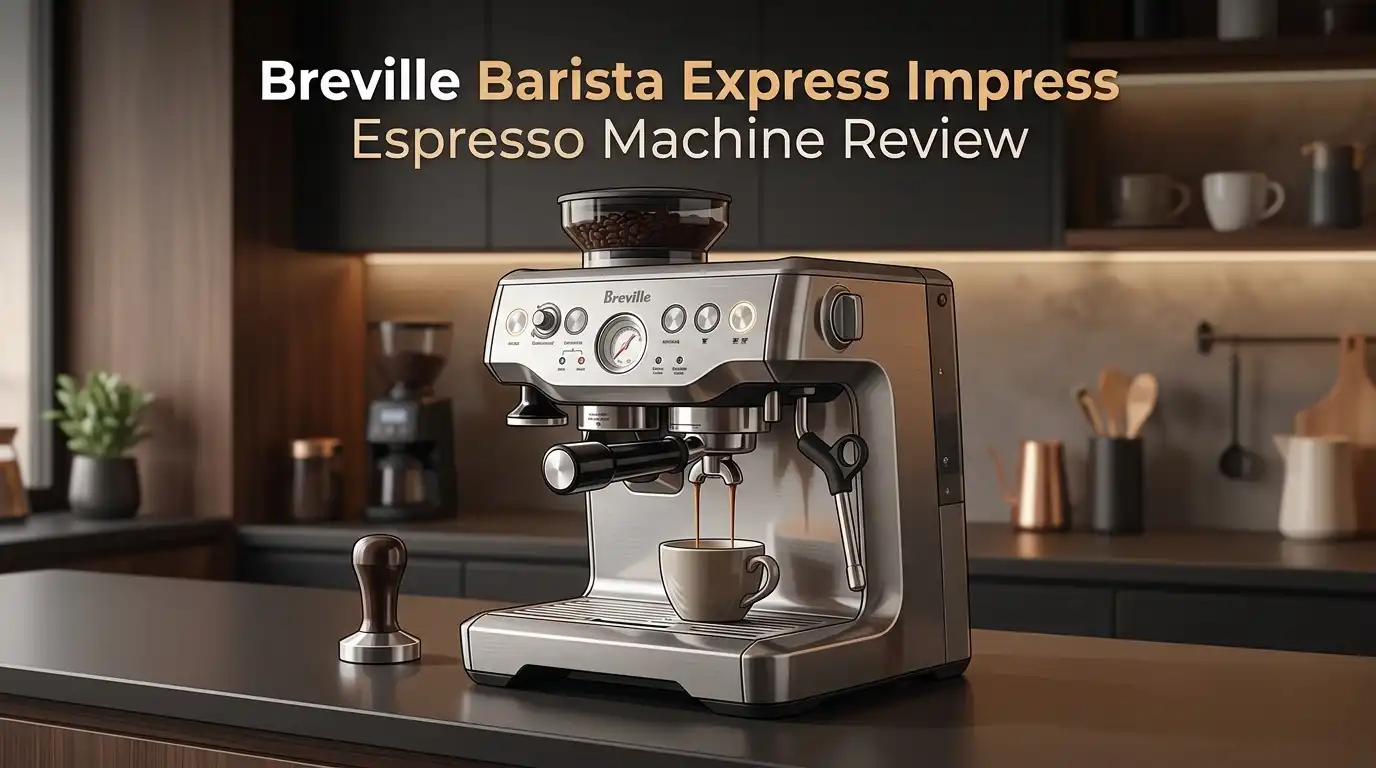
Breville Barista Express Impress Espresso Machine Review 2026
Espresso machines promise a lot. Most of them hand you a portafilter and wish you luck. The Breville Barista Express Impress takes a different path. It grinds, doses, and tamps for you, then tells you whether you got it right. That smiley face on the front panel is not a gimmick. It is feedback.
I spent weeks pulling shots on this machine. I made good espresso. I also made bad espresso. This review covers both.
If you want to know whether the Impress deserves counter space in your kitchen in 2026, keep reading. I will share the unboxing, the daily routine, the taste results, and the honest flaws that other reviews skip.
In A Nutshell:
- The assisted tamping actually works. The lever applies around 22 pounds of pressure every single time. Your puck comes out level and compact without any wrist technique. This removes one big variable for beginners.
- The dose feedback system is the main selling point. An LED scale shows whether you underdosed, hit the target, or overdosed. The machine remembers and adjusts the next grind. It learns your beans over a few shots.
- Heat up time is around 30 to 40 seconds. The thermocoil system with digital PID control means you are not waiting around. Water hits the puck near 200 degrees Fahrenheit.
- Consistency is not perfect. This surprised me. A machine built around repeatability still gave me the occasional fast, sour shot. You will still need a scale and patience.
- The steam wand is capable but not powerful. You can make silky microfoam and pour latte art. You will wait longer than you would on a commercial machine.
- Price sits near $650. That buys you a grinder, a tamper, a milk jug, four baskets, and a cleaning kit. As a complete starter package, the value is strong.
Breville Barista Express Impress Espresso Machine


Last update on 2026-11-17 / Affiliate links / Images from Amazon Product Advertising API
The Barista Express Impress carries the model number BES876. Breville built it as a direct upgrade to the original Barista Express. You get a stainless steel conical burr grinder, a 54mm stainless steel portafilter, a 2 liter removable water tank, and a 15 bar Italian pump.
The headline feature is the Impress Puck System. It combines intelligent dosing, assisted tamping, and a visual dose indicator into one workflow.
The grinder offers 25 settings instead of the 16 found on the older model. The bean hopper holds 250 grams and has UV tinting to protect your beans from light.
The machine weighs about 14.3 pounds and stands 16.1 inches tall. Measure your cabinet clearance before you order. This is not a small appliance.
Unboxing Experience: What Is Actually In The Box?
The box is heavy and well packed. Breville uses molded cardboard inserts rather than loose foam, which feels thoughtful. The machine sits under a cloth cover. Lift it out and the brushed stainless steel catches the light immediately.
Underneath the machine sits a storage drawer. Open it and you find the accessories. You get a stainless steel milk pitcher, four filter baskets, a water filter with holder, the Razor precision trimming tool, cleaning tablets, descaling powder, a cleaning disc, a steam wand pin, a brush, and an Allen key.
This is a complete barista starter kit. Most brands make you buy the milk jug separately. Breville does not. Setup took me under ten minutes. Attach the hopper, soak and install the water filter, fill the tank, and run a few flush cycles.
Design And Build Quality: Does It Look The Part?
The Impress looks like a small commercial machine shrunk for a home kitchen. The brushed stainless steel housing has real weight behind it. The analog pressure gauge sits front and center and gives the whole thing a vintage workshop feel.
Controls split logically. Grinder, hopper, and tamping lever live on the left. Group head, steam wand, and brew buttons live on the right. Nothing feels like an afterthought. Even the removable water tank has a solid handle and a firm seal.
The cup warming tray on top is generous and actually gets warm. The drip tray slides out smoothly and has an empty me float indicator. Build quality here feels like a step up from the original Barista Express. Panel gaps are tight and the tamping lever has no wobble.
The Impress Puck System Explained
This is the feature that justifies the name. Here is how it works in practice.
You slot the portafilter into the grinding cradle and press DOSE. The grinder runs and fills the basket. The TAMP light blinks. You pull the lever down in one smooth motion until the machine beeps. The lever applies consistent pressure and rotates slightly to polish the surface.
Now look at the LED scale. A smiley face means your dose is correct. A bar to the left means you need more coffee, and the machine will grind a small top up automatically. A bar to the right means you overdosed, and you use the Razor tool to trim the excess.
The machine logs this and adjusts the next grind time. After three or four shots it settles into your bean.
Top 3 Alternative For Breville Barista Express Impress

Last update on 2026-11-17 / Affiliate links / Images from Amazon Product Advertising API
Breville Barista Pro

Last update on 2026-11-18 / Affiliate links / Images from Amazon Product Advertising API
Breville Bambino Plus

Last update on 2026-11-16 / Affiliate links / Images from Amazon Product Advertising API
Breville Barista Touch
Grinder Performance And Grind Settings
The integrated conical burr grinder gives you 25 outer settings plus an inner burr adjustment hidden under the hopper. Breville suggests starting at setting 16. I found my sweet spot much finer, around 11, using a medium light espresso blend.
Grinding is quiet by espresso machine standards. It is also clean. Grounds go straight into the basket with almost no retention and no mess on the counter. That alone saves me a wipe down every morning.
The weakness is that this grinder doses by time, not weight. Bean density changes as the bag ages, so your dose drifts. The dose indicator catches this and corrects it, which helps a lot. Still, a dedicated grinder with a scale will beat it on precision. Remember to adjust the grind dial only while the grinder is running.
Espresso Taste: How Good Are The Shots?
When this machine gets it right, it gets it very right. My best double shots ran 27 seconds and produced about 2 ounces of thick, syrupy espresso. The flavor had sweetness up front, a full body, and a long chocolate finish. Crema sat dense and reddish brown.
Pre infusion runs for roughly 8 seconds at low pressure. You can lengthen it manually, which I enjoyed playing with. Longer pre infusion softened the acidity in brighter beans noticeably.
Not every shot landed, though. Some mornings the shot ran fast and tasted thin and sour. Nothing in my routine had changed. This is the frustrating part of a machine that promises consistency. When it works, the espresso rivals a decent local café. When it misses, you dump it and start over.
Steam Wand And Milk Foam Quality
The steam wand is a commercial style single hole wand that rotates a full 360 degrees. A rubber sleeve keeps your fingers safe. You get full manual control, which I prefer over automatic frothers.
Texturing milk takes practice but the wand cooperates. I made glossy microfoam with whole milk and poured clean hearts and tulips within a week. Oat milk also textured well, though it needed a slightly lower stretch phase.
Steam power is modest. A single boiler at this price cannot match a dual boiler machine. Expect 40 to 50 seconds to texture a 12 ounce jug. You also wait a short moment while the machine switches between brew and steam modes. Purge the wand before and after every use or milk will dry inside the tip.
Heating Speed And Temperature Control
The thermocoil heating system reaches brew temperature in roughly 30 to 40 seconds from cold. Compare that to the 20 or 30 minutes a traditional single boiler needs and the convenience is obvious. The power button stops flashing when the machine is ready.
A digital PID controller monitors water temperature continuously and targets around 200 degrees Fahrenheit. You can nudge this up or down through the menu, which experienced users will appreciate.
Temperature stability is the weak link. I measured warmer than expected shots from a freshly heated machine. My fix was simple. I lowered the factory preset by a couple of degrees and flushed the group head for three seconds before locking in the portafilter. That one habit improved my shot consistency more than any grind change.
Daily Use: How Easy Is The Routine?
The morning routine takes about three minutes once you know it. Power on, slot the portafilter into the cradle, press DOSE, pull the tamp lever, check the smiley face, flush, lock in, press 2 CUP.
The interface explains itself. Buttons are labeled in plain words. The filter size button tells the machine which basket you loaded. The dose dial lets you override the automatic amount when you want to experiment.
The biggest workflow annoyance is the grinding cradle. You cannot remove the portafilter mid grind to settle the bed. When I tried, grounds went everywhere. That limits distribution techniques that more advanced users rely on. You accept the machine’s way of doing things, or you fight it.
Cleaning And Maintenance Requirements
Daily care is light. Rinse the baskets, flush the group head after each shot, and wipe the steam wand with a damp cloth right away. Milk residue hardens fast and becomes a real chore later.
The machine prompts you for deeper work. A CLEAN/DESCALE light flashes when a backflush cycle is due. You drop a cleaning tablet onto the supplied cleaning disc inside the blind basket and follow the manual. The cycle runs on its own.
Descaling comes less often but still matters. The included water filter slows limescale but does not stop it. Replace that filter roughly every three months or 40 liters. Skipping maintenance shows up in the cup within weeks as dull, flat tasting espresso. Empty the drip tray before the float pops up.
What The Barista Express Impress Does Not Do Well
Honesty time. First, shot to shot consistency falls short of the marketing. The dose assistance helps, but temperature behavior and time based grinding still introduce variation.
Second, you cannot adjust spout height. Tall travel mugs do not fit under the group head. Removing the drip tray creates room, but a plastic nodule underneath makes cup placement awkward and unstable.
Third, steam power is limited and the single boiler means no simultaneous brewing and steaming.
Fourth, the grinder cannot be bypassed for weight based dosing without manual workarounds. Fifth, the footprint is large and the 16.1 inch height blocks many overhead cabinets. Finally, the warranty runs only one year, which feels short for a machine in this price bracket.
Pros And Cons Of The Breville Barista Express Impress
Pros
- Assisted tamping delivers consistent puck pressure every time, removing a skill barrier for new users.
- The dose indicator and automatic adjustment teach you what a correct dose looks like, which speeds up learning.
- Heat up takes under a minute, so weekday espresso stays realistic.
- Grinding is clean, quiet, and leaves almost no mess on the counter.
- The accessory bundle is unusually generous, including a steel milk pitcher and a full cleaning kit.
- Build quality feels premium, with brushed stainless steel and a satisfying analog pressure gauge.
- Manual steam wand gives real control and allows genuine latte art.
Cons
- Shot consistency varies more than the marketing suggests.
- Temperature runs warm from the factory and needs adjustment.
- You cannot remove the portafilter during grinding to redistribute grounds.
- Fixed spout height blocks tall mugs.
- Steam power is modest for milk heavy drinks.
- Large footprint and tall profile limit placement options.
- One year warranty only.
Barista Express Impress vs Original Barista Express
The original Barista Express sells for around $550 and remains a strong seller. The Impress costs roughly $100 more. Is the gap worth paying?
The Impress adds the puck system, the dose feedback scale, and 25 grind settings instead of 16. Those finer grind steps matter. On the original model, I struggled to find a grind fine enough for a proper slow pour with some beans.
If you have never pulled a shot before, the Impress is the better buy. The guidance shortens your learning curve by weeks and wastes less coffee. If you already own a tamper, a scale, and good technique, the original saves you money and gives you more hands on control. Both share the same grinder quality, boiler, and steam wand.
Who Should Buy The Barista Express Impress?
Last update on 2026-11-17 / Affiliate links / Images from Amazon Product Advertising API
Buy this machine if you are stepping up from pods or a drip brewer and want real espresso without buying four separate pieces of equipment. The guided workflow removes the two steps that defeat most beginners, which are dosing and tamping.
It also suits households where more than one person makes coffee. The feedback system keeps everyone honest, so your partner cannot blame the machine for a bad shot.
Skip it if you are already a confident home barista. You will find the fixed workflow restrictive and will get better results pairing a Bambino Plus with a quality standalone grinder for similar money. Also skip it if you make four milk drinks back to back every morning, since the single boiler will slow you down.
Price And Value In 2026
The Barista Express Impress sits near $649.95 at list price, with regular discounts around holidays and Prime events. Factor in what is included. A comparable standalone burr grinder costs $200 or more. A decent tamper, milk jug, and cleaning kit add another $80.
Viewed as a bundle, the value holds up well. You are paying a small premium over the original Barista Express for genuine workflow improvements, not cosmetic ones.
Running costs stay low. Water filters cost a few dollars each, and cleaning tablets last months. Beans will be your real expense, and good beans matter more than any setting on this machine. Buy fresh, locally roasted coffee within three weeks of the roast date and this machine rewards you.
Final Verdict: Is It Worth Buying?
The Breville Barista Express Impress earns a recommendation with clear limits attached. It makes genuinely good espresso, it looks great on a counter, and it teaches beginners faster than any similarly priced machine I have used.
It is not the perfect machine. Consistency wobbles, temperature needs tuning, and advanced users will hit the ceiling of its fixed workflow within a few months.
My rating sits at 4.3 out of 5. For a first real espresso machine, it is one of the safest purchases in 2026. For an upgrade from an existing setup, look harder at the alternatives before you commit. Buy it for the guidance and convenience, not for competition level precision, and you will be very happy with it.
Frequently Asked Questions
Is the Breville Barista Express Impress good for beginners?
Yes. The dose indicator and assisted tamping handle the two hardest beginner steps. Most new users pull a drinkable shot on day one and a genuinely good shot within a week.
What grind setting should I start with?
Breville recommends setting 16. Most users end up finer. I got my best results at setting 11 with a medium light roast. Darker roasts generally need a coarser setting.
Can I use pre ground coffee in it?
Yes, with the double wall filter baskets included in the box. Those baskets regulate pressure and compensate for inconsistent grinds. Flavor will be noticeably flatter than freshly ground beans in single wall baskets.
How long does the machine take to heat up?
Roughly 30 to 40 seconds from cold. The power button stops flashing when the machine reaches brew temperature.
Does it make regular coffee or Americanos?
It brews espresso only. You can make an Americano by adding hot water to a shot, but there is no dedicated hot water spout, so you will need a kettle.
How often should I descale it?
The machine prompts you automatically based on usage. In hard water areas expect a descale every two to three months even with the water filter installed.
Does the Impress come with a warranty?
Yes, a one year limited warranty covering manufacturer defects. Registering the product on the Breville site is worth the two minutes it takes.

Hi, I’m Emma Lee — the coffee-obsessed creator behind Morning Drip Vault. I spend my days testing coffee machines, exploring brewing techniques, and reviewing the latest coffee gear. My mission is simple: helping you find the perfect machine to brew your best cup, every single morning.