Fellow Ode Gen 2 64mm Flat Burr Grinder Review 2026: Worth Buying?
Filter coffee lovers keep asking one question. Does the Fellow Ode Gen 2 still deserve a spot on the counter in 2026? This grinder arrived as a fix for everything people disliked about the first Ode.
It kept the slim body, added better burrs, and promised cleaner cups. Years later, it sits in home kitchens, small offices, and even a few cafes that cannot stretch to a commercial machine.
This review covers the good parts, the annoying parts, and the things Fellow simply does not advertise. Read on before you spend the money.
In a Nutshell:
- Grind quality is the main selling point. The 64mm flat burrs produce a tight particle spread. Pour over cups taste clearer and sweeter than anything from a basic conical grinder. Flavor separation in single origin beans is the biggest upgrade you will notice.
- It is fast and quiet. Fifteen grams disappears in roughly five to six seconds. The motor hum stays low enough for early mornings in an apartment with sleeping housemates.
- Retention sits near zero. Anti static treatment, a magnetic catch cup, and a built in knocker keep leftover grounds down to about a tenth of a gram. Bean swapping becomes painless.
- It cannot make espresso. This is not a limitation you can work around. Fellow built the burr geometry and motor for brewed coffee only. Moka pot users will also feel short changed.
- The body is plastic at a premium price. At around $399.95 for the standard model, some buyers expect metal. Build feels solid, but it does not feel luxurious.
- Maintenance is mandatory. Oily dark roasts clog the chute. A monthly brush out keeps performance steady.
Fellow Ode Gen 2 64mm Flat Burr Grinder Overview

Last update on 2026-11-15 / Affiliate links / Images from Amazon Product Advertising API
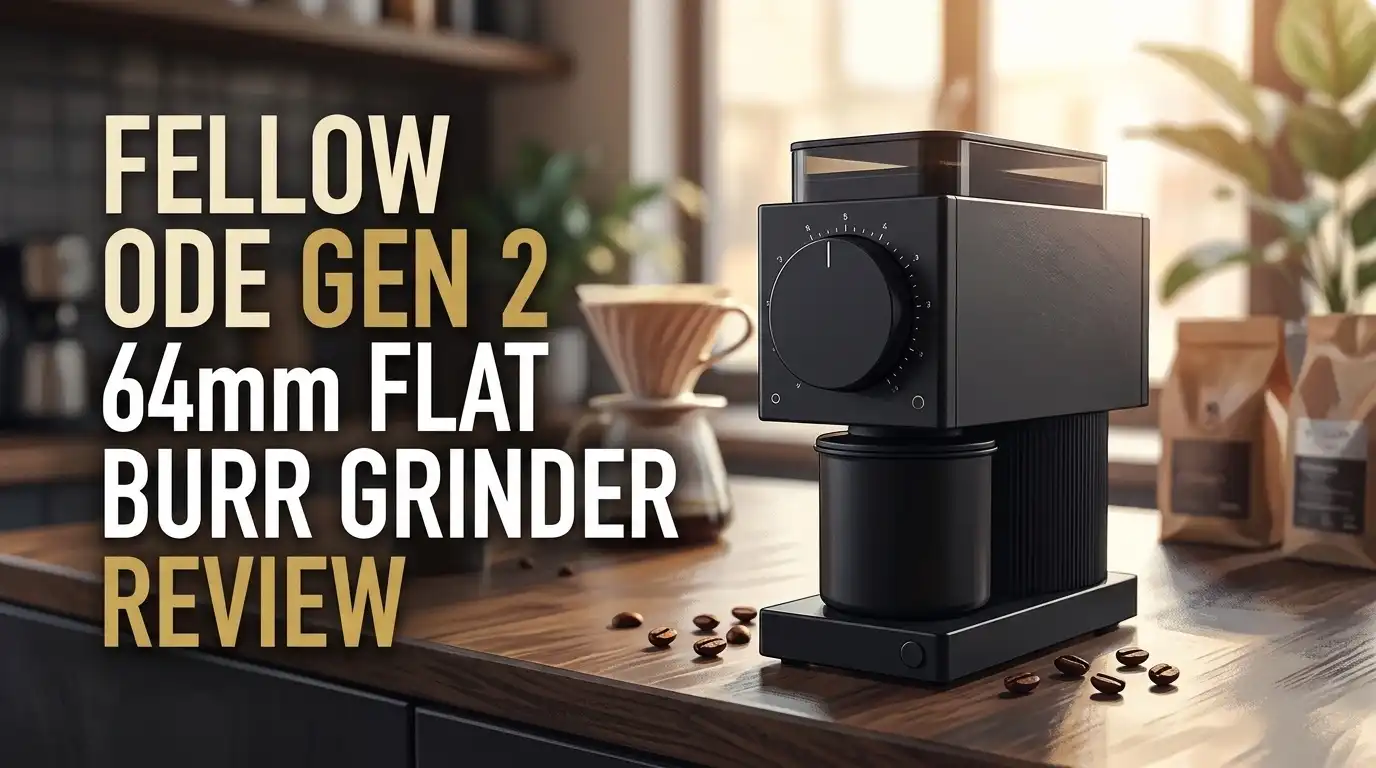
The Fellow Ode Gen 2 is a single dose electric grinder made for brewed coffee. It uses 64mm flat burrs, the same diameter you find in many cafe grinders. Fellow redesigned the burr set after the first generation drew criticism for weak clarity.
The result is a two stage grinding geometry that cuts beans more precisely and grinds finer than the original. Thirty one click settings cover everything from cold brew to fine filter. The hopper takes a single dose of beans, so nothing sits inside going stale.
A magnetic catch cup snaps under the chute and pulls off with one hand. The grinder stops on its own when the beans run out. Everything about the layout pushes you toward a fast, clean morning routine. It weighs close to ten pounds and takes up very little counter space.
Unboxing Experience and First Impressions
The box is compact and plain, which already hints at the design language inside. Fellow packs the grinder in molded pulp rather than foam. You lift the body out, and the weight surprises you. It feels denser than it looks in photos.
Inside the smaller compartment you get the magnetic catch cup, a cleaning brush with a bent tip for the chute, a short manual, and a bag of seasoning beans in some regions. There are no cables to untangle and no tools to hunt down. Setup takes about two minutes.
You plug it in, turn the dial, and it runs. The first thing most people do is press the start button with an empty hopper just to hear how quiet it is. The matte finish picks up fingerprints slightly, so keep a cloth nearby.
Key Specifications at a Glance
Specifications tell you what the grinder was built to do. The burr set measures 64mm and sits in a vertical mount, which helps grounds fall straight down instead of pooling inside. Motor speed runs near 1400 RPM with direct drive, so no belt slips or stretches over time.
The single dose load bin holds enough beans for one brew, while the catch cup handles large doses for batch drip. Grind retention sits around 0.1 grams in normal use. Fellow lists thirty one stepped settings with a side dial for micro adjustment on the burr carrier.
Power draw stays modest at household voltage. Warranty coverage runs one year in most markets. The standard model ships with Fellow Gen 2 Brew Burrs, while a separate version ships with SSP MP Red Speed burrs at a higher price.
Top 3 Alternative for Fellow Ode Gen 2


Last update on 2026-11-14 / Affiliate links / Images from Amazon Product Advertising API
Baratza Encore ESP Coffee Grinder

Last update on 2026-11-14 / Affiliate links / Images from Amazon Product Advertising API
Fellow Opus Conical Burr Coffee Grinder

Last update on 2026-11-14 / Affiliate links / Images from Amazon Product Advertising API
Baratza Virtuoso+ Coffee Grinder
Design and Build Quality
Fellow designs products that look good on a shelf, and the Ode follows that rule. The footprint is narrow, so it slides under most kitchen cabinets. Matte black and white finishes both hide dust reasonably well.
The dial clicks with a satisfying mechanical feel, and the single button sits flush on the front. The magnetic catch cup is the detail people fall in love with. It aligns itself, holds firm, and releases cleanly. Honest note here, though.
The outer shell is plastic over a metal frame. At this price, a full metal body would feel more appropriate, and some rivals offer exactly that.
A few owners also report a light rattle during grinding, usually from the hopper lid or the catch cup seating. None of that affects the coffee, but it shapes the perception of value.
Grind Quality and Consistency
This is where the Ode Gen 2 earns its reputation. Flat burrs cut beans into a narrower band of particle sizes than conical burrs. That translates into even extraction across the coffee bed.
In side by side V60 brews against an entry level conical grinder, the Ode cup tasted cleaner and more defined. Fruit notes in washed Ethiopian beans came through with much more separation. Repeatability is strong too.
Return to the same setting a week later and the brew lands in the same place. Fines production exists, as it does with every grinder, but it stays within a range that suits filter brewing.
One honest caveat matters here. Flat burrs push flavor toward clarity and away from heavy body. Drinkers who love thick, syrupy conical cups sometimes find the result thin.
Grind Settings and Dialing In
Thirty one clicks sounds limited next to grinders with forty or more steps. In practice the range is narrow on purpose, so each click moves a small amount inside filter territory. That makes dialing in fast.
Start around setting 4 to 6 for V60, move slightly coarser for Chemex, and open it up near the top end for French press and cold brew. Numbering varies between units because calibration differs slightly from factory to factory.
Fellow includes a side dial that lets you recalibrate the burr contact point, which you should check before the first grind.
Expect your settings to drift finer during the first two or three bags of beans. That is burr seasoning, and it is normal. Once the burrs settle, your numbers stop moving and stay reliable.
Speed, Noise and Daily Workflow
Morning routines live or die on friction, and the Ode removes most of it. Weigh beans, drop them in the load bin, close the lid, press once. Fifteen grams finishes in roughly five to six seconds. A thirty gram dose takes under ten.
Batch drip doses of forty grams or more still clear quickly. The grinder shuts off by itself, so you never stand there guessing. Noise level deserves praise. Flat burr grinders usually scream.
This one produces a low mechanical whirr that most people describe as tolerable at five in the morning. Several owners say they grind next to a sleeping baby without issue.
The sound is not silent, and there is a sharper rattle at the very end as the last beans clear, but it beats most competitors easily.
Retention, Static and Mess Control
Fellow attacks mess from three angles. Anti static treatment reduces the charge that makes grounds leap across the counter. A knocker inside the chamber taps grounds loose automatically. The magnetic catch cup seals the exit so nothing escapes.
Together they bring retention down to roughly a tenth of a gram, which means your dose in matches your dose out. That accuracy matters for anyone who weighs recipes to the decimal point. Honest reality check, though.
Anti static coating is not permanent magic. After a year of daily grinding, several owners notice more clinging and more dust on the counter.
A quick pass with the included brush across the chute and the ionizer studs fixes it in seconds. Skip that step for months and grounds build up, retention rises, and the grinder starts flinging coffee.
Best Brewing Methods for This Grinder
The Ode Gen 2 is a specialist, not a generalist. V60 pour over is its home ground, and the clarity shows immediately. Chemex benefits from the even particle spread, producing a clean cup without muddiness.
Kalita Wave works beautifully in the medium fine range. AeroPress has plenty of room across the dial, from fine filter style to coarse immersion. French press and cold brew sit comfortably at the coarse end.
Automatic drip machines, including SCA certified brewers, pair well with it for batch brewing. Moka pot is a stretch.
The grinder can reach the coarse side of moka territory on some units, but results are inconsistent. Espresso is simply off the table. The dial runs out of range long before espresso fineness, and Fellow states this openly.
What the Fellow Ode Gen 2 Does Not Do Well
Every honest review needs this section. First, espresso is impossible, and no burr swap or calibration trick changes that. Second, oily dark roasts cause trouble.
Owners report clogging in the chute and grounds sticking inside the chamber when grinding very oily beans. Light and medium roasts behave far better. Third, some units produce a chirp or rattle that feels cheap for the price.
Fourth, large consecutive batches heat the burrs, so a short pause between doses helps. Fifth, flavor profile preference is real.
A few long time Baratza owners switched over and missed the sweetness and body their conical grinder delivered. The Ode trades warmth for clarity, and not everyone wants that trade. Finally, the one year warranty feels short for a premium purchase.
Cleaning and Maintenance Routine
Treat the Ode like a tool, not an appliance, and it rewards you. Every few grinds, brush the exit chute and the ionizer studs. This takes ten seconds and prevents the slinging problem that fills Amazon complaint reviews.
Once a month, or after roughly a kilogram of beans, remove the outer burr and brush the chamber clean. That job takes ten to fifteen minutes with no special tools. Every three or four months, do a full teardown, clean both burrs, reassemble, and recalibrate using the side dial.
Grinder cleaning tablets work well between deep cleans. Almost every reported failure in owner forums traces back to skipped maintenance rather than a manufacturing fault.
Burrs themselves last for years of home use. Replacement burr sets are sold separately if you ever wear them out or want an upgrade.
Stock Burrs vs SSP Burr Upgrade
Fellow sells two versions of the same machine. The standard Ode Gen 2 ships with Fellow Gen 2 Brew Burrs at around $399.95. The upgraded version ships with SSP MP Red Speed burrs at around $599.95.
Many owners buy the standard model and add SSP burrs later if they want a change. The stock Gen 2 burrs are genuinely good and suit most drinkers. They deliver balance, sweetness, and enough clarity for specialty beans.
SSP burrs push harder toward separation and brightness, which light roast fans love. Spending two hundred extra dollars for a flavor shift rather than a flavor jump is a personal call. My honest view is simple. Buy the standard model, live with it for a year, and upgrade only if you feel limited.
Fellow Ode Gen 2 Pros and Cons
Here is the balanced summary after weeks of testing.
Pros
- 64mm flat burrs deliver excellent consistency and clean, defined filter cups
- Grind retention near 0.1 grams makes bean swapping effortless
- Very quiet compared with most electric grinders in this class
- Fast grinding, roughly five to six seconds for a fifteen gram dose
- Magnetic catch cup and built in knocker keep the counter clean
- Auto stop protects the motor and keeps doses repeatable
- Compact footprint with a genuinely attractive design
- Burrs are user replaceable, including an SSP upgrade path
Cons
- Completely unsuitable for espresso, with no workaround
- Plastic outer shell feels modest at a premium price
- Oily dark roasts can clog the chute and chamber
- Maintenance is required, not optional, for steady performance
- Thirty one stepped settings offer less precision than stepless rivals
- Some units rattle or chirp during grinding
- One year warranty is short for the money
Price and Value in 2026
The standard Ode Gen 2 sits near $399.95, with the SSP version close to $599.95. Refurbished units and seasonal promotions drop the price lower, and Amazon listings often undercut the official site.
At four hundred dollars, this grinder competes with the Baratza Virtuoso+ below it and single dose enthusiast grinders above it. Value depends entirely on what you brew.
For a filter only household, the cost per cup over five years looks reasonable. For someone who also pulls shots, buying the Ode means buying a second grinder later.
That doubles the real cost and kills the value argument instantly. Compared against hand grinders, the Ode charges a premium for convenience, speed, and quiet operation. Many buyers consider that fair after one week of use.
Who Should Buy the Fellow Ode Gen 2
Buy it if filter coffee is your main ritual. V60, Chemex, Kalita, AeroPress, drip machine, and cold brew drinkers get the full benefit. Buy it if you weigh doses and want what goes in to come out.
Buy it if you live in an apartment and need quiet mornings. Buy it if counter aesthetics genuinely matter to you. Skip it if espresso sits anywhere in your routine, even occasionally. Skip it if you brew mostly oily dark roasts, since clogging will frustrate you.
Skip it if you refuse to do monthly cleaning. Skip it if you prefer heavy body and syrupy sweetness over clarity, because conical burrs serve that taste better. Budget shoppers should look at the Baratza Encore ESP instead and spend the savings on better beans.
Final Verdict on the Fellow Ode Gen 2

Last update on 2026-11-15 / Affiliate links / Images from Amazon Product Advertising API
The Fellow Ode Gen 2 remains one of the best dedicated filter grinders you can buy for home use in 2026. It grinds fast, stays quiet, holds almost no coffee inside, and produces cups with real clarity.
Owners three and four years in report no failures beyond routine cleaning, which says a lot about durability. The flaws are real and worth repeating. No espresso capability, a plastic shell at a premium price, and a dislike of oily beans all count against it.
None of those flaws break the experience for the intended user. My score lands at 4.4 out of 5 for filter focused buyers. If pour over is your daily ritual and your budget reaches this level, the Ode Gen 2 earns its place.
Frequently Asked Questions
Can the Fellow Ode Gen 2 grind for espresso?
No. Fellow states clearly that the Ode is built for brewed coffee only. The 64mm flat burrs and motor target drip and immersion brewing. The dial runs out of range before reaching espresso fineness. Choose the Fellow Opus or a dedicated espresso grinder instead.
Is the Fellow Ode Gen 2 better than the Baratza Encore?
For grind consistency, retention, and noise, yes by a clear margin. The Encore costs far less and offers excellent repairability. Upgrading from an Encore to an Ode produces a noticeable jump in cup clarity, though some drinkers miss the Encore’s sweeter, fuller body.
How often should I clean the Fellow Ode Gen 2?
Brush the chute and ionizer studs every few grinds. Remove the outer burr and clean the chamber roughly once a month or after a kilogram of beans. Do a full teardown and recalibration every three to four months for best results.
What grind setting works for V60?
Most owners land between settings 4 and 6 for V60, though calibration varies between units. Start in that range, taste, and adjust by one click. Expect your setting to drift finer during the first two bags while the burrs season.
Do I need the SSP burr upgrade?
Not for most people. The stock Gen 2 Brew Burrs deliver balanced, sweet, and consistent results. SSP burrs shift flavor toward brightness and separation, which suits light roast specialty beans. Try the standard model first and upgrade only if you want that specific profile.
Is the Fellow Ode Gen 2 quiet enough for early mornings?
Yes. It ranks among the quieter electric grinders available. The motor produces a low hum rather than a shriek, and grinding finishes in seconds. Many owners grind at five in the morning without waking anyone in the next room.

Hi, I’m Emma Lee — the coffee-obsessed creator behind Morning Drip Vault. I spend my days testing coffee machines, exploring brewing techniques, and reviewing the latest coffee gear. My mission is simple: helping you find the perfect machine to brew your best cup, every single morning.