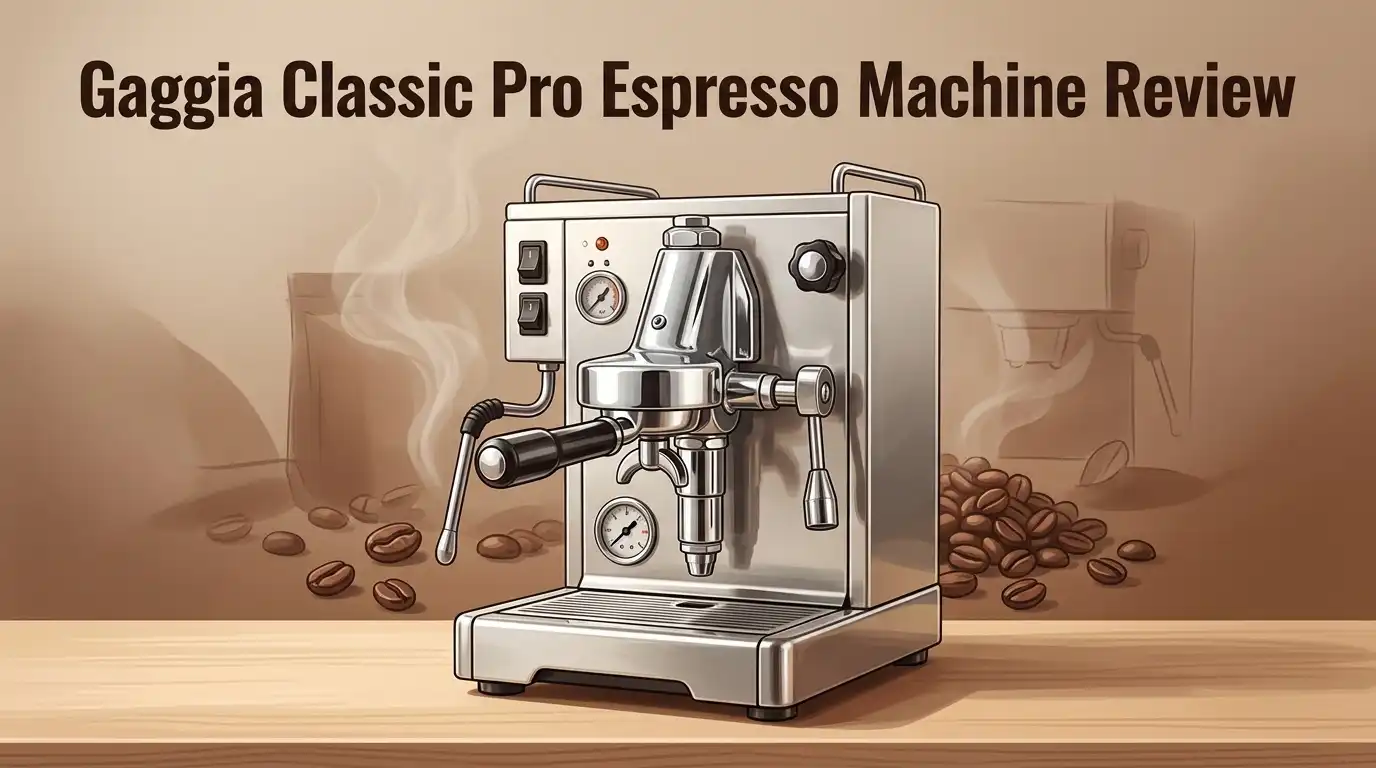
Gaggia Classic Pro Espresso Machine Review 2026: Still Worth It?
The Gaggia Classic Pro has survived three decades of kitchen counter trends. Pod machines came and went. Super automatics promised barista magic at the press of a button. Meanwhile this small stainless steel box kept doing the same thing, year after year, with a 58mm portafilter and a commercial style group head.
So the obvious question in 2026 is simple. Does a machine designed in the early 1990s still deserve your money, especially now that the latest E24 version ships with a brass boiler?
I have pulled shots on this machine, argued about it, cleaned it, and watched friends either fall in love with it or quietly sell it six months later. This review covers both outcomes honestly.
Key Takeaways:
- The Gaggia Classic Pro is a real home barista machine, not a kitchen appliance. It uses a commercial size 58mm portafilter, a brass group head, and a three way solenoid valve. Those three features alone separate it from almost everything else at this price.
- The E24 version with the brass boiler is the one to buy in 2026. Boiler capacity rose roughly 30 percent to just over 100ml. Steam performance improved slightly, and the older coated boiler controversy no longer applies.
- You must learn the machine. There is no PID, no automatic preinfusion, and no assisted milk steaming. Temperature surfing is part of daily life here. Beginners who want instant results will struggle during week one.
- Repairability is the headline strength. Parts cost little, sit in stock everywhere, and swap out with basic tools. Many Classics from 2005 still run today. Resale values stay stubbornly high.
- Budget for a grinder. A Classic Pro with a cheap blade grinder produces sour, thin espresso. Plan to spend at least as much on grinding as you do on brewing.
- Skip it if convenience matters most. Fast heating machines with automatic milk texturing exist, and they suit busy mornings better.
Gaggia Classic Pro Espresso Machine


Last update on 2026-10-22 / Affiliate links / Images from Amazon Product Advertising API
The Gaggia Classic Pro sits in a strange and wonderful category. It costs around 450 to 500 dollars, yet it borrows hardware from machines that cost three times more. The body is brushed stainless steel. The group head is solid brass. The portafilter weighs enough to feel serious in your hand.
Inside, a single boiler heats water for both brewing and steaming. A vibration pump pushes water through the puck. A three way solenoid valve releases pressure the moment the shot ends, which gives you a dry puck that knocks out cleanly and no messy sneeze when your grind runs too fine.
Three chunky rocker switches run everything. Power, brew, steam. That is the entire interface. No screens, no menus, no firmware updates.
The machine measures roughly 8 inches deep, 9.5 inches wide, and 14.2 inches tall. It weighs about 19 pounds. The water tank holds just over two liters and lifts out from the top for refilling.
This is a machine that rewards attention and punishes autopilot.
Unboxing Experience: What Arrives in the Box
The box arrives heavier than expected. Gaggia keeps packaging simple with molded foam inserts and a plain cardboard shell, so there is no theatrical reveal here. You lift the machine out, and the weight immediately tells you something.
Inside you will find the machine itself, the 58mm portafilter, a plastic tamper, a measuring scoop, and two pressurized baskets along with two standard baskets. You also get a rubber gasket for the pressurized baskets and a short instruction booklet.
First impressions are mixed in a very honest way. The stainless steel panels feel excellent. The drip tray feels flimsy by comparison. The included tamper is plastic and too small for the basket, and almost everyone replaces it within a month.
My advice: order a proper 58mm tamper and a distribution tool before the machine even arrives.
Setup takes about ten minutes. Fill the tank, flip the power switch, run water through the group head and the steam wand to prime the pump, then flush a few times. The pump sounds loud during priming. That is normal.
Build Quality and Design
Pick up the portafilter and you understand the appeal. It is solid stainless steel on current models, and it locks into the brass group with a satisfying clunk that plastic machines cannot fake.
The brushed stainless steel panels resist fingerprints reasonably well, though they do show water spots. A microfiber cloth handles that in seconds. The footprint stays compact enough for a normal kitchen counter, and the height clears most cabinets.
Not everything impresses equally. The drip tray is thin pressed metal that flexes when you lift it. The plastic cup grill feels cheap. The water tank lid rattles slightly. Gaggia clearly spent the budget where it matters most and economized everywhere else.
The internal layout is the real design win. Open the top panel with a screwdriver and you find components you can actually identify. The boiler, the pump, the solenoid, the thermostats. Everything sits in reach. Nothing is glued shut or potted in resin.
That decision is why Classics from twenty years ago still pull shots today.
Top 3 Alternative for Gaggia Classic Pro

Last update on 2026-10-22 / Affiliate links / Images from Amazon Product Advertising API
Breville Bambino Plus
No products found.
Rancilio Silvia Espresso Machine

Last update on 2026-10-21 / Affiliate links / Images from Amazon Product Advertising API
De’Longhi Dedica Arte EC885
Brewing Performance and Espresso Quality
Here is the honest truth. The Classic Pro can produce espresso that genuinely rivals machines costing well over a thousand dollars, but only after you do your part.
The 58mm basket gives you a wide, shallow puck, which extracts more evenly than the tiny baskets found on budget machines. Swap the pressurized baskets for the standard ones once your grinder is dialed in, and the cup changes completely. Crema becomes real crema rather than foam created by a pressure valve.
Pressure on North American models arrives set near 9 bar from the factory on recent versions. Older units run closer to 12 bar, and many owners fit a cheaper OPV spring to bring that down. Lower pressure produces sweeter, less bitter shots.
Shot consistency depends entirely on your routine. Weigh your dose. Weigh your output. Time the shot. An 18 gram dose pulling 36 grams in roughly 28 seconds is the standard starting point.
Do that with fresh beans and a decent grinder, and this machine delivers thick, syrupy espresso with real clarity. Skip the discipline and you get sour water.
The E24 Brass Boiler Update Explained
The boiler story matters, so let us clear it up.
Older Classic Pro models used an aluminum boiler holding roughly 80ml. In 2023, Gaggia released the Evo version with a solid brass group head and a nonstick coated aluminum boiler. The coating was meant to prevent galvanic corrosion between the brass group and aluminum boiler.
It did not go well. On some units the coating failed, and owners found small flakes in their water. The community named it Boilergate. Gaggia reverted to uncoated boilers, then solved the problem properly.
The current E24 version uses a solid brass boiler with roughly 30 percent more capacity, just over 100ml. No coating exists, so no coating can fail.
The larger capacity brings a genuine benefit. Steam holds out longer for bigger milk volumes, and temperature swings during brewing shrink slightly. Brass also holds heat differently from aluminum, which helps stability once the machine is fully warm.
If you buy new in 2026, you get the E24. If you buy used, ask which version you are getting.
Steam Wand and Milk Frothing
The Classic Pro uses a commercial style steam wand with a single hole tip. It swivels freely and reaches well over the drip tray.
Steam power is respectable for a single boiler at this price. In real use, texturing six ounces of milk takes around 30 seconds. Twelve ounces takes closer to 60 seconds on the brass boiler version. That is faster than the older aluminum models but slower than dedicated dual boiler machines.
The single hole tip is your friend and your enemy. It produces less chaotic steam than multi hole tips, which makes it easier to create smooth microfoam suitable for latte art. It also demands correct pitcher angle and depth, so your first twenty attempts will probably produce bubbly foam.
One quirk worth knowing. The steam ready light is not a reliable signal. Many owners find the machine steams best roughly 30 seconds after the light turns on. You learn your own machine’s timing.
You must also purge the wand before and after every use. Milk dries fast inside that narrow tip.
Heat Up Time and Temperature Surfing
This section covers the Classic Pro’s biggest daily annoyance, so read it carefully before buying.
The ready light comes on within about five minutes. The machine is not actually ready at that point. The group head, portafilter, and boiler body all need to reach thermal equilibrium, which takes 15 to 20 minutes for genuinely stable shots.
Many owners solve this with a simple smart plug that switches the machine on before they wake up. That single 15 dollar accessory changes the ownership experience more than any mod.
Temperature surfing is the second part of the routine. Without PID control, the thermostat cycles the heating element on and off. Brew water temperature drifts within a range rather than holding one number. Experienced users flush a small amount of water through the group, wait for the light to cycle, then pull the shot at a predictable point.
It sounds fussy because it is fussy. Some people find the ritual enjoyable. Others find it exhausting. Be honest with yourself about which type you are.
Pros and Cons of the Gaggia Classic Pro
Every honest review needs a balanced scorecard. Here is mine after extended use.
Pros
- Commercial grade 58mm portafilter and brass group head open the door to bottomless portafilters, precision baskets, puck screens, and every accessory the hobby offers.
- Three way solenoid valve produces dry pucks that knock out cleanly and prevents pressure sneeze when the grind runs fine.
- Outstanding repairability. Parts are cheap, widely stocked, and replaceable with basic hand tools. Repair guides exist for every common fault.
- Brass boiler on the E24 ends the coating controversy and improves steam consistency with larger milk volumes.
- Enormous modding community. PID kits, OPV springs, pressure gauges, and full Gaggiuino conversions all exist with detailed instructions.
- Strong resale value. Used Classics hold price better than almost any competing machine.
- Compact stainless steel body that looks good and survives daily abuse for years.
Cons
- No PID temperature control out of the box, which means temperature surfing becomes part of your routine.
- Long practical warm up time of 15 to 20 minutes despite a quick ready light.
- Small boiler limits back to back milk drinks for larger groups.
- Plastic tamper and flimsy drip tray feel out of place on an otherwise solid machine.
- Steep learning curve that punishes casual users during the first few weeks.
- Loud vibration pump that will wake a sleeping household.
What the Gaggia Classic Pro Does Not Do Well
Reviews that only list strengths help nobody, so here is the blunt section.
This machine is bad at convenience. If your morning involves rushing out the door in eight minutes, the Classic Pro will annoy you daily. There is no auto start, no timer, and no shortcut around the warm up.
It also struggles with milk volume for groups. Making four cappuccinos in a row means waiting for the boiler to recover between brewing and steaming, then waiting again to cool back down for the next shot. The switch between brew temperature and steam temperature is slow in both directions.
The included pressurized baskets are a trap. They mask grind problems and produce fake crema. New owners often stay on them for months and wonder why their coffee tastes flat.
Water tank access sits at the top rear, which is awkward if you place the machine under a cabinet.
Finally, the machine offers zero feedback. No pressure gauge, no shot timer, no temperature readout. You are flying blind unless you add a scale, a timer, and eventually a gauge yourself.
Modding the Gaggia Classic Pro
Half the Classic Pro’s reputation comes from what owners do to it after purchase.
The most common first mod is the OPV spring swap, which drops brew pressure from around 12 bar to 9 bar. The part costs a few dollars and takes 20 minutes. Shots become noticeably sweeter.
The second common mod is a PID kit. These range from simple plug in controllers to full replacement control boards. A PID holds brew temperature within a degree or two, which removes the need for temperature surfing entirely.
The most ambitious option is Gaggiuino, an open source project that adds a touchscreen, pressure profiling, flow control, and shot graphing. It effectively converts a 500 dollar machine into something resembling a 2,500 dollar one, though it requires soldering and patience.
Other popular additions include a low profile drip tray, a silicone group gasket, a stainless steel shower screen, a bottomless portafilter, and a pressure gauge that screws into the portafilter line.
You do not need any of these to make good coffee. They exist because the machine welcomes them, and that openness is rare.
Best Grinder Pairings for the Classic Pro
Your grinder matters more than your machine. I will repeat that because new buyers ignore it constantly.
A Classic Pro paired with a cheap blade grinder produces inconsistent, muddy espresso. The same machine paired with a capable burr grinder produces something you would happily pay for in a specialty cafe.
Entry level options that work well include the Baratza Encore ESP, the Breville Smart Grinder Pro, and the Breville Dose Control Pro. Each offers enough fine adjustment steps to dial in espresso without fighting the machine.
Stepping up brings real gains. Grinders such as the DF54, the Turin DF64, or the Eureka Mignon Specialita deliver flatter particle distribution and faster dialing in. Expect to spend 300 to 500 dollars in that tier.
Hand grinders also work beautifully here. The 1Zpresso J series and the Kingrinder K6 produce espresso quality grind at a fraction of electric prices, provided you accept the arm workout.
Gaggia sells its own MD15 grinder, but its 15 adjustment steps are too coarse for precise espresso work.
Gaggia Classic Pro vs Breville Bambino Plus
This comparison decides most purchases, so let us make it clear.
The Breville Bambino Plus heats in about three seconds using a thermojet system. It offers automatic preinfusion, automatic milk texturing with temperature and foam settings, and a tiny footprint. Beginners produce drinkable cappuccinos on day one.
The Gaggia Classic Pro offers none of that convenience. It offers durability, repairability, a full size portafilter, and a ceiling for improvement that the Bambino cannot approach.
Think of it as a philosophy choice. The Bambino is an excellent appliance. The Classic Pro is an entry level tool for a hobby.
Choose the Bambino Plus if you value speed, hate fiddling, and want consistent milk drinks without practice. Choose the Classic Pro if you want to learn espresso properly, plan to keep the machine for a decade, and enjoy tinkering.
One more practical point. The Bambino uses a 54mm portafilter with a plastic body, which limits accessory options and long term repair prospects. The Classic uses the industry standard 58mm size.
Cleaning and Daily Maintenance
Maintenance is straightforward, which is a large part of why these machines last.
Daily routine takes two minutes. Knock out the puck, rinse the basket, wipe the group gasket, flush the group head for a few seconds, and purge plus wipe the steam wand immediately after frothing. Empty the drip tray.
Weekly, backflush with water using the blind basket that you can buy separately. Every two to four weeks, backflush with espresso machine detergent. This clears oils from the solenoid valve and keeps shots tasting clean.
Descaling depends on your water. With filtered or bottled low mineral water, every three to six months is fine. With hard tap water, every two months. Use proper descaling solution, never vinegar, which can damage internal seals over time.
The group gasket hardens over roughly one to two years and needs replacing when the portafilter starts locking past the center point. That part costs a few dollars.
Shower screens should come off monthly for a soak in detergent solution. One screw holds it in place.
Price and Value in 2026
The Classic Pro typically sells between 450 and 500 dollars in the United States, with occasional sales pushing it lower. The E24 with the brass boiler sits at the top of that range.
At that price, the competition is genuinely fierce. Several machines offer PID control, pressure gauges, and faster heating for similar money.
So why does the Classic still hold value? Because total cost of ownership tells a different story. A sealed thermoblock machine that fails at year four becomes waste. A Classic that fails at year four costs 30 dollars in parts and an afternoon.
Resale reinforces the point. Used Classics regularly sell for 250 to 350 dollars, meaning your real cost over several years stays remarkably low.
Factor in accessories honestly though. A tamper, distribution tool, scale, and blind basket add 80 to 150 dollars. A proper grinder adds 200 to 500 dollars more.
Budget around 900 to 1,000 dollars for a complete setup that performs properly. That figure surprises people, but it applies to any espresso machine at this level.
Who Should Buy the Gaggia Classic Pro
Let me be direct about fit, because the wrong buyer ends up disappointed.
Buy it if you find the process interesting rather than tedious. If the idea of weighing beans, adjusting grind size, and chasing a better shot sounds enjoyable, this machine will reward you for years.
Buy it if you care about repairing things rather than replacing them. The Classic is one of very few appliances left that respects that instinct.
Buy it if you already own or plan to buy a real espresso grinder.
Do not buy it if you want coffee in two minutes flat on a Tuesday morning. Do not buy it if manual milk steaming sounds like homework. Do not buy it if you expect the machine to compensate for stale supermarket beans.
The Classic Pro is a machine with opinions. It asks for effort and returns quality in exact proportion to what you give it. That trade suits some people perfectly and suits others not at all.
Final Verdict
The Gaggia Classic Pro remains one of the smartest espresso purchases available in 2026, provided you match its personality.
The E24 brass boiler version fixed the one genuine quality concern of recent years and added modest steam improvements along the way. Everything else that made this machine a legend stays intact. Full size portafilter, brass group head, solenoid valve, stainless body, and parts availability that competitors cannot match.
It is not the easiest machine. It is not the fastest. It has no screen, no PID, and no automatic anything. Your first month will involve wasted coffee and mediocre milk.
Then something clicks. You learn your machine’s rhythm, your grinder’s sweet spot, and your beans’ behavior. The shots get good, then they get excellent, and they stay that way for years.
Rating: 4.5 out of 5. Points lost for the missing PID, the slow warm up, and the throwaway tamper. Points earned for build quality, repairability, and a ceiling that most machines at twice the price never reach.
Frequently Asked Questions
Is the Gaggia Classic Pro good for beginners?
It depends on the beginner. Someone who enjoys learning a craft will thrive with it. Someone who wants push button coffee will find it frustrating. Expect two to four weeks before your shots become consistently good.
Does the Gaggia Classic Pro have PID temperature control?
No. The standard machine uses simple thermostats. You either learn temperature surfing or install an aftermarket PID kit, which many owners eventually do.
What is the difference between the Classic Pro and the E24?
The E24 is the current Classic Pro. Its main change is a solid brass boiler with roughly 30 percent more capacity, replacing the older aluminum design. It also uses a stainless steel portafilter and dispersion plate.
How long does the Gaggia Classic Pro take to heat up?
The ready light appears in about five minutes, but the machine performs best after 15 to 20 minutes of warm up. A smart plug on a timer solves this neatly.
Can the Gaggia Classic Pro make lattes and cappuccinos?
Yes. The steam wand produces good microfoam once you learn the technique. There is no automatic frothing, so milk texturing is entirely manual.
Do I need to mod the Gaggia Classic Pro?
No. It makes good espresso in stock form. Mods such as an OPV spring or PID kit improve consistency, but they are optional upgrades rather than requirements.
What size portafilter does it use?
It uses a standard 58mm portafilter, the same size found on commercial machines. This gives you access to a huge range of baskets and accessories.
How long will a Gaggia Classic Pro last?
With regular descaling and occasional part replacement, 10 to 20 years is realistic. Machines from the early 2000s still run in kitchens today.

Hi, I’m Emma Lee — the coffee-obsessed creator behind Morning Drip Vault. I spend my days testing coffee machines, exploring brewing techniques, and reviewing the latest coffee gear. My mission is simple: helping you find the perfect machine to brew your best cup, every single morning.