
Breville Oracle Espresso Machine Review 2026: Worth It?
Buying a $3,000 espresso machine feels scary. You want café quality coffee at home, but you also want a machine that will not sit unused after three weeks.
The Breville Oracle line promises both. It grinds, doses, tamps, brews, and steams milk for you, yet it still uses a professional 58mm portafilter.
I spent weeks pulling shots on the current Oracle range. This review covers what the machine does brilliantly, what it does poorly, and whether the 2026 version earns the money. No marketing fluff. Just honest notes from daily use.
In A Nutshell:
- The Oracle Dual Boiler (BES995) is the 2026 flagship. It replaced the older Oracle and Oracle Touch, both now discontinued. It costs around $2,999 and adds a true Manual mode for home baristas.
- Automation is the main selling point. The machine grinds, doses, and tamps 22 grams into a 58mm basket. The Auto MilQ wand textures dairy, oat, soy, and almond milk hands free with nine texture levels and precise temperature control.
- Cup quality is genuinely good. Dual stainless steel boilers with PID control let you brew and steam at the same time. Espresso tastes sweet and balanced once dialed in.
- Auto Dial In is not finished yet. The machine adjusts grind size after each shot, but it does not prompt a grinder purge. Getting dialed in can take five or six shots instead of two.
- The forced auto off is annoying. You can only set it between 5 and 20 minutes. On a dual boiler machine, that means repeated reheating.
- The Oracle Jet is the smarter buy for many people. It costs about $1,000 less, heats almost instantly, and makes cold brew. You lose Manual mode and simultaneous steaming.
What Is The Breville Oracle Espresso Machine?

Last update on 2026-10-21 / Affiliate links / Images from Amazon Product Advertising API
The Oracle sits between a super automatic and a traditional prosumer machine. Breville calls it an automatic espresso machine. I call it a cheat code for good espresso.
A normal espresso machine makes you grind, dose, distribute, and tamp by hand. The Oracle does all four steps with a motorised tamp fan. You lock in the portafilter, tap the screen, and walk away.
The current model is the Oracle Dual Boiler, model BES995. It uses a 450ml brew boiler and a 950ml steam boiler, both stainless steel and PID controlled. A heated 58mm group head keeps temperature stable.
The older Oracle BES980XL and Oracle Touch BES990 still appear on retail sites, but Breville has retired both. If you see one cheap, the parts supply is the real question.
Unboxing The Oracle: First Impressions
The box is heavy. Really heavy. The machine weighs close to 38 pounds, so plan on two people lifting it onto the counter.
Breville packs everything in moulded card trays. Inside you get the 58mm stainless portafilter with a splitter spout, a stainless milk jug, the Knock Box 10, two single wall baskets, a water filter and holder, two hex keys, a cleaning disc, cleaning tablets, descaling powder, steam wand cleaning powder, brushes, and a water hardness strip.
The first thing I noticed was the finish. Brushed stainless steel across the front, chunky metal portafilter, and a screen that sits proud of the body. It feels like a $3,000 object, which matters.
Setup took about 15 minutes. You flush the water circuit, run a hardness test, set the clock, and pair WiFi. The onscreen guide is genuinely clear, with no manual required.
Design And Build Quality
The Oracle Dual Boiler measures roughly 17.9 by 14.6 by 14.8 inches. That is wide. Measure your counter before you order, especially the height clearance under cabinets, because the hopper loads from the top.
The 2.2 litre water tank fills from the top too, so you do not have to drag the machine forward. Small design win that you appreciate daily.
Build quality is a clear step above Breville’s cheaper machines. The group head is solid brass under the steel. The portafilter has proper weight. The drip tray slides smoothly and holds a decent volume.
The screen is the star. It measures 5.7 inches and runs on a quad core processor, so swiping feels like a phone rather than a 2014 kiosk. Icons respond instantly.
One gripe: the glossy touchscreen shows every fingerprint and milk splash. Keep a microfibre cloth nearby.
Auto Mode And Manual Mode Explained
This is the big 2026 upgrade. Swipe up or down to switch between two completely different personalities.
Auto mode looks like a friendly drinks menu. You get espresso, americano, café crème, latte, cappuccino, flat white, cortado, latte macchiato, and piccolo. There are also recipe drinks like iced latte, mocha, espresso martini, hot chocolate, and babyccino with onscreen steps.
My partner learned Auto mode in about two minutes. Tap, lock, walk away.
Manual mode is for people like me. The screen turns black with a red digital pressure gauge. You control brew temperature in single degree steps, shot volume, grind size, steam temperature and texture, manual preinfusion with a bloom step, and grinder behaviour by weight or by time.
You can save a favourite shot profile once you nail an extraction. This single feature makes the Oracle a serious home barista machine rather than a fancy toy.
Top 3 Alternative For Breville Oracle Espresso Machine


Last update on 2026-10-22 / Affiliate links / Images from Amazon Product Advertising API
Breville Oracle Jet Espresso Machine

Last update on 2026-10-21 / Affiliate links / Images from Amazon Product Advertising API
Breville Dual Boiler Espresso Machine BES920XL

Last update on 2026-10-22 / Affiliate links / Images from Amazon Product Advertising API
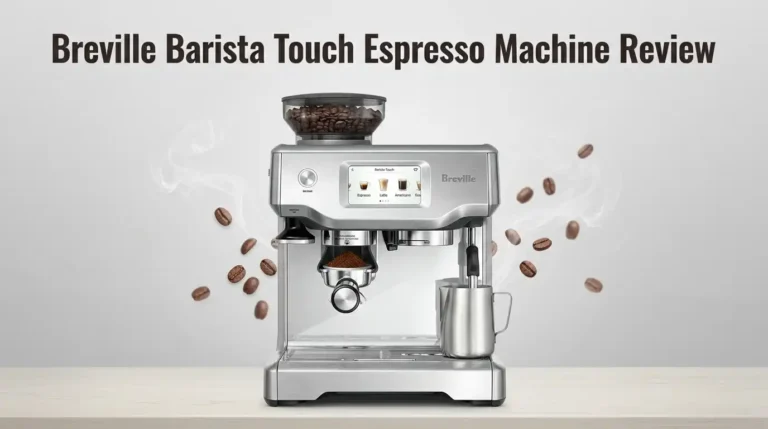
Breville Barista Touch Impress Espresso Machine
The Grinder And Auto Dial In Performance
The Oracle uses fully integrated Baratza European Precision Burrs. You get 45 digital grind settings on the screen plus 10 inner burr positions you can reach with the hex key.
The burrs handle medium and medium dark roasts easily. Light roasts need the inner burr moved finer, which takes five minutes once and then never again.
Grind retention is low and the grinder is remarkably quiet, topping out near 60 decibels at one metre. Parents of sleeping babies will care about that.
Auto Dial In is the headline feature. The machine reads each shot, decides if it ran fast or slow, and shifts grind size for you, usually by three settings.
In practice it rarely nails the shot inside two attempts. It does not tell you to purge the old grounds, so your next shot mixes two grind sizes. I needed six shots and manual purging before things settled.
Espresso Quality In The Cup
Here is what actually matters. Does the coffee taste good?
Yes. Once dialed in, the Oracle pulls sweet, syrupy, well balanced espresso that I would happily serve to a picky friend. The 22 gram dose in a 58mm basket gives body that smaller 54mm machines cannot match.
Temperature stability is excellent thanks to PID control and the heated group. Shot after shot tastes the same, which is the whole point of a dual boiler.
The automatic tamp is consistent and surprisingly good. I ran side by side tests against hand tamping with a distribution tool and the difference was small.
The limit is the grinder, not the brew group. With very light Scandinavian roasts you can hit channelling that a $600 standalone grinder would avoid. For 90 percent of beans, this is a non issue.
Auto MilQ Milk Steaming Tested
The Auto MilQ system uses a temperature sensor in the wand tip plus a small air pump. You choose milk type, texture level, and target temperature, then lift the ring pull and walk away.
You get four milk settings for dairy, oat, soy, and almond. There are nine texture levels from flat to old school cappuccino foam. Temperature runs from about 115F to 165F in single degree steps.
The foam is latte art ready. Glossy, tight, no big bubbles. Oat milk came out just as well as whole dairy, which was not true on earlier Breville machines.
Steaming takes roughly 40 seconds for a small jug. Not fast for a dual boiler, but you steam while the shot pulls, so timing works out.
The steam is also very dry, producing barely a millilitre of water in 30 seconds. The wand purges itself afterwards.
The Breville Plus App And WiFi Features
Most appliance apps are useless. This one is not.
Pairing took under a minute on Android. No endless resets, no Bluetooth tantrums. The app connects over WiFi and stays connected.
The useful part is remote power on. You can wake the machine from bed, watch the warm up progress, and get a notification when it reaches temperature. There are 10 schedules you can set across different days of the week.
You can also adjust screen brightness, barista light brightness, sound level, and light or dark mode. The app holds the manual, video tutorials, and a support ticket system.
You cannot brew coffee from the app, and that is the right call. You have to stand in front of the machine to lock the portafilter anyway, so app brewing would just add bugs.
WiFi also delivers firmware updates, which Breville has used to fix real problems in the past.
Speed, Heat Up Time, And Daily Workflow
The brew boiler reaches temperature in about three minutes. The steam boiler takes under five. That is quick for a dual boiler, though nowhere near the instant heat of a ThermoJet machine.
A single latte takes me roughly 90 seconds from locked portafilter to finished drink. Two drinks back to back take about three minutes because you steam and brew simultaneously.
That simultaneous capability is the real argument for this machine. Hosting six people for brunch stops being stressful.
The hot water spout pours gently rather than spitting, which makes tea and americanos cleaner. Water arrives in the high 180sF and dispenses 200ml in around 28 seconds.
The workflow does have friction points. The portafilter needs a firm twist, and the grind outlet occasionally needs a brush.
What The Oracle Does Not Do Well
Honest reviews list the bad parts, so here they are.
The forced auto off is the worst flaw. You can only set 5 to 20 minutes, and you cannot disable it. On a dual boiler machine that wastes energy reheating and wastes your time waiting.
Auto Dial In is unfinished. It needs purge prompts and faster convergence. Cheaper machines get you dialed in quicker with manual guidance.
No cold extraction. The Oracle Dual Boiler only offers iced recipes that tell you to add ice. The Oracle Jet makes genuine cold brew and cold espresso. If iced coffee is your daily drink, this is a real loss.
Hot water is too hot for americanos. One temperature serves tea and coffee, and it suits tea.
Long term reliability is also a fair question. Older Oracle models developed boiler and steam probe leaks after a couple of years of heavy use.
Pros And Cons Of The Breville Oracle
Pros
- Dual user modes let a home barista and a tap and go family member share one machine happily
- True dual stainless steel boilers brew and steam at the same time with PID controlled stability
- Automatic grind, dose, and tamp into a professional 58mm portafilter with a 22 gram dose
- Auto MilQ produces microfoam that genuinely rivals hand steaming, including plant milks
- Baratza burrs with 45 digital settings plus 10 inner burr positions for light roasts
- Among the quietest espresso machines I have tested, grinder included
- A smartphone app that actually works, plus WiFi firmware updates
- Premium brushed stainless build with a fast 5.7 inch touchscreen
Cons
- Compulsory auto off capped at 20 minutes with no way to disable it
- Auto Dial In needs too many shots and skips grinder purge prompts
- No cold brew or cold espresso extraction
- Single hot water temperature that runs too hot for americanos
- Large footprint that will dominate a small kitchen counter
- Expensive at around $2,999, with the grinder being the weakest link
- Constant 32 decibel cooling fan hum while powered on
Cleaning And Maintenance
Daily cleaning is light. Wipe the steam wand, knock out the puck, and flush the group. The wand purges itself after each steam, which keeps the tip clear.
Weekly you should backflush with the cleaning disc and a tablet. The screen prompts you when a cycle is due, so you do not need to track it.
Descaling depends on your water. The included hardness strip sets the reminder interval. Using the water filter genuinely extends boiler life, so replace it every two to three months.
The grinder needs occasional attention. Pull the hopper, brush the burrs, and clear the grind outlet with the supplied brush.
The Boiler Drain Mode is a thoughtful touch. It empties both boilers before descaling, transport, or long storage, which protects the machine during moves.
Oracle Dual Boiler Versus Oracle Jet
This is the decision most buyers face. The Jet costs around $1,999 and the Dual Boiler around $2,999.
The Jet uses ThermoJet heating, so it is ready almost instantly. It cannot brew and steam simultaneously, so it queues tasks instead. For one or two drinks, you barely notice.
The Jet adds cold extraction, making real cold brew in under three minutes and cold espresso in just over one minute. It has a 4.5 inch screen and Barista Guidance that suggests grind changes rather than making them.
The Dual Boiler adds Manual mode, Auto Dial In, the phone app, top burr adjustment, and simultaneous brewing and steaming.
My rule is simple. Buy the Jet if you want speed, iced drinks, and one or two coffees at a time. Buy the Dual Boiler if you want hands on control or you serve several drinks per session.
Price And Value In 2026
At $2,999 the Oracle Dual Boiler is Breville’s most expensive machine. That is a lot of money.
Compare it against a separate setup. A Breville Dual Boiler BES920XL costs around $1,599, and pairing it with an excellent standalone grinder still leaves you money ahead. You lose the automation and the auto milk.
The value case rests on convenience and household harmony. If you are the only coffee nerd in a house of four people, a machine that both parties can use has real worth.
Running costs are reasonable. You will spend money on filters, cleaning tablets, and descaler, roughly $60 a year.
If your budget is tight, wait for a sale. Breville discounts the Oracle range during major shopping events, and savings of $300 to $500 are common.
Who Should Buy The Breville Oracle?
Last update on 2026-10-21 / Affiliate links / Images from Amazon Product Advertising API
Buy this machine if you want café drinks at home without studying extraction theory, and you also want the option to geek out later. The dual mode design makes that possible.
It suits mixed households best. One person taps a latte icon. Another pulls manual shots with bloom preinfusion and saves a profile.
It also suits anyone who makes three or more milk drinks in a row. Simultaneous brewing and steaming genuinely saves time.
Skip it if iced coffee is your main drink, because the Jet wins there. Skip it if you are a dedicated home barista with no one else to accommodate, since a Breville Dual Boiler plus a great grinder delivers more control for less.
Skip it too if counter space is tight. This machine needs room.
Final Verdict
The Breville Oracle Dual Boiler is the most capable automatic espresso machine Breville has built. The espresso is genuinely good, the milk system is excellent, and Manual mode transforms it into a proper barista tool.
It is not perfect. The forced auto off is a baffling restriction at this price. Auto Dial In needs another firmware generation. The missing cold extraction stings.
My rating is 4.5 out of 5. It earns that score on cup quality, automation, and build, and loses half a point on the auto off and the unfinished dial in feature.
If you have the budget and the counter space, you will enjoy this machine every single morning.
Frequently Asked Questions
Is the Breville Oracle Touch discontinued?
Yes. Breville has retired both the original Oracle BES980XL and the Oracle Touch BES990. The current range consists of the Oracle Jet and the Oracle Dual Boiler. You can still find Oracle Touch stock at some retailers, often discounted, but spare parts support will shrink over the coming years. For a new purchase in 2026, the Jet or the Dual Boiler makes more sense.
Does the Breville Oracle make good espresso?
It makes very good espresso. The 22 gram dose in a professional 58mm basket, PID temperature control, and a heated group head produce sweet and balanced shots. Automatic tamping is consistent. The main limit is the integrated grinder, which handles medium roasts beautifully but can struggle with very light roasts.
How long does the Oracle take to heat up?
The brew boiler reaches temperature in about three minutes. The steam boiler takes under five minutes. The Breville Plus app lets you power the machine on remotely or schedule automatic warm ups, so it can be ready before you reach the kitchen.
Can the Oracle use plant based milk?
Yes. Auto MilQ includes dedicated settings for dairy, oat, soy, and almond milk, each with its own air pump profile. Oat milk texturing is particularly good on the current model. You get nine texture levels and temperature control in single degree increments.
Is the Oracle worth it over the Barista Touch Impress?
It depends on your goals. The Barista Touch Impress costs far less and uses an assisted tamping system with a 54mm basket. The Oracle adds a 58mm portafilter, dual boilers, fully automatic tamping, and Manual mode. If you want simultaneous brewing and steaming or hands on control, the Oracle justifies the gap. If you make one or two drinks a day, the Barista Touch Impress offers better value.
How noisy is the Breville Oracle?
It is among the quietest machines in its class. The grinder peaks near 60 decibels at one metre, and the pump sits around 45 to 50 decibels. There is a constant cooling fan hum of about 32 decibels while the machine is on, which some users notice in a quiet kitchen.

Hi, I’m Emma Lee — the coffee-obsessed creator behind Morning Drip Vault. I spend my days testing coffee machines, exploring brewing techniques, and reviewing the latest coffee gear. My mission is simple: helping you find the perfect machine to brew your best cup, every single morning.