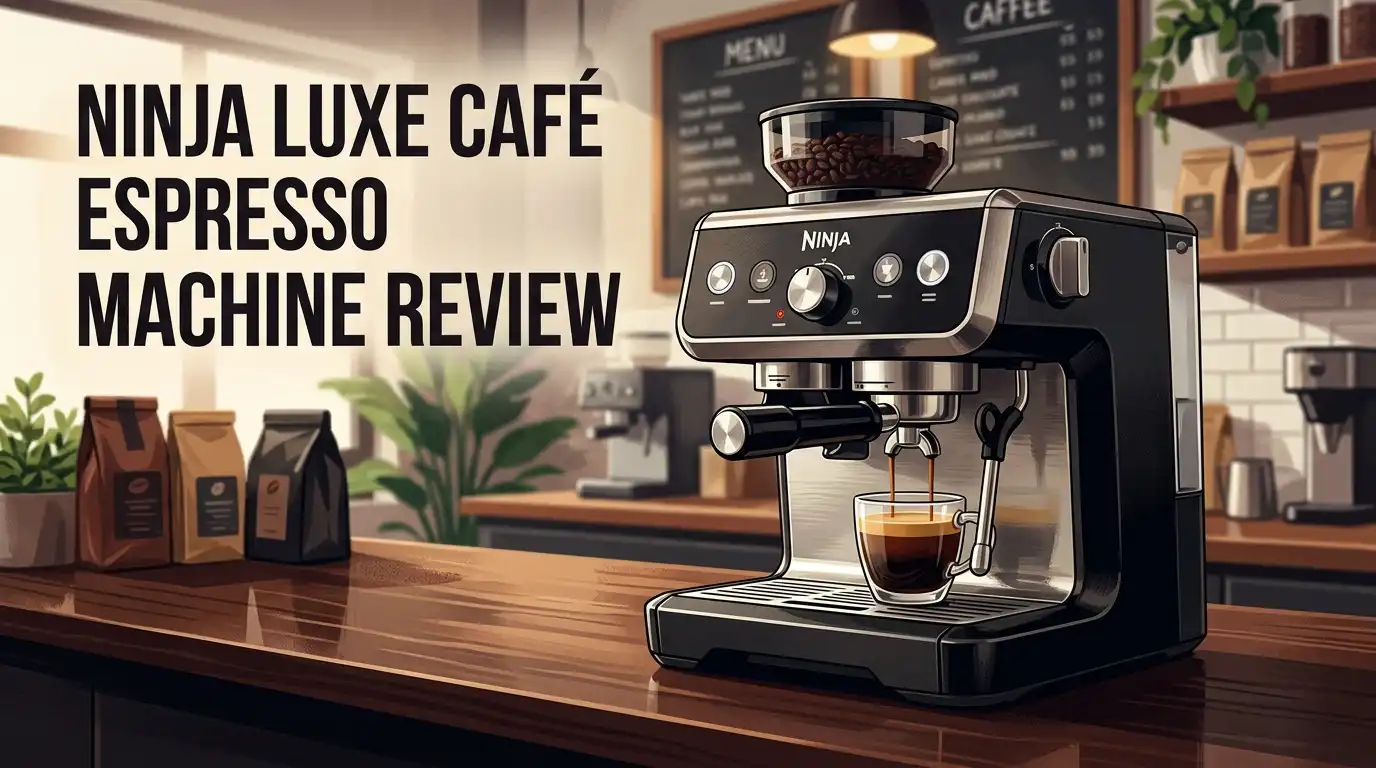
Ninja Luxe Café Espresso Machine Review 2026: Worth Buying?
Espresso machines used to force a choice. You either paid for real espresso or you settled for a drip pot. The Ninja Luxe Café Premier refuses that trade.
It grinds, weighs, tamps, pulls shots, brews filter coffee, and makes cold brew from one 14 inch tall box. Ninja priced it around $499 to $549, which lands it right on top of the Breville Barista Express.
So the question matters. Is this a serious espresso machine or a clever appliance wearing a barista costume? I spent weeks pulling shots, steaming oat milk, wiping static off the drip tray, and getting mildly annoyed at one specific part.
In A Nutshell:
- It makes genuinely good espresso. The machine dosed 17 to 18 grams consistently and produced 36 gram double shots in 25 to 30 seconds with thick crema. That is real espresso, not a pressurized basket trick.
- Barista Assist Technology does the hard thinking. The built in scale weighs your dose inside the portafilter, then the display recommends a grind setting based on how your last shot ran. Beginners skip weeks of guesswork.
- Three machines, one footprint. Espresso, drip style coffee, and cold brew all come from the same 53 mm portafilter using two different baskets. The machine auto detects which basket you loaded.
- The cold brew is the weak link. It tastes flat and thin compared to overnight steeping. The cold pressed espresso mode, however, is excellent.
- The steam wand underperforms. The whisk pitcher creates usable foam fast, but silky microfoam for latte art needs manual steaming and practice.
- Build quality sits above the price. Real brushed steel panels, 25.7 pounds of heft, a spring loaded tamper, and a 2 liter removable tank. Only a 1 year warranty, though.
Ninja Luxe Café Premier Espresso Machine


Last update on 2026-11-18 / Affiliate links / Images from Amazon Product Advertising API
The Luxe Café Premier carries model number ES601. It runs a 1650 watt single thermoblock with a PID controller and a 15 bar pump.
The portafilter measures 53 mm and holds either a standard double basket or a very deep “Luxe” basket for drip and cold brew. Both baskets are single wall, which signals that Ninja expects you to actually dial in your grind.
You get three espresso styles, four coffee styles, and seven cup sizes from 6 to 18 ounces. Heat up takes under 30 seconds. The 2 liter tank and 12 ounce bean hopper both pop out for refilling. The spec sheet reads like a machine costing twice as much, which is exactly why this thing sold so hard through 2025 and into 2026.
The Unboxing Experience
Ninja has infomercial DNA, and the packaging proves it. The box is covered in splashy claims and so much printed instruction that you could almost skip the manual. Do not skip the manual. The settings menu rewards five minutes of reading.
Lift the machine out and you find a second box hiding under the group head. That one holds the milk pitcher with its magnetic whisk disc inside. Do not lose that disc. The frothing system depends on it.
Then comes the blue tape ritual. Expect a solid minute of peeling. Inside the starter kit you get two baskets, a click pillar tamper that feels surprisingly good, a dosing collar, a cleaning brush, and a blind filter. Thankfully there is no flimsy plastic scoop. Nobody misses those.
Design And Build Quality
The Luxe Café looks modern instead of retro. No chrome lever, no 1950s curves. Brushed steel plates cover the front, top, and sides, with dark grey plastic filling the gaps. The plastic feels dense rather than hollow, which is not always true at this price.
At 25.7 pounds it stays planted on the counter. Dimensions run roughly 14.6 inches tall, 13 inches wide, and 13.4 inches deep, so it fits under most cabinets. That matters because the Barista Express is taller.
Workflow clearly drove the design. There is a magnetic parking spot for the tamper, a slot for the dosing collar, and a storage compartment for spare baskets and cleaning tools. Everything lives on the machine instead of scattered in a drawer. Small thing. Huge daily difference.
Top 3 Alternatives For Ninja Luxe Café Espresso Machine

Last update on 2026-11-18 / Affiliate links / Images from Amazon Product Advertising API
Breville Barista Express Espresso Machine

Last update on 2026-11-17 / Affiliate links / Images from Amazon Product Advertising API
De’Longhi La Specialista Arte Evo Espresso Machine

Last update on 2026-11-17 / Affiliate links / Images from Amazon Product Advertising API
Gaggia Classic Evo Pro Espresso Machine
Barista Assist Technology And The Built In Scale
This feature justifies the price alone. The portafilter sits in a grinding cradle that contains a scale. The machine tares, grinds, and stops at the target dose by weight instead of by time. Timed dosing drifts as beans age. Weight does not.
After each shot the display reads your extraction and suggests a grind adjustment. Shot ran too fast? It tells you to go finer, and it shows your current setting next to the recommended one. You turn the dial until the numbers match.
Change bean bags and the machine recalibrates itself over two or three shots. You will waste a little coffee during that process. That is normal for any espresso machine. The difference here is that Ninja tells you what to do instead of leaving you to guess.
The Conical Burr Grinder
The stainless conical burr grinder offers 25 settings and covers both espresso and drip ranges. That breadth comes with a cost. Fewer clicks land inside the usable espresso window, so each adjustment moves you further than it would on a dedicated espresso grinder.
Ninja solved one classic annoyance cleverly. When you adjust finer, the motor pulses slightly with each click. That prevents the burrs from jamming on trapped grounds and removes the need to purge after big changes. It is a genuinely smart piece of engineering.
The grinder also runs quiet. Noticeably quiet. Compared to the rattle of a Barista Express, this one sounds muffled and controlled. Early morning grinding will not wake the house. Static is the one complaint, and I cover that below.
How The Espresso Actually Tastes
Here is the honest part. I expected mediocre shots. I got good ones. The machine pulled 18 grams in, 36 grams out, in the 25 to 30 second window, shot after shot. Crema came out thick and lasting.
With a Brazilian blend the shots showed clear chocolate and hazelnut, decent sweetness, and no harsh bitterness. The highest of the three temperature settings produced the best cup by a clear margin. The lower settings tasted thin and underdeveloped.
The 1:2 ratio works best, and you can change it in the menu. Pre infusion is present and helps with evenness. Is this competition level espresso? No. Is it better than the espresso at most neighborhood cafés? Honestly, yes. That is remarkable at this price.
Drip Coffee Performance
The deep Luxe basket turns the portafilter into a brew chamber. You skip tamping entirely, and the machine pulses water through to mimic a pour over. Four styles exist: Classic, Rich, Over Ice, and Cold Brew.
The drip coffee surprised me. It came out delicate but satisfying, with medium body and rounded acidity. It tastes closer to pour over than to a cheap drip pot, which is a real achievement.
Two warnings. First, 18 ounces is the ceiling, so this never replaces a 12 cup carafe for a family. Second, filter grind for drip uses a lot of beans, and you must regrind when switching back to espresso. Owners who want both daily will find that workflow tedious. Some skip drip mode entirely after a few weeks.
Cold Brew And Cold Pressed Espresso
Split verdict here. The cold brew mode disappointed me. It produces a cold coffee in minutes, but the result tastes thin and slightly hollow next to proper overnight steeping. Do not buy this machine as a cold brew solution. Buy a mason jar instead.
The cold pressed espresso, though, is a triumph. The machine extends extraction time and delivers water in two short bursts at lower temperature. The result tastes sweet, syrupy, and creamy. Pour it over ice with a splash of oat milk and it beats most café iced lattes.
That single mode earns the cold section its place. Cold pressed espresso is the feature nobody expected and everybody keeps using. The two standard cold brew presets will likely sit unused after your first month.
Milk Frothing And The Whisk Pitcher
The system is unusual. A standard steam wand pairs with a pitcher containing a magnetic whisk in the base. The whisk spins during steaming to create a vortex. Four presets exist: Steamed, Thin Froth, Thick Froth, and Cold Foam, plus a dairy or plant based setting.
It works, and it is completely hands free. You walk away and come back to hot foamed milk. The foam quality, however, lands at airy cappuccino level rather than glossy microfoam. Latte art is difficult with the automatic mode.
Experienced users should steam manually with their own pitcher. Results improve immediately. One real gripe: the wand is single wall, so milk bakes onto it fast and dries hard. Wipe it within seconds or scrub it later.
Daily Workflow And The Drip Tray
Ninja built the most complicated drip tray I have used. It has multiple levels for espresso and cappuccino cups, plus a removable center section that lets an 8 inch travel mug fit under the spouts. That tall cup clearance genuinely beats the Barista Express.
The cost is complexity. There are many parts, emptying takes real effort, and the tray fills far faster than expected. Drip mode dumps a lot of water into it.
Static is the other daily friction. The dosing chamber holds a charge, and grounds end up scattered on the tray instead of in the basket. A quick spritz of water on the beans reduces it. Plan on a small wipe down every day, not every week. That is the price of the three in one design.
Cleaning And Maintenance
Daily upkeep stays simple. Rinse the portafilter and basket, pop the shower screen off the group head for a scrub, and clean the wand and whisk pitcher after milk drinks. Five minutes total.
The machine tracks usage and prompts you when a cleaning cycle or descaling cycle is due. The blind filter handles backflushing. Descaling needs a commercial solution and takes about 20 minutes start to finish.
Water quality matters a lot because the thermoblock scales up quickly in hard water areas. There is no built in water filter, which is a notable omission at this price. Use filtered water from day one. Owners who ignore this report performance drops within a year, and the 1 year limited warranty gives you very little cushion.
What The Ninja Luxe Café Does Not Do Well
Authentic reviews name the flaws, so here they are. The United States ES601 has no dedicated hot water button, which makes americanos awkward. It also ships with no single shot basket, so solo drinkers must pull doubles or buy a basket separately.
The steam wand foam cannot match a Breville auto wand for texture. The cold brew modes underdeliver. The drip tray fills constantly. Static scatters grounds. The portafilter can be stubborn to lock into the group head.
Parts availability is also unproven compared to Breville and Gaggia, and the thermoblock is not repairable at home. Only 25 grind settings cover two very different brew ranges. Serious espresso hobbyists will outgrow the grinder before they outgrow the pump.
Pros And Cons
Pros
- Excellent espresso quality for the money, with consistent 18 gram doses and 36 gram yields
- Built in scale and Barista Assist guidance remove the beginner learning curve
- Cold pressed espresso mode tastes outstanding
- Very quiet grinder with motor assisted fine adjustment
- Spring loaded tamper, dosing collar, and onboard storage included
- 8 inch cup clearance fits travel mugs
- Single wall baskets only, so no fake crema
- Fast heat up under 30 seconds with adjustable PID temperature
Cons
- Cold brew modes taste thin and disappointing
- Automatic milk foam struggles with silky microfoam
- Single wall steam wand is hard to clean
- Drip tray has too many parts and fills quickly
- Static scatters grounds during dosing
- No hot water function and no single shot basket in the US model
- Only 1 year limited warranty and no water filter
Ninja Luxe Café vs Breville Barista Express
Both cost around $499. Both are hybrid machines with built in grinders, single boilers, 15 bar pumps, and 2 liter tanks. The similarity ends at philosophy.
The Barista Express teaches you. It gives you manual control, a 54 mm basket, strong aftermarket support, and a decade of proven reliability. You will learn espresso on it, and you will tinker.
The Luxe Café helps you. The scale, the grind recommendations, and the auto basket detection carry you to a good shot on day three instead of week three. It also adds drip coffee, cold brew, and far better cup clearance.
Pick Breville if you want to become a barista. Pick Ninja if you want great coffee without becoming one. Breville builds the more durable machine. Ninja delivers the more useful one.
Who Should Buy The Ninja Luxe Café
Buy it if you drink both espresso and filter coffee and have one small stretch of counter. Buy it if you want latte quality drinks without studying extraction theory. Buy it if your household includes people who will never learn to tamp. The guided workflow genuinely works for them.
Skip it if you only drink black filter coffee, because a good grinder and a $40 pour over setup will beat it. Skip it if cold brew is your main drink. Skip it if you already own a dedicated grinder and want a machine you can modify and repair for a decade.
Value is the headline here. You get a scale, a decent grinder, real espresso, and a tamper for the price of a machine that usually includes two of those four.
Final Verdict
The Ninja Luxe Café Premier earns its hype. It makes espresso that embarrasses machines at its price, and the built in scale is the kind of feature that normally costs $200 extra. The cold pressed espresso alone will convert skeptics.
It is not flawless. The cold brew is weak, the automatic foam is mediocre, the drip tray is fussy, and the 1 year warranty feels thin for a $499 purchase. None of those issues touch the core espresso performance, which is what most buyers actually care about.
Rating: 4.5 out of 5. For beginners and convenience focused coffee drinkers in 2026, this is the easiest recommendation in its price class. Hobbyists who want to tinker should still choose Breville or Gaggia.
Frequently Asked Questions
Does the Ninja Luxe Café make real espresso?
Yes. It uses a 15 bar pump, single wall baskets, pre infusion, and a PID controlled thermoblock. In testing it pulled 36 gram doubles from 18 gram doses in 25 to 30 seconds. That is true espresso extraction, not the pressurized imitation that budget machines produce.
What is the difference between the ES601 and ES701?
The ES601 is the Premier series and the ES701 is the Deluxe series. The ES701 adds a color touchscreen, more drink presets, and a larger capacity. Espresso quality is essentially identical, so the ES601 offers better value unless you want the screen.
Do I need a separate grinder?
No, and that is the point. The 25 setting conical burr grinder with weight based dosing handles both espresso and filter grinds. Serious hobbyists chasing very light roasts may eventually want an upgrade, but most owners never add one.
How long does the Ninja Luxe Café last?
Ninja covers it for 1 year. Real world longevity depends almost entirely on water quality. Use filtered water, descale when prompted, and expect several years of service. Hard water without descaling kills thermoblocks fast.
Can it make latte art?
Manually, yes, with practice. The automatic whisk system produces foam that is slightly too airy for consistent art. Steam manually with your own pitcher if latte art matters to you.
Is the cold brew worth using?
Mostly no. The two cold brew presets taste thin compared to overnight steeping. The cold pressed espresso mode is excellent, though, and it makes a far better iced drink base.

Hi, I’m Emma Lee — the coffee-obsessed creator behind Morning Drip Vault. I spend my days testing coffee machines, exploring brewing techniques, and reviewing the latest coffee gear. My mission is simple: helping you find the perfect machine to brew your best cup, every single morning.