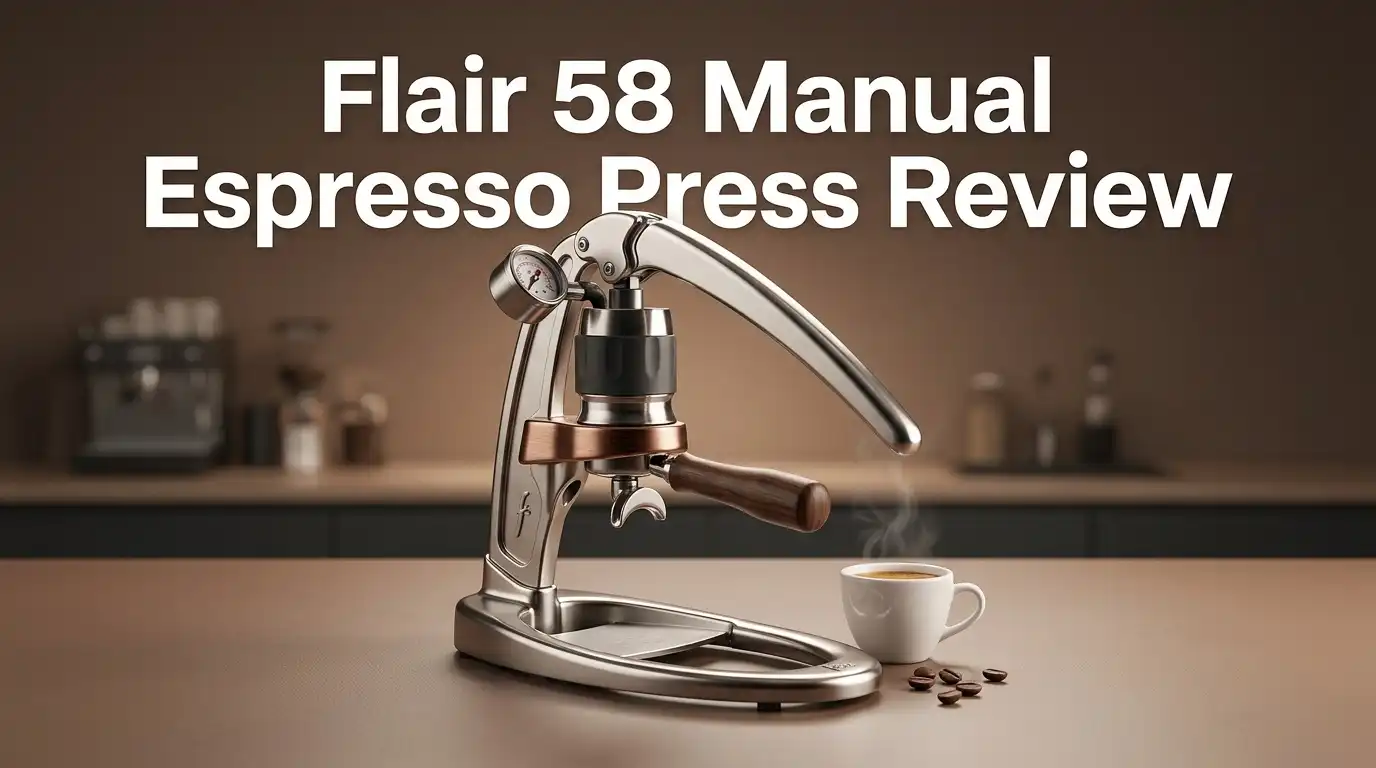
Flair 58 Manual Espresso Press Review 2026: Worth It?
Manual espresso has a reputation. People think it means weak shots, sore arms, and a lot of mess on the counter. The Flair 58 breaks that reputation in about three pulls.
This machine has no pump, no boiler, and no computer telling you what to do. You supply the pressure. You supply the water. You decide how the shot behaves from the first drop to the last.
This review covers the unboxing, the real workflow, the espresso quality, and the things Flair does not advertise.
In a Nutshell:
- The espresso quality is genuinely excellent. With a decent grinder, the Flair 58 pulls shots that match or beat machines costing twice as much. The direct lever gives you true pressure profiling, so you can run a soft preinfusion and then ramp to nine bars by hand.
- The 58mm portafilter is the headline feature. It opens the door to the entire universe of standard espresso accessories: puck screens, distribution tools, aftermarket baskets, and tampers. No other manual press offers this much flexibility.
- The preheat controller helps, but it does not fully solve temperature. The brew chamber heats unevenly from top to bottom. Light roast drinkers need to raise the lever, add water, and wait a few minutes for consistent results.
- Expect real friction in daily use. You must purge leftover water after every shot. The frame flexes slightly above six bars. The raised lever needs roughly 25 inches of clearance under your cabinets.
- This is not a beginner appliance. You need a quality burr grinder, a kettle, and a scale before the machine makes sense. Budget for the full kit, not just the press.
- Best for tinkerers. If you enjoy the process and want control over every variable, you will love it. If you want a button that makes coffee, look elsewhere.
What Is the Flair 58 Manual Espresso Press?
No products found.
The Flair 58 is a direct lever espresso press. You heat water in your own kettle, pour it into a stainless steel brew chamber, and pull a long lever to force that water through a coffee puck. The current model is the Flair 58 Plus 2, which carries an integrated preheat controller nested into the base.
There is no pump anywhere in this machine. Your arm does the work. A pressure gauge sits at the top of the lever assembly and shows you exactly how many bars you are applying in real time. The entire brew path is stainless steel, so no plastic touches your coffee.
Flair positions this as its flagship. It costs around $699 at retail, which puts it against serious semi automatic machines. The difference is that you get full manual control in a footprint about half the size.
Unboxing the Flair 58: What Arrives in the Box
The box is smaller and heavier than you expect. Everything sits in dense foam cutouts, and the first thing you lift out is the base with the preheat controller already wired inside. That base has real mass to it. Nothing feels hollow.
The walnut accents catch your eye immediately. The portafilter handle, the T shaped lever grip, and the palm tamper all share the same dark wood. Against the matte black frame, it looks more like furniture than kitchen equipment.
Inside you will find the lever assembly with the brew head attached, three baskets (high dose, low dose, and pressurized), the pressure gauge, a drip tray, a puck screen, a valve plunger with a locking hook, an articulating magnetic shot mirror, the power adaptor, and the brewing guide.
The mirror is a lovely touch. It lets you watch a bottomless extraction without crouching down.
Flair 58 Specifications at a Glance
Here are the numbers that matter before you clear counter space.
The machine weighs 12 pounds and measures 17.5 by 13 by 6.5 inches in its shipping dimensions. The base itself is 7.5 inches wide and 13 inches deep. With the lever lowered, it stands 11 inches tall. Raise the lever and you need roughly 25 inches of vertical clearance, which rules out a lot of kitchens with low cabinets.
Dose range runs 16 to 20 grams. Water capacity is 90ml, and yield reaches up to 55ml. That covers ratios from 1:1 all the way past 3:1.
The preheat controller offers three settings: 85°C, 90°C, and 95°C. Those roughly match dark, medium, and light roasts. Flair backs the press stand and non electrical brew head parts with a five year limited warranty. Electronics carry shorter coverage.
Top 3 Alternative for Flair 58 Manual Espresso Press

Last update on 2026-11-18 / Affiliate links / Images from Amazon Product Advertising API
Flair 49 PRO

Last update on 2026-11-18 / Affiliate links / Images from Amazon Product Advertising API
Flair Classic Espresso Maker

Last update on 2026-11-18 / Affiliate links / Images from Amazon Product Advertising API
Flair NEO Flex
Build Quality and Materials
This machine feels overbuilt in the best way. The frame is powder coated steel. The brew cylinder is stainless. The piston, the valve plunger, and the portafilter are all metal. There is no plastic anywhere in the brew path, which means nothing leaches, warps, or stains over time.
The walnut holds up well. After months of heat and steam, the wood still looks clean with occasional oiling. The magnetic mirror mount grips firmly and stays where you put it.
Flair also deserves credit for upgradability. Owners of older Flair 58 units could swap in the newer base with the integrated heater without replacing the whole machine.
That kind of backward compatibility is rare at any price. Long term reviewers report years of daily use with no structural failures, only occasional O ring replacements on the plunger valve.
Setup and Your First Shot
Assembly takes about ten minutes. You attach the post and lever to the base with the included screws and allen key, slide the gauge into place, and plug in the power adaptor. That is the whole process.
Your first shot will probably be bad. Mine was. The lever gives you so much authority that beginners either rush the pull or never reach nine bars at all. Watch the gauge, not the cup.
A workable starting recipe looks like this: 18 grams in, grind slightly coarser than you would for a pump machine, preheat on the highest setting, pour 90ml of water at roughly 95°C, then apply gentle pressure until the first drops appear.
Hold around three bars for ten seconds, then ramp to nine. By shot five or six, the motion becomes muscle memory.
The Preheat Controller: Helpful but Imperfect
This is the feature Flair markets hardest, and it is also where honest reviews diverge from the sales page. The controller heats the brew head to one of three temperatures and beeps when ready. That part works.
The problem is thermal stratification inside the chamber. Hot water rises, and the heating element sits closer to the top. Independent testing with thermocouples found the water at the bottom of the chamber sitting several degrees cooler than the water at the top.
If you preheat with the lever down and brew immediately, the bottom water can measure around 87°C to 88°C. That is too cool for light roasts. Preheating with the lever raised improves things by a few degrees.
Letting the water sit in the chamber for three to five minutes evens everything out to 92°C or higher, but that reintroduces the waiting game the controller was supposed to eliminate.
Espresso Quality in the Cup
Now the good news. The shots this machine produces are genuinely impressive. Direct lever control means you can run a long, soft preinfusion at two or three bars without the temperature collapsing, because the brew head stays heated. That capability alone separates the Flair 58 from unheated manual presses.
Clarity is the signature of this machine. Flavors separate cleanly. A washed Ethiopian tastes bright and layered rather than muddy. Fruit notes arrive distinctly instead of blending into a single sweet blur.
Some people find that clarity goes too far. A 58mm basket at 16 grams creates a shallow puck, and shallow pucks can push shots toward sharpness or light astringency.
The fix is simple: dose closer to 20 grams, or buy a step down basket. Because the platform is standard 58mm, you have dozens of basket options to experiment with.
Daily Workflow and Cleanup
The daily rhythm settles quickly. Grind, distribute, tamp with the walnut palm tamper, lock the portafilter into the brew head, drop a puck screen on top, pour water, lower the plunger valve, and pull.
Cleanup is where the Flair 58 loses points. The brew chamber holds 90ml but you only use part of it, so leftover water sits above the puck after every shot. You have to press that water out before you can knock the puck. It is not difficult, but it adds a step and occasionally splashes.
On the plus side, there is no descaling, ever. No boiler means no scale. You rinse the chamber, wipe the brew head, and knock out the puck. Total cleanup takes under a minute once the water purge becomes habit.
Where the Flair 58 Falls Short
Authentic reviews name the weaknesses, so here they are plainly.
The temperature gradient is the biggest one. Medium and light roast drinkers must develop a preheating routine and stick to it. The three temperature settings are somewhat redundant, because most owners immediately select the highest one and never touch the others.
Frame flex is real. Push past six bars and the body gives slightly, tilting the portafilter forward. Through a bottomless portafilter, the stream visibly runs off center. It does not ruin the shot, but it looks sloppy.
Counter clearance eliminates many kitchens. Water purging adds a step. And the machine makes espresso only. There is no steam wand, so milk drinks require a separate steamer or a handheld frother. Flair sells stovetop and electric options, but they cost extra.
Pros and Cons of the Flair 58
Pros
- Outstanding espresso quality with clarity and sweetness that rivals machines at double the price.
- True manual pressure profiling with a live gauge, letting you shape preinfusion and ramp exactly how you want.
- 58mm standard portafilter opens access to the full accessory ecosystem of baskets, screens, and distribution tools.
- Heated brew head supports extended preinfusion and blooming shots without temperature collapse.
- No descaling, no boiler, no plumbing. Cleanup takes under a minute and maintenance is nearly zero.
- Portable off grid use. Unplug the controller and the machine still works anywhere you have hot water.
- Five year limited warranty on the stand and brew head metal components.
Cons
- Uneven brew chamber temperature that requires workaround routines for light roasts.
- Frame flex above six bars pushes the extraction stream off center.
- Leftover water purge needed after every single shot.
- Tall clearance requirement of about 25 inches with the lever raised.
- No milk steaming included at any price point.
- Requires a quality burr grinder, adding $150 or more to the real cost.
- Learning curve of roughly a week before shots become consistent.
Flair 58 vs Cafelat Robot: The Real Rivalry
These two machines dominate serious manual espresso conversations. The Robot takes the opposite approach to thermal management: no electronics at all. You pour boiling water into a room temperature basket and brew within about twenty seconds. Temperature declines predictably from roughly 93°C to 91°C.
That predictability is the Robot’s superpower. No preheating, no surfing, no waiting. Cleanup is also tidier, since you simply remove the basket and let it drain.
The Flair 58 answers with flexibility. The heated group head enables shot styles the Robot cannot attempt, including long blooming preinfusions. The 58mm platform lets you swap baskets endlessly. If you want to experiment and collect data, the Flair wins. If you want a machine that already reached its final form and simply works, the Robot wins.
What Else You Need to Buy
The Flair 58 is a brewing head, not a complete system. Budget accordingly.
A quality espresso capable burr grinder is mandatory. Manual pressure amplifies grind inconsistency, so cheap blade grinders produce channeling and sour shots. Expect to spend at least $150, and look for stepless adjustment.
A kettle with a thermometer makes life easier. You are pouring water directly into the chamber, so knowing its temperature matters more here than on a pump machine. A digital scale rounds out the kit for dosing beans and measuring yield.
If you want cappuccinos, add a milk steamer. Total realistic spend lands between $900 and $1,200 once you include a grinder and accessories. Factor that in before comparing the sticker price to an all in one machine.
Who Should Buy the Flair 58 (and Who Should Skip It)
Buy this machine if you genuinely enjoy process. The Flair 58 rewards attention, repetition, and curiosity. It suits the person who already owns a good grinder, reads about extraction theory, and finds satisfaction in a shot they shaped themselves.
It also suits small kitchens. The footprint is about 40% smaller than a standard semi automatic, and there is no plumbing or descaling schedule.
Skip it if you want convenience. If three people need lattes before work, this is the wrong machine. Each shot takes a few minutes of hands on attention, and there is no steam wand.
Skip it if your cabinets sit low over your counter. Skip it if you are not ready to buy a serious grinder, because the Flair 58 cannot compensate for bad grinds.
Final Verdict: Is the Flair 58 Worth It in 2026?
No products found.
The Flair 58 Plus 2 remains the most capable manual espresso press you can buy. Nothing else combines direct lever control, a heated brew head, a 58mm standard portafilter, and build quality this solid.
It is also still a machine with real flaws. The preheat system does not fully deliver on its promise. The frame flexes. You purge water after every shot. These are not deal breakers, but they are the kind of details a future redesign could fix.
My honest take: if you want espresso as a hobby, this is a joy to own and the shots justify every dollar. If you want espresso as a convenience, the frustrations will outweigh the romance. Know which person you are before you order, and the Flair 58 will either become your favorite kitchen object or an expensive paperweight.
Frequently Asked Questions
Does the Flair 58 need electricity to work?
No. The preheat controller uses electricity, but the brewing itself is entirely manual. Unplug the machine and it still pulls full shots anywhere you can heat water. Many owners travel with it using a camp stove or hotel kettle. The electricity only improves thermal stability, it does not power any part of the extraction.
How long does the Flair 58 take to make one shot?
Plan on about three minutes total. That includes preheating the brew cylinder, grinding and prepping your puck, heating water, and pulling the shot. Light roast drinkers who wait for the chamber to equalize should add three to five minutes. Back to back shots go faster because the head stays hot.
Can you make lattes and cappuccinos with the Flair 58?
The machine produces espresso only. There is no steam wand. You can make lattes by adding a separate milk steamer, either a stovetop unit or an electric one. Flair sells both as accessories. Plenty of owners use a standalone electric frother and get perfectly good milk texture for home drinks.
Is the Flair 58 hard for beginners?
The learning curve is moderate, not brutal. Most people need about a week to pull consistent shots. The included pressurized basket helps beginners who do not yet own a great grinder. That said, the machine assumes you want to learn. If you prefer a machine that handles variables automatically, a pump machine fits better.
What grind size works best on the Flair 58?
Start slightly coarser than you would use on a pump machine, then adjust. Manual pressure builds more gradually, so an overly fine grind stalls the lever and makes the pull exhausting. Aim for a 25 to 35 second total extraction at a 1:2 ratio, then tighten or loosen grind from there based on taste.
Does the Flair 58 require descaling?
No. There is no boiler and no internal water lines, so scale never accumulates. Maintenance means rinsing the brew chamber, wiping the brew head, and occasionally replacing the plunger O ring. This is one of the lowest maintenance espresso machines available, which saves both time and money over years of use.

Hi, I’m Emma Lee — the coffee-obsessed creator behind Morning Drip Vault. I spend my days testing coffee machines, exploring brewing techniques, and reviewing the latest coffee gear. My mission is simple: helping you find the perfect machine to brew your best cup, every single morning.