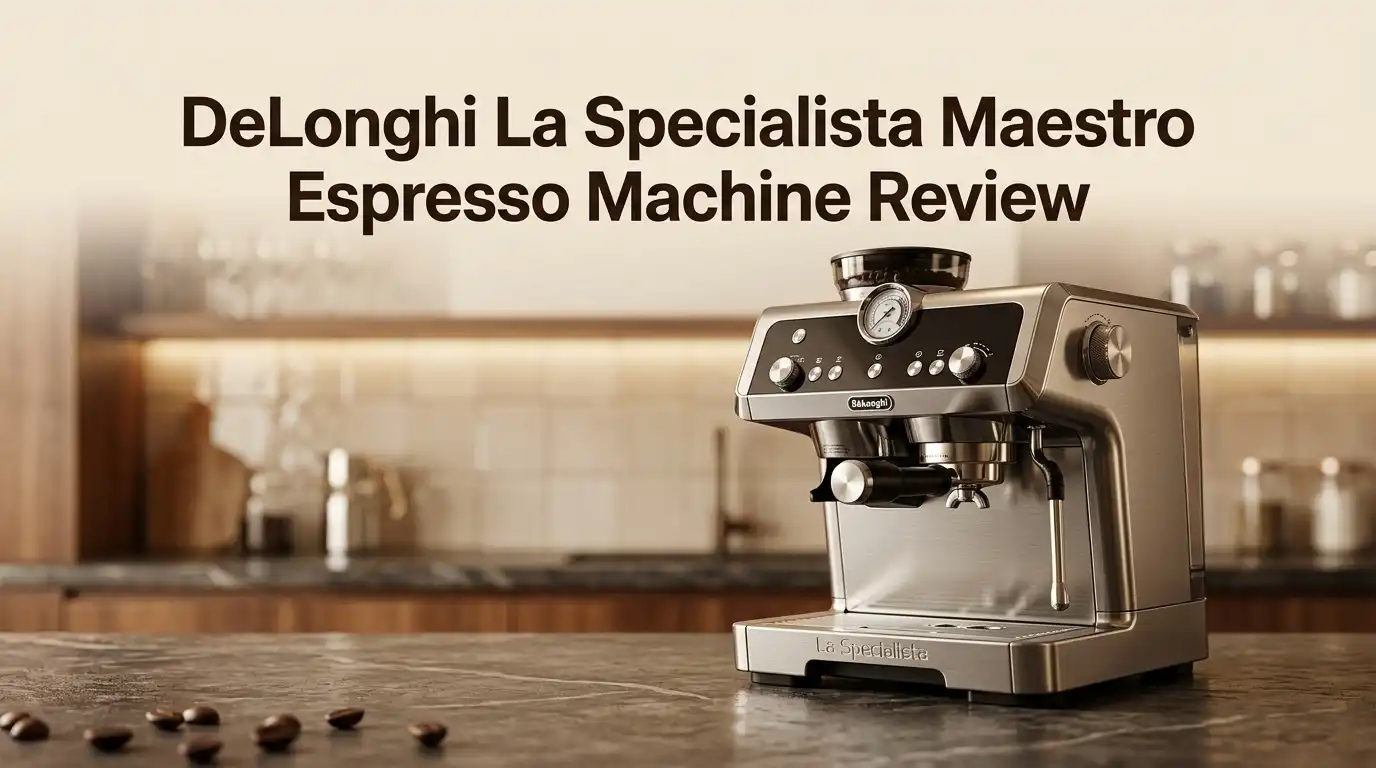
DeLonghi La Specialista Maestro Espresso Machine Review 2026: Worth It?
The DeLonghi La Specialista Maestro sits at the top of the La Specialista family, and it carries a price tag that makes most people pause. You get a conical burr grinder, an automatic tamping lever, a dual heating system, and a milk carafe that builds foam without any skill from you.
That sounds like a café in a box. The real question is simple. Does it brew espresso good enough to justify spending more than a thousand dollars?
I spent weeks pulling shots, steaming milk, wiping splashes, and digging through owner feedback to answer that. This review covers the unboxing, the grinder, the tamping station, the milk system, the cleaning routine, and the parts that genuinely annoy people.
In a Nutshell:
- Espresso quality is genuinely strong. The 19 bar pump, dynamic pre infusion, and single wall filter baskets produce dense crema and sweet shots once you dial in your beans. This is not a pod machine pretending to be an espresso maker.
- The grinder has only 8 settings. That is the biggest weakness. Breville rivals offer 30 steps. You will sometimes land between two settings with no perfect option, so you adjust dose instead.
- The LatteCrema milk carafe beats most beginners at frothing. It pours silky microfoam automatically and even changes the order of milk and coffee depending on the drink you pick. The manual steam wand is powerful but takes practice.
- It is big and heavy. Expect roughly 35 pounds and a footprint that eats a large chunk of counter. Measure your space before you buy, especially under wall cabinets.
- The 51mm portafilter limits accessories. Most third party baskets, tampers, and distribution tools are made for 54mm or 58mm. Your upgrade path is narrow.
- Cleaning is constant. Espresso splashes onto the shiny front panel almost every shot. You will keep a cloth nearby forever.
What Is the DeLonghi La Specialista Maestro?


Last update on 2026-11-16 / Affiliate links / Images from Amazon Product Advertising API
The La Specialista Maestro is a hybrid espresso machine. That means the grinder, the tamper, the brew group, and the milk frother all live in one body. DeLonghi launched it as a direct answer to Breville’s popular grinder plus espresso combos, and the layout reflects that goal.
The left side handles beans. You dose with a dial, grind straight into the portafilter, then tamp with a lever. The right side handles water and milk. You lock the portafilter into the group head, pick a drink, and press OK.
The machine automates the technical parts that beginners usually ruin. Pressure, temperature, and pre infusion run themselves. You still control grind size, dose, and timing, so it rewards curiosity instead of hiding everything behind one button.
Unboxing Experience: What Arrives in the Box
The box is heavy enough that you will want a second pair of hands. Mine arrived double boxed with thick foam corners, and the machine came wrapped in a cloth bag rather than thin plastic. That small touch feels appropriate at this price.
Lifting it onto the counter is the hard part. At about 35 pounds, it does not slide gracefully. Place it where you want it and leave it there.
Inside you will find two single wall filter baskets, a stainless steel milk pitcher, the LatteCrema carafe, a cleaning brush, a cloth, a water hardness test strip, and descaler.
There is no knock box, which still feels like an odd omission on a flagship machine. Budget about twenty dollars for one, because you will want it by day two.
Design and Build Quality: Does It Feel Premium?
The brushed stainless steel body looks serious on a counter. Buttons protrude with a satisfying click, the dials turn with resistance, and the analog pressure gauge gives the whole face a retro workshop feel. Nothing rattles or flexes.
Two monochrome LCD panels handle information. The left panel shows your dose number and the current step. The right panel shows your drink selection. This is not a color touchscreen, and compared to the Breville Barista Touch Impress it feels dated.
The reflective front panel is the design flaw. It looks gorgeous for about four minutes, then collects fingerprints, milk flecks, and coffee droplets. Owners of the black version report this less, since dark finishes hide smudges better than polished steel does.
Top 3 Alternative for DeLonghi La Specialista Maestro

Last update on 2026-11-15 / Affiliate links / Images from Amazon Product Advertising API
Breville Barista Touch Impress

Last update on 2026-11-17 / Affiliate links / Images from Amazon Product Advertising API
Breville Barista Express Impress

Last update on 2026-11-16 / Affiliate links / Images from Amazon Product Advertising API
De’Longhi La Specialista Arte Evo
The Grinder and Smart Dosing System
The 8.8 ounce bean hopper clicks on and off the top in seconds, which makes swapping beans painless. Below it sits the grind adjustment dial with eight settings. The burrs are stainless steel and conical.
Dosing works through a large dial on the left. You pick a number from 0 to 30, press the X2 button if you want a double, lock the portafilter, and the grinder runs automatically. Sensors monitor grind speed and adjust output, so repeat doses stay close to each other.
In practice the dosing accuracy impressed me more than the grind range did. Shot after shot, my scale showed variation of less than half a gram. Eight settings is still too few. Light roasts especially suffer, since the finest setting sometimes is not fine enough for a slow, sweet extraction.
Smart Tamping Station: Does Automatic Tamping Work?
Pull the lever toward you like a slot machine handle and the station tamps your puck. It is oddly satisfying. The display even tells you when to do it, so nobody gets lost.
The result is consistently level and consistently compressed. No wrist strain, no tilted pucks, no channeling caused by a crooked tamp. For anyone who has struggled with a handheld tamper, this is a real improvement.
The pressure is fixed. You cannot increase or decrease it, so your only variables are grind and dose. Some owners pull the lever twice for a slightly denser puck, and that trick does change extraction time a little. It is a workaround, not a feature, and purists will notice the missing control.
Espresso Quality and Dynamic Pre Infusion
This is where the Maestro earns its price. Dynamic pre infusion wets the puck gently and adapts the wetting time to your dose before the pump ramps to full pressure. Even saturation means fewer fast channels through the coffee.
The machine ships with single wall baskets rather than pressurized ones. That matters. Pressurized baskets fake crema. Single wall baskets reward proper grinding and produce real texture.
My shots came out golden brown with fine, dense crema that held for minutes. Active Temperature Control adds five temperature settings matched to roast level, which helps a lot with darker beans. Expect a learning curve of roughly two weeks and one bag of coffee before your settings feel locked in. After that, the consistency is excellent.
LatteCrema and the Manual Steam Wand
You get two ways to handle milk. The LatteCrema carafe fills with cold milk, clicks into the right side, and dispenses foam automatically with three texture levels. The manual steam wand has a three hole tip and serious power.
The carafe is smarter than it looks. When I ordered a latte macchiato, it poured milk first and coffee second, exactly as the drink demands. Foam quality is consistently tight and glossy.
The manual wand is harder to master than a typical home wand because the steam pressure is high and the pitcher is small. Honestly, the automatic carafe produced better microfoam than my own hand did on most attempts. Latte art fans will still prefer the wand once they adapt.
Cold Brew, Model Numbers, and Which One to Buy
Shopping gets confusing fast. The EC9665M is the standard Maestro. The EC9885M adds Cold Extraction Technology and a few extra grind steps built around cold drinks. Prices differ by roughly a hundred dollars depending on the week.
Cold extraction pulls a chilled concentrate in a few minutes rather than hours. It works, and it tastes fine, but it is thinner than true overnight cold brew.
My honest take is that most buyers use the cold feature a handful of times and then forget it exists. If you already own the EC9665M, skip the upgrade. You can pour a normal espresso straight over a glass of ice and get a result that is just as good for iced lattes.
Daily Use and Cleaning Routine
Startup is fast. The dual thermoblock system reaches brewing temperature in seconds, so a morning espresso takes under a minute from flipping the switch.
Daily cleaning means rinsing the portafilter, purging the steam wand, and emptying the drip tray. The LatteCrema carafe has a self cleaning cycle you run after each milk drink, which takes about ten seconds and saves you from sour smells.
Weekly you brush out the grind chute and scrub the shower screen. Descaling runs through a dedicated button and takes roughly twenty minutes. Nothing goes in the dishwasher.
The annoying part is the wiping. Coffee splashes from the spouts hit the front panel nearly every shot, so a microfiber cloth becomes permanent counter equipment.
What the Maestro Does Not Do Well
An honest review needs this section. Several things frustrate owners.
The grinder range is too narrow for serious bean nerds. Eight steps simply cannot match a 30 step machine when you switch between light Ethiopian beans and dark Italian blends.
You cannot brew espresso and steam milk at the same time, even with two heating elements. The back to back workflow is fast, but the dual boiler marketing oversells it.
There is no two cup brewing into separate cups. One spout, one drink at a time.
The 51mm portafilter locks you out of most aftermarket gear. Bottomless portafilters, precision baskets, and distribution tools exist in that size, but choices are thin and quality varies. Repairs also require DeLonghi service rather than simple home fixes.
Pros and Cons of the La Specialista Maestro
Pros
- Excellent espresso with dense crema thanks to dynamic pre infusion and single wall baskets
- LatteCrema carafe produces café quality foam with zero skill required
- Automatic tamping removes the most common beginner mistake
- Very fast heat up time, usually under 60 seconds
- Five brew temperature settings for different roast levels
- Tall 5.5 inch clearance fits large travel mugs
- Strong build quality and a genuinely attractive stainless body
Cons
- Only 8 grind settings, far fewer than Breville competitors
- Shiny front panel shows every splash and fingerprint
- No simultaneous brewing and steaming despite two heating elements
- 51mm portafilter limits accessory upgrades
- Monochrome display feels basic next to touchscreen rivals
- Heavy and large, roughly 35 pounds
- No knock box included at a premium price
Who Should Buy the DeLonghi La Specialista Maestro?
Last update on 2026-11-16 / Affiliate links / Images from Amazon Product Advertising API
This machine suits the person who wants real espresso without becoming a full time hobbyist. You care about taste, you enjoy a little hands on ritual, and you do not want to buy a separate grinder, tamper, and frother.
It also suits households with mixed habits. One person can pull a careful manual shot while another presses a button for a cappuccino from the carafe.
Skip it if you chase single origin light roasts or plan to weigh every shot to the tenth of a gram. The grinder will frustrate you.
Skip it also if counter space is tight, because this machine does not politely tuck into a corner. A Gaggia Classic plus a separate grinder would serve that buyer better.
Final Verdict: Is It Worth the Money in 2026?
Yes, with clear conditions. The La Specialista Maestro delivers espresso that genuinely tastes good, milk foam that embarrasses many home baristas, and a workflow that feels engaging rather than robotic. Build quality holds up, and a well maintained DeLonghi commonly runs for a decade.
The value equation depends on the price you pay. At full list, the Breville Barista Touch Impress offers a nicer interface and a better grinder for similar money. Wait for a sale, and the Maestro becomes a strong buy.
Buy it for the milk system and the espresso quality. Do not buy it expecting unlimited grind control or a touchscreen experience. Know those limits and you will enjoy this machine every single morning.
Frequently Asked Questions
How much does the DeLonghi La Specialista Maestro cost?
Pricing moves often. The EC9665M generally lands between 1,100 and 1,500 dollars, and the EC9885M with cold extraction sits roughly a hundred dollars higher. Holiday sales frequently cut several hundred dollars off, so checking current listings before buying pays off.
Does the La Specialista Maestro have a dual boiler?
It uses a dual thermoblock heating system rather than true dual boilers. You cannot brew and steam at the same time, but you can move from espresso to milk almost instantly with no waiting.
What size portafilter does it use?
The Maestro uses a 51mm portafilter with single wall filter baskets. That size is smaller than the 54mm Breville standard and the 58mm commercial standard, which limits your aftermarket accessory options.
Can beginners use this machine easily?
Yes. The display guides each step, the tamping is automatic, and the LatteCrema carafe handles milk for you. Expect about two weeks of experimenting before your espresso settings feel perfect.
How long does the DeLonghi La Specialista Maestro last?
With regular cleaning and consistent descaling, owners commonly report eight to ten years of service. Water hardness matters most, so use filtered water and never skip descaling cycles.

Hi, I’m Emma Lee — the coffee-obsessed creator behind Morning Drip Vault. I spend my days testing coffee machines, exploring brewing techniques, and reviewing the latest coffee gear. My mission is simple: helping you find the perfect machine to brew your best cup, every single morning.