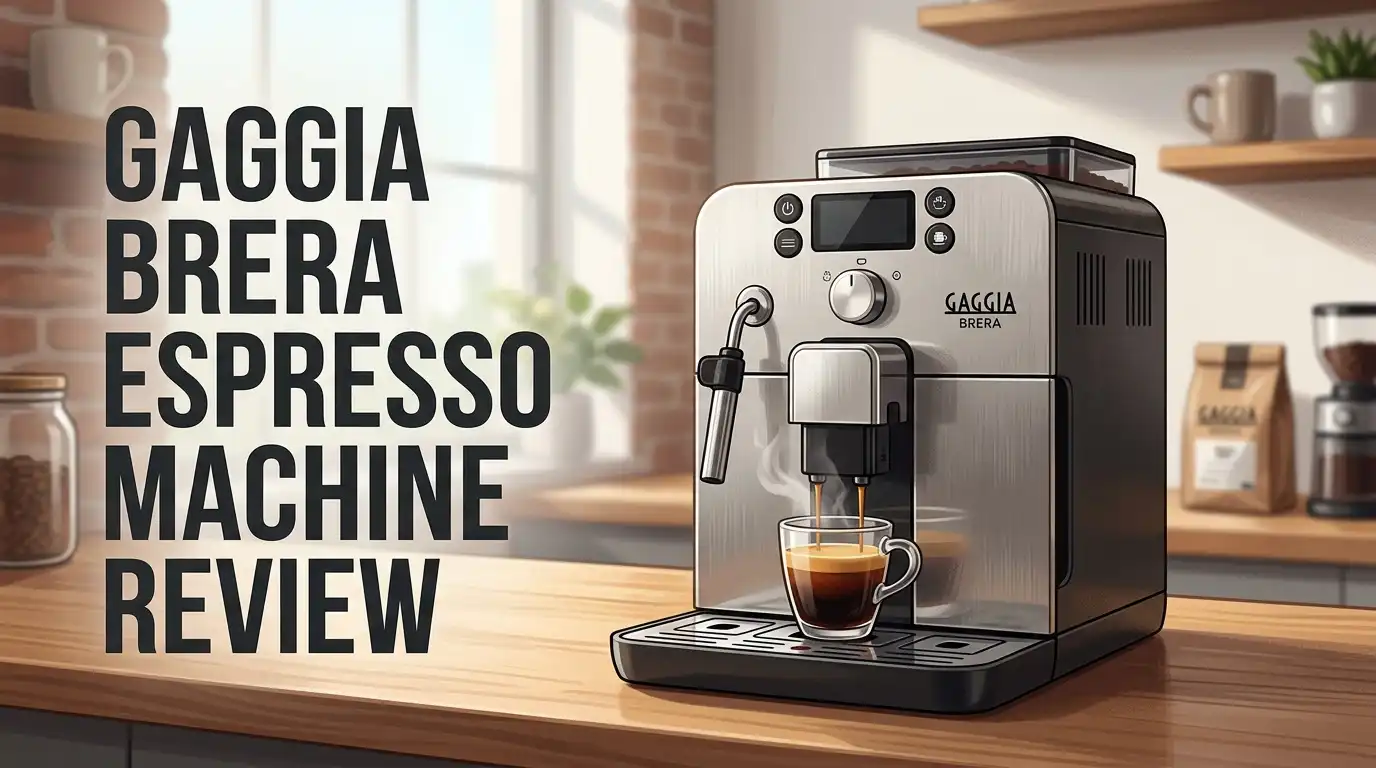
Gaggia Brera Espresso Machine Review 2026: Still Worth It?
The Gaggia Brera has been sitting on kitchen counters since 2010, and it still sells hundreds of units every month. That is unusual for a machine this old. Most super automatic espresso machines get replaced every three or four years.
So why does this little Italian machine keep hanging around? I spent several weeks pulling shots, steaming milk, and cleaning the brew group to find out. I also dug through owner reports going back a decade, because a machine this old has a paper trail that newer models simply do not have.
This review covers the good parts and the annoying parts. The Brera makes genuinely tasty espresso for the money. It also has a flimsy steam wand, a tiny water tank, and a leak problem that shows up after a few years. You deserve to know both sides before you spend your money.
In A Nutshell:
- The espresso quality punches above the price. Once I reduced the shot volume to around 1.5 ounces, the Brera produced thick crema and a sweet, balanced cup. The 15 bar pump and automatic pre infusion do real work here. Pre infusion is standard, not an upgrade, which is rare at this price.
- It is the smallest real super automatic you can buy. At 12.4 inches tall, 10 inches wide, and 18 pounds, it slides under most kitchen cabinets. Studio apartments, dorm rooms, and office break rooms all work.
- The build quality is mostly plastic. The front panel is stainless steel. Almost everything else is black ABS plastic, including the guts of the steam wand. This machine will not outlast you.
- Milk drinks need your hands. You get a pannarello wand, not an automatic milk carafe. Only espresso and lungo are one touch. Cappuccino and latte require manual steaming every single time.
- Five grind settings feel limiting. Competitors offer 12 or 13. In my testing, moving between settings barely changed the cup, which suggests the adjustment range is narrow.
- Leaks are the most common long term complaint. Owners report water pooling under the machine after two or three years. New o rings and brew group lubricant fix it for about twenty dollars.
Gaggia Brera Super Automatic Espresso Machine


Last update on 2026-11-19 / Affiliate links / Images from Amazon Product Advertising API
The Brera is a bean to cup machine built in Italy. It grinds, tamps, brews, and ejects the puck without any input from you. Gaggia lists it at $499 direct, though street prices swing between $400 and $630 depending on the season.
Inside you get a flat ceramic burr grinder, a stainless steel lined aluminum thermoblock boiler, and a removable brew group. The water reservoir holds 1.2 liters. The bean hopper takes 8.8 ounces of whole beans.
Gaggia calls the brain of the machine the Adapting System. It adjusts grind time based on your chosen strength and the beans you load. In practice this means the machine learns your coffee over two or three cycles and then stays consistent.
The drink list is short. Espresso and espresso lungo are programmed. Hot water and steam come from the wand. Everything else is on you.
Unboxing Experience: What Actually Arrives
The box is compact and surprisingly light for an espresso machine. Mine weighed in around 21 pounds with packaging. One person can carry it from the doorstep to the counter without help.
Gaggia keeps the presentation simple. The machine sits in molded foam with a plastic sleeve over the body. There is no fancy magnetic lid or tissue paper. This is a working appliance, not a luxury unboxing.
Accessories are thin. You get a measuring scoop for pre ground coffee, a small tube of food grade lubricant for the brew group, and the instruction manual. That is genuinely all of it.
No water filter is included. No descaling solution. No milk pitcher. No cleaning tablets. Budget another $40 to $60 for the Mavea Intenza filter, a stainless steel frothing pitcher, and descaler. Gaggia clearly cut these to hit the price point, and it stings a little.
Design And Build Quality Assessment
The Brera looks like a small radio from the 1970s, in a good way. Rounded corners replace hard angles. The silver version photographs well and reads as more expensive than it is.
The brushed stainless steel front plate is the highlight. It feels solid and resists fingerprints better than glossy plastic. Side panels are a different story. They are ABS plastic and they flex when you press them.
The steam wand disappointed me most. Gaggia wrapped brushed metal around a black plastic core. It wobbles in the hand and it does not sit on a ball joint, so positioning a pitcher takes patience.
Nothing on my unit rattled or misaligned. Panel gaps were tight and the drawers slid smoothly. Still, the overall impression is a well assembled machine made from inexpensive materials rather than a durable one.
Top 3 Alternative for Gaggia Brera

Last update on 2026-11-19 / Affiliate links / Images from Amazon Product Advertising API
Gaggia Magenta Plus Super Automatic Espresso Machine

Last update on 2026-11-19 / Affiliate links / Images from Amazon Product Advertising API
Philips 3200 Series Fully Automatic Espresso Machine with LatteGo

Last update on 2026-11-19 / Affiliate links / Images from Amazon Product Advertising API
De’Longhi Magnifica Evo Automatic Espresso Machine
Ceramic Flat Burr Grinder Performance
Ceramic burrs are the right call for a machine at this price. They stay sharp for years and they transfer less heat into the beans during grinding. Cooler grounds mean the aromatics survive to reach your cup.
The grinder is quiet by super automatic standards. It runs for roughly six seconds per shot and pulls about 10 grams of coffee at full strength. Ten grams is a single dose, so do not expect double shot volume from one cycle.
Five grind settings are the weak point. You adjust them with a key inside the hopper while the grinder runs. Moving from setting one to setting five changed my shots far less than I expected, which tells me the range between coarse and fine is quite narrow.
Oily dark roasts are also a risk. Several owners report the hopper jamming with very oily beans, so medium roasts perform more reliably here.
Espresso Taste And Shot Quality
This is where the Brera earns its reputation. My first shots at factory settings tasted thin and watery. That is normal and easy to fix.
I set aroma strength to three beans, then reprogrammed the shot volume down to roughly 1.5 ounces. The difference was immediate. Crema became thick and hazelnut colored, and the body filled out properly.
Automatic pre infusion deserves credit. The machine wets the puck, pauses, then applies full pressure. This releases carbon dioxide and produces a more even extraction. Machines twice this price sometimes skip it.
Shot to shot consistency impressed me. Twenty cups in a row landed within a few seconds of each other. The temperature held steady too, thanks to the thermoblock.
Is it specialty cafe quality? No. A manual machine with a good grinder still wins on clarity and nuance. But for pushing one button before work, the result is genuinely enjoyable.
Milk Frothing With The Pannarello Wand
The pannarello is a training wheel for milk. It sucks air in automatically through a small hole, which means you cannot really fail at making foam. You also cannot make proper microfoam for latte art.
Gaggia’s Rapid Steam Technology heats the wand in under 10 seconds. That is fast. You press the steam button, wait for the light, purge a little water, and go.
The foam it produces is airy and stiff, closer to cappuccino foam than latte texture. It sits on top of the espresso rather than blending into it. Fine for cappuccinos, less ideal for flat whites.
The wand length is only 2.5 inches of usable steel. Tall pitchers do not fit well, and the limited pivot makes swirling awkward. Experienced baristas can remove the pannarello sleeve to expose the bare tip, which improves texture noticeably.
Cleaning matters here. Milk dries inside the sleeve fast, so purge and wipe after every drink.
Control Panel And Daily Operation
There is no touchscreen and no app. You get a small display with colored icons and a handful of physical buttons. Gaggia never updated this interface, and in 2026 it looks dated.
The learning curve is short but real. Coffee bean symbols represent strength, one for mild and three for strong. A scoop icon means the machine expects pre ground coffee in the bypass chute.
Daily use is simple. Press power, wait roughly 40 seconds for heating, then press espresso or lungo. The machine rinses itself at startup and shutdown, which keeps the group clean.
Programming a cup size is easy. Hold the drink button, release when your cup reaches the right level, and the machine remembers it. The memo function stores one setting per drink, not separate user profiles, so a household with different tastes will overwrite each other constantly.
Water Tank, Dreg Drawer And Cup Clearance
Both the water tank and the dreg drawer pull out from the front. That matters if your machine lives under a cabinet, because you never need to reach over the top.
The 1.2 liter tank is small. Two people drinking milk drinks will refill it every day or two. The dreg drawer holds only 8 pucks, which is the lowest capacity in this class. Expect to empty it twice a week at minimum.
Cup clearance is the bigger limitation. The adjustable spout gives you 4.5 inches of height at maximum. A standard travel mug will not fit. Latte glasses often will not fit either.
The workaround is brewing into a small cup and pouring up. Annoying, but liveable. If travel mugs are part of your routine, look at a taller machine instead.
Cleaning, Descaling And Brew Group Care
The removable brew group is the Brera’s best long term feature. It pops out of a side door in seconds. Rinse it under warm water, let it dry, and grease the shaft with the included lubricant every month or two.
Skipping lubrication causes most Brera failures. Owners who grease regularly report five to ten years of service. Owners who never open the side door report grinding noises and error codes within two years.
Descaling is automatic on units made after 2013. The machine flashes a warning, you add solution to the tank, and you follow the prompts. Gaggia recommends its own descaler, though many owners use citric acid based alternatives.
Nothing goes in the dishwasher. Not the brew group, not the drip tray, not the hopper. A damp cloth and mild soap handle everything. Total weekly upkeep runs about ten minutes.
Known Problems And What The Brera Does Not Do Well
Honest reviews list the failures, so here they are.
Internal leaking is the number one complaint. After two or three years, water starts appearing under the machine or filling the drip tray too fast. The cause is usually worn o rings on the brew group and the water inlet behind it. A twenty dollar o ring kit plus fresh lubricant solves it, and the repair takes about thirty minutes.
The pre ground bypass is poorly designed. Scoops of coffee sometimes fall straight through the chute into the machine, producing hot coffee flavored water instead of espresso.
Other real weaknesses include a one year warranty when rivals offer two, no temperature adjustment at all, no water filter in the box, and grinder noise that will wake a sleeping household. Scarce authorized repair shops make out of warranty service difficult in rural areas.
Pros And Cons Of The Gaggia Brera
Pros
- Excellent espresso quality for the price, with thick crema and consistent shot to shot results
- Automatic pre infusion comes standard, which improves extraction noticeably
- Smallest footprint of any true super automatic, fitting under standard cabinets
- Durable flat ceramic burrs that resist heat transfer and stay sharp
- Removable brew group makes deep cleaning and long term repair realistic
- Front loading water tank and dreg drawer for cabinet friendly access
- Steam wand heats in under 10 seconds thanks to Rapid Steam Technology
- Pre ground bypass lets you brew decaf without emptying the hopper
- Made in Italy with widely available replacement parts
Cons
- Heavy use of ABS plastic, including inside the steam wand
- Only five grind settings, and the range between them feels narrow
- Just two one touch drinks, so every milk beverage needs manual work
- 4.5 inch cup clearance blocks travel mugs
- Small 1.2 liter tank and tiny 8 puck dreg drawer
- No water filter, descaler, or milk pitcher included
- Leak prone o rings after a few years of daily use
- One year warranty and no temperature control
- Dated icon based display with a short learning curve
Gaggia Brera Versus The Competition
The Gaggia Magenta Plus sits one step up. It uses the same five setting ceramic grinder but adds a bigger 1.8 liter tank, a color display, and more programmed drinks. Expect to pay roughly $200 more.
The Philips 3200 LatteGo costs about the same as the Brera and offers 12 grind settings, a 1.8 liter tank, a two year warranty, and the LatteGo carafe for genuine one touch cappuccino. Its plastic body is bulkier and less charming, but the feature sheet wins.
The De’Longhi Magnifica Evo brings 13 grind settings, a touch display, and cold foam. It costs more and takes up more counter space.
Here is the honest summary. The Brera wins on size, espresso character, and repairability. It loses on milk automation, grind control, and warranty length.
Who Should Buy The Gaggia Brera In 2026
Buy the Brera if you mainly drink straight espresso, americano, or the occasional cappuccino, and counter space is tight. That combination is exactly what this machine was built for.
It also suits people who enjoy light maintenance. If opening a side door and greasing a brew group sounds fine rather than tedious, the Brera will reward you with many years of service.
Skip it if your household drinks lattes every morning. Manual frothing four times before work gets old quickly, and a carafe based machine will make you happier.
Also skip it if you want deep control over grind size and brew temperature. Five grind settings and a fixed temperature are not enough for anyone who likes tinkering.
Travel mug users should look elsewhere entirely. The 4.5 inch clearance is a hard limit with no workaround.
Final Verdict On The Gaggia Brera
Last update on 2026-11-19 / Affiliate links / Images from Amazon Product Advertising API
The Gaggia Brera earns a solid recommendation with clear conditions attached. It makes better espresso than its price suggests, it fits where bigger machines cannot, and it can be repaired at home for the cost of a few coffees.
The plastic construction and flimsy steam wand keep it from greatness. So does the short drink list. This is a competent espresso maker, not a full cafe replacement.
My score is 7.8 out of 10 for value, and about 6.5 out of 10 for build quality.
Sixteen years on the market is meaningful evidence. Machines that fail constantly disappear. The Brera stayed because it does one job well and because owners can keep it running. For a first super automatic, that combination is hard to argue with.
Frequently Asked Questions
How long does the Gaggia Brera last?
Owners who lubricate the brew group monthly and descale on schedule regularly report five to ten years of daily use. Owners who skip maintenance often see grinder faults or leaks within two years. Maintenance matters more than anything else with this machine.
Can the Gaggia Brera make a latte or cappuccino?
Yes, but not automatically. You brew espresso with one button, then steam milk separately using the pannarello wand. The wand produces stiff foam rather than silky microfoam, so cappuccino comes out better than a flat white.
Why is my Gaggia Brera leaking water?
Worn o rings are the usual cause, specifically the large seal on the brew group and the two smaller seals on the water inlet behind it. A replacement kit costs around twenty dollars. Lubricating the brew group shaft often helps as much as the new seals.
Does the Gaggia Brera use pods or capsules?
No. It is a bean to cup machine with an internal ceramic burr grinder. You can also add pre ground coffee through the bypass chute, though that chute is finicky and sometimes drops grounds past the brew chamber.
What grind setting should I use on the Brera?
Start at the middle setting and leave it there for your first several drinks, as Gaggia recommends. If shots run fast and thin, move one step finer. Reducing shot volume to roughly 1.5 ounces improves taste more than grind changes do.
Is the Gaggia Brera loud?
The grinder is noticeable for about six seconds per shot. It is quieter than most steel burr grinders but still loud enough to hear through a closed door. Early risers in shared homes should keep that in mind.

Hi, I’m Emma Lee — the coffee-obsessed creator behind Morning Drip Vault. I spend my days testing coffee machines, exploring brewing techniques, and reviewing the latest coffee gear. My mission is simple: helping you find the perfect machine to brew your best cup, every single morning.