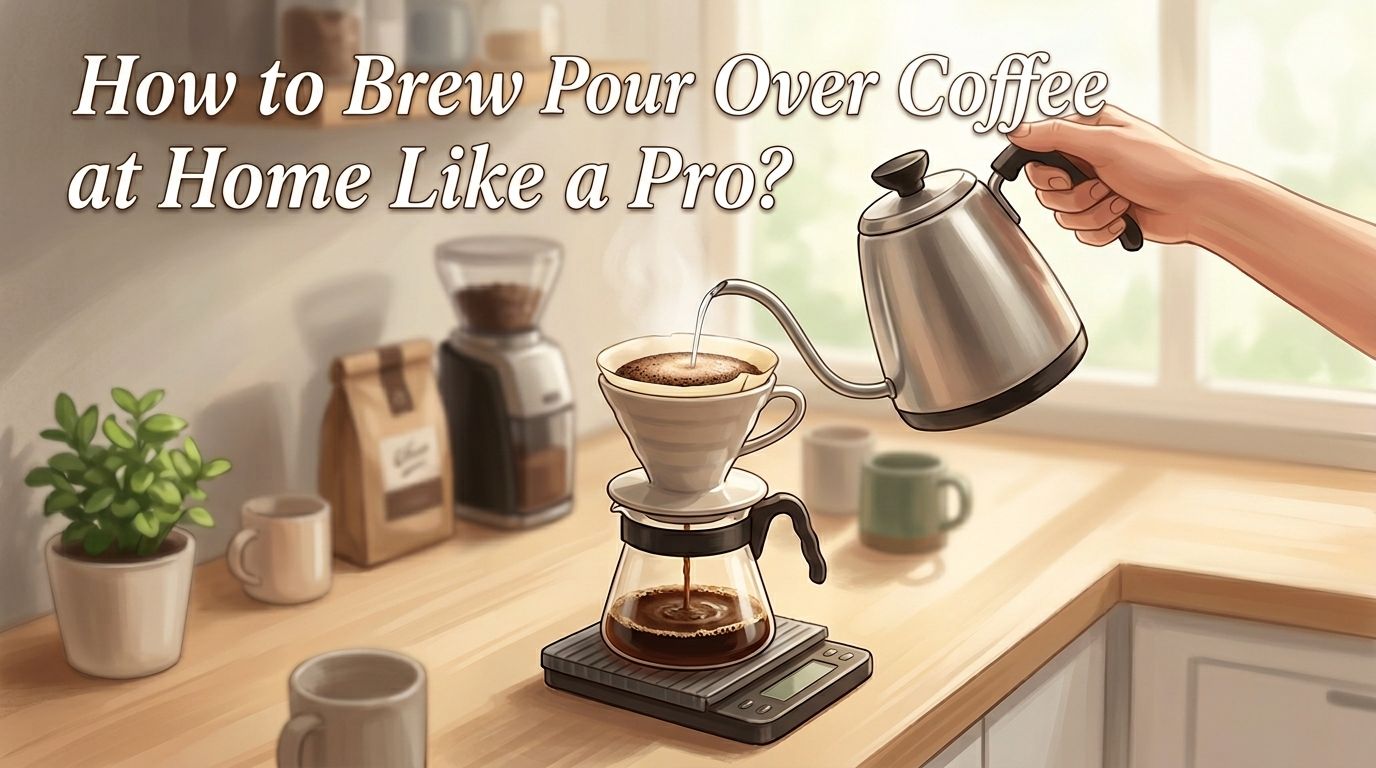
How to Brew Pour Over Coffee at Home Like a Pro?
You just bought a pour over dripper, a bag of specialty beans, and now you are staring at them with no idea where to start. Sound familiar? Pour over coffee looks simple on the surface.
You pour hot water over ground coffee and let gravity do the work. But the difference between a flat, bitter cup and a bright, flavorful one comes down to small details most people overlook.
This guide walks you through every step of the pour over process. You will learn the right grind size, water temperature, ratio, pouring technique, and more.
In a Nutshell
- Start with fresh, whole bean coffee. Pre ground coffee loses flavor fast due to oxidation. Grinding your beans right before brewing makes the biggest single improvement to your cup quality.
- Use a coffee to water ratio between 1:15 and 1:17 by weight. For a standard single cup, that means roughly 18 grams of coffee to 300 grams of water. A kitchen scale is the most useful tool you can add to your setup.
- Heat your water to 195°F to 205°F (90°C to 96°C). Water that is too hot will over extract your coffee and create bitterness. Water that is too cool will under extract it and leave you with a sour, flat taste.
- Always bloom your coffee first. Pour about twice the weight of your coffee in water (for example, 36 grams of water for 18 grams of coffee) and wait 30 to 45 seconds. This releases trapped carbon dioxide and allows the water to extract flavor evenly.
- Aim for a total brew time of 3 to 4 minutes. If your brew drains too fast, your grind is too coarse. If it takes too long, your grind is too fine. Use brew time as your guide for dialing in the perfect grind size.
- Choose the right dripper for your skill level. The Kalita Wave is the most forgiving for beginners. The Hario V60 gives advanced brewers maximum control. The Chemex produces a clean, delicate cup and brews larger volumes well.
How to Choose the Right Pour Over Dripper for Your Brewing Style
The dripper you pick affects flow rate, extraction, and how much technique you need. Three drippers dominate the pour over space: the Hario V60, the Kalita Wave, and the Chemex. Each one has a different design and produces a slightly different cup.
The Hario V60 has a single large hole at the bottom and spiral ridges inside. It gives you full control over flow rate, but it requires a precise pouring technique. The Kalita Wave has a flat bottom with three small drain holes. This design slows the water down and makes extraction more even, even if your pour is not perfect. The Chemex uses thick paper filters and a wider design, which removes more oils and produces a very clean cup.
Pros of V60: Maximum flavor clarity and control.
Cons of V60: Steep learning curve and less forgiving of mistakes.
Pros of Kalita Wave: Consistent results and beginner friendly.
Cons of Kalita Wave: Slightly less flavor complexity than the V60.
Pros of Chemex: Great for multiple cups and a very clean taste.
Cons of Chemex: Thick filters can mute some flavors, and the carafe is fragile.
How to Pick the Best Coffee Beans for Pour Over Brewing
Your beans matter more than your equipment. Pour over brewing highlights the origin characteristics of coffee better than most methods. Light to medium roast beans tend to shine in a pour over because the method preserves bright, fruity, and floral notes.
Look for beans with a roast date printed on the bag. Coffee tastes best between 7 and 30 days after roasting. After that window, the flavors fade. Single origin beans from regions like Ethiopia, Colombia, or Kenya often offer interesting flavor profiles that pour over brewing brings out well.
Dark roasts can work, but they tend to taste smoky and one dimensional in a pour over. If you enjoy dark roasts, a French press or espresso machine may serve those beans better. Freshness is the number one factor that determines flavor quality in your cup.
How to Grind Coffee Beans to the Perfect Size for Pour Over
Grind size controls how fast water passes through your coffee bed and how much flavor it extracts. For most pour over drippers, you want a medium fine grind. It should look similar to table salt or fine sea salt.
A burr grinder produces a much more consistent grind than a blade grinder. Blade grinders chop beans unevenly, creating a mix of dust and large chunks. This causes some coffee to over extract (bitter) and some to under extract (sour) at the same time. Even an entry level burr grinder will improve your results.
Pros of burr grinders: Consistent particle size and adjustable settings.
Cons of burr grinders: Higher upfront cost than blade grinders.
Pros of blade grinders: Cheap and widely available.
Cons of blade grinders: Inconsistent grind and less control over extraction.
If your final cup tastes bitter, try a slightly coarser grind. If it tastes sour or weak, go slightly finer. Small adjustments make a big difference.
How to Measure the Correct Coffee to Water Ratio Every Time
Guessing your ratio leads to inconsistent results. The standard starting point for pour over coffee is 1:16, which means 1 gram of coffee for every 16 grams of water. Some people prefer a stronger cup at 1:14 or a lighter cup at 1:17.
For a single cup, use 18 grams of coffee and 288 grams of water (roughly 1:16). A digital kitchen scale that reads in grams is essential here. Measuring by volume with tablespoons is unreliable because different coffees have different densities.
Consistency is the real goal. Once you find a ratio you enjoy, you can replicate it every morning. Write down your recipe. Track what works. This simple habit turns a random cup into a repeatable great one.
If you do not own a scale, a rough guide is about 2 rounded tablespoons of coffee per 6 ounces of water. But investing in a scale will improve your pour over results more than almost any other piece of equipment.
How to Heat Water to the Ideal Temperature for Pour Over Coffee
Water temperature affects extraction speed and flavor balance. The sweet spot is between 195°F and 205°F (90°C to 96°C). Water at a full boil (212°F / 100°C) is too hot and will pull harsh, bitter compounds from your coffee.
If you do not have a temperature controlled kettle, bring your water to a boil and then let it sit for 30 to 60 seconds. This brings it into the correct range. A gooseneck kettle is strongly recommended because it gives you a slow, controlled pour that a regular kettle cannot match.
Pros of gooseneck kettle: Precise flow control, better pour accuracy.
Cons of gooseneck kettle: Costs more than a standard kettle, smaller capacity.
Pros of standard kettle: Affordable and already in most kitchens.
Cons of standard kettle: Hard to control flow rate, which causes uneven extraction.
Lighter roast coffees generally benefit from hotter water because they are denser and harder to extract. Darker roasts extract more easily, so slightly cooler water (closer to 195°F) can prevent bitterness.
How to Bloom Your Coffee Grounds for Better Flavor Extraction
Blooming is one of the most important steps in pour over brewing, and many beginners skip it. When hot water first hits fresh coffee grounds, carbon dioxide escapes rapidly. This gas creates bubbles and pushes water away from the coffee, which blocks proper extraction.
To bloom, pour twice the weight of your coffee in water over the grounds. If you used 18 grams of coffee, pour 36 grams of water. Pour slowly and evenly to wet all the grounds. Then wait 30 to 45 seconds before you continue.
You will see the coffee bed swell and bubble during the bloom. The fresher your beans, the more dramatic the bloom will be. If your coffee barely bubbles at all, your beans may be stale.
Skipping the bloom leads to uneven extraction and a cup that tastes flat. This quick pause lets the CO2 escape so the remaining water can make full contact with the coffee and pull out the good flavors.
How to Pour Water Correctly Using the Right Technique
Your pouring technique directly shapes the flavor of your cup. After the bloom, begin pouring water in a slow, steady, circular pattern starting from the center and moving outward. Avoid pouring directly on the edges of the filter.
Pour in stages rather than all at once. Many recipes call for 3 to 4 separate pours with brief pauses between them. For example, after blooming with 36 grams, pour to 150 grams, pause for 15 seconds, pour to 225 grams, pause again, and then finish at 288 grams.
Keep your stream thin and consistent. A gooseneck kettle makes this much easier. Pouring too fast floods the coffee bed, which causes the water to channel through weak spots instead of extracting evenly. Pouring too slowly can cause over extraction in certain areas.
Try to keep the water level in the dripper relatively steady rather than letting it drain completely between pours. This maintains a consistent brewing temperature throughout the process.
How to Fix Bitter or Sour Pour Over Coffee
Bitter and sour coffee are the two most common problems, and both have clear fixes. Bitter coffee means over extraction. The water pulled too many compounds from the grounds. Sour coffee means under extraction. The water did not pull enough.
To fix bitter coffee, try a coarser grind, lower water temperature, or a faster pour. Any of these changes will reduce extraction. You can also try shortening your total brew time.
To fix sour coffee, try a finer grind, hotter water, or a slower pour. These changes increase extraction and bring out the sweetness and balance that a good pour over should have.
If your coffee tastes both bitter and sour at the same time, your grind is likely inconsistent. This produces a mix of over extracted fine particles and under extracted large particles. Switching to a quality burr grinder usually solves this.
How to Rinse Your Paper Filter Before Brewing (And Why It Matters)
Paper filters can add a papery taste to your coffee if you skip the rinse. Before adding your coffee grounds, place the filter in the dripper and pour hot water through it. This removes the paper taste and also preheats your dripper and mug.
Discard the rinse water from your mug or server before you start brewing. This step takes less than 30 seconds but makes a noticeable difference in cup cleanliness.
Chemex filters are thicker and benefit even more from a thorough rinse than thinner V60 or Kalita filters. Some brewers rinse twice to make sure all paper residue is gone.
Metal filters are an alternative to paper. They let more oils and fine particles through, producing a fuller body similar to French press coffee. However, the cup will be less clean and bright compared to a paper filtered pour over.
How to Time Your Pour Over Brew for Consistent Results
Total brew time is one of the best indicators of whether your extraction is on track. Most pour over recipes aim for 3 to 4 minutes from the first pour to the last drip. A timer on your phone or a dedicated coffee scale with a built in timer works well.
If your brew finishes in under 2:30, your grind is probably too coarse and the coffee will taste thin and sour. If it takes longer than 4:30, your grind is likely too fine and the coffee will taste heavy and bitter.
Write down your brew time alongside your grind setting, ratio, and tasting notes. This log helps you make small adjustments and zero in on your ideal cup over time. Consistency comes from tracking variables and changing only one thing at a time.
The bloom phase counts as part of your total brew time. Start your timer when you begin pouring the bloom water.
How Pour Over Coffee Compares to French Press and Drip Machines
Each brewing method has strengths and trade offs. Pour over coffee produces a clean, bright cup with clear flavor notes because the paper filter removes oils and sediment. French press produces a fuller, heavier body because the metal mesh filter lets oils and fine particles into the cup.
Drip machines automate the process and brew larger volumes with little effort. However, most drip machines do not offer the same level of control over water temperature, flow rate, or bloom timing that a manual pour over does.
Pros of pour over: Clean taste, high flavor clarity, full control over every variable.
Cons of pour over: Requires hands on attention and takes more time.
Pros of French press: Rich body, easy technique, no paper filters needed.
Cons of French press: Sediment in the cup, can taste muddy, harder to highlight delicate flavors.
Pros of drip machine: Convenient, brews multiple cups, no skill required.
Cons of drip machine: Less control, often produces a generic tasting cup.
If you enjoy tasting the unique character of different coffee origins, pour over is the best method for you. It rewards attention and lets the coffee speak for itself.
How to Clean and Maintain Your Pour Over Equipment
Keeping your equipment clean protects the flavor of every cup you brew. Old coffee residue builds up over time and adds stale, rancid flavors to fresh brews. After each use, discard the used filter and grounds, then rinse the dripper with hot water.
For glass Chemex carafes, use a bottle brush and warm soapy water once a week. Rinse thoroughly to remove all soap. Ceramic and plastic drippers are easy to clean under running water.
Clean your gooseneck kettle regularly too. Mineral deposits from hard water can accumulate inside. A mixture of equal parts water and white vinegar, boiled inside the kettle and left to sit for an hour, removes most buildup.
If you use a metal filter, scrub it gently with a soft brush after each use. Coffee oils cling to metal more than paper and can turn rancid if left uncleaned.
Frequently Asked Questions
How many tablespoons of coffee do I need for one cup of pour over?
Use about 2 rounded tablespoons of ground coffee for every 6 ounces of water. For more accurate results, weigh your coffee using a digital scale and aim for 18 grams of coffee to 288 grams of water.
How long should pour over coffee take to brew?
A standard pour over should take between 3 and 4 minutes from the first pour to the last drip. If it drains faster, use a finer grind. If it drains slower, use a coarser grind.
Can I use pre ground coffee for pour over?
You can, but the results will not match freshly ground beans. Pre ground coffee loses aroma and flavor quickly after grinding. If you must use pre ground, choose a medium fine grind and use it as soon as possible after opening the package.
Do I really need a gooseneck kettle for pour over coffee?
A gooseneck kettle is not strictly required, but it is highly recommended. The thin, controlled spout lets you pour slowly and evenly. A regular kettle pours too fast and makes it hard to maintain even extraction across the coffee bed.
What is the best water to use for pour over coffee?
Use filtered water with some mineral content. Distilled water lacks minerals that help extract flavor from coffee. Very hard water can taste chalky and dull. Filtered tap water works well for most people.
Why does my pour over coffee taste watery?
Watery pour over usually means under extraction. Your grind may be too coarse, your water may be too cool, or you may not be using enough coffee. Try a finer grind, hotter water, or a stronger ratio like 1:14 or 1:15.

Hi, I’m Emma Lee — the coffee-obsessed creator behind Morning Drip Vault. I spend my days testing coffee machines, exploring brewing techniques, and reviewing the latest coffee gear. My mission is simple: helping you find the perfect machine to brew your best cup, every single morning.