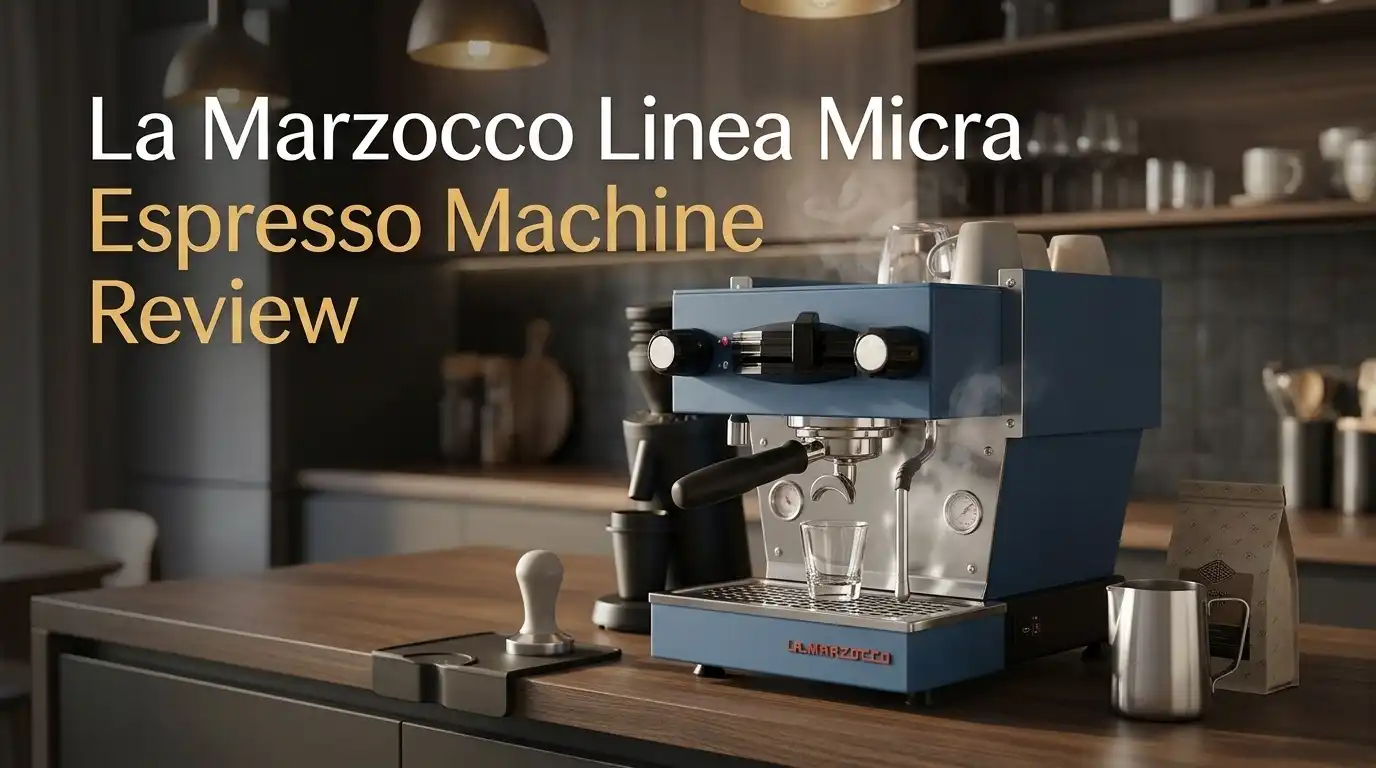
La Marzocco Linea Micra Espresso Machine Review 2026: Worth It?
The La Marzocco Linea Micra sits on a kitchen counter and quietly changes how your mornings feel. It is small, heavy, and built like a café machine that someone shrank in a workshop.
People who buy it rarely talk about specifications. They talk about how the first shot tasted and how fast they stopped thinking about upgrading.
This review covers two years of owner feedback, hands on testing reports, and the real quirks nobody mentions in the glossy product photos.
In a Nutshell:
- The espresso quality is genuinely commercial grade. The Micra uses dual boilers, PID temperature control, and a rotary pump. Testers who pulled over 200 shots reported consistent, repeatable results with almost no sink shots once dialed in.
- It heats up in a few minutes, not thirty. The small 0.25 liter coffee boiler sits downstream of the 1.6 liter steam boiler, so water arrives preheated. You get fast startup plus stability during back to back shots.
- Cup clearance is the biggest daily annoyance. You get roughly three inches under the portafilter spouts. Tall travel mugs and large Americano glasses will not fit. You pull into small cups and pour across.
- The steam wand is powerful but short. Steam pressure rivals café machines. The three inch wand makes small milk volumes awkward because the tip grazes the surface and adds extra foam.
- There is no shot timer built into the machine. At this price that omission stings. You will use a phone, a scale, or the app.
- Expect $4,500 plus accessories. Add a capable grinder, a scale, and a tamper. Budget closer to $6,000 for a complete setup.
What Is the La Marzocco Linea Micra?

Last update on 2026-11-18 / Affiliate links / Images from Amazon Product Advertising API
The Linea Micra is La Marzocco’s smallest home espresso machine. The company built commercial equipment for cafés since 1927, and the Micra scales that engineering down to a 11.4 inch wide body. It launched as a compact sibling to the Linea Mini and borrows styling from the Linea Classic S found in coffee shops worldwide.
This is a semi automatic machine. You grind, you dose, you tamp, and you control the shot with a mechanical brew paddle. There is no built in grinder and no automatic milk system. The Micra assumes you want to learn espresso properly.
La Marzocco sells it in seven colors, including stainless steel, white, black, blue, and a few seasonal finishes. The current list price starts at $4,500 in the United States.
Unboxing the Linea Micra: First Impressions
The box arrives heavy. The machine weighs 42 pounds, and the packaging adds more, so plan on two people or a sturdy back. Inside you find thick foam cradles, a quality that already signals the price bracket.
La Marzocco includes the convertible portafilter, two filter baskets, a tamper, a stainless steel milk pitcher, a cleaning brush, a blind basket for backflushing, and the water softener cartridge. The accessories feel like real tools, not throwaway extras.
The first touch moment is the paddle. It clicks with a short, weighted movement that feels mechanical rather than electronic. Lifting the machine onto the counter is the hardest part of setup. Fill the 2 liter reservoir, plug it in, flip the switch, and the barista lights glow under the group head.
Build Quality and Materials
The Micra uses thick stainless steel panels rather than plastic housing. Tap the side and you hear a dull thud instead of a hollow rattle. The drip tray attaches magnetically and lifts off cleanly with one hand.
Inside, La Marzocco uses the same stainless boilers, brass fittings, and serviceable components found in its commercial line. That matters for longevity. Owners report years of daily use with nothing more than gasket replacements and routine descaling.
The integrated group head is machined as part of the coffee boiler. This removes the thermal gap that causes temperature drift in cheaper machines. Repairability is a quiet selling point here. Parts exist, technicians know the platform, and the machine was designed to be opened rather than discarded.
Top 3 Alternatives for La Marzocco Linea Micra

Last update on 2026-11-17 / Affiliate links / Images from Amazon Product Advertising API
Breville BES920XL Dual Boiler Espresso Machine

Last update on 2026-11-18 / Affiliate links / Images from Amazon Product Advertising API
Rocket Espresso Appartamento 2.0 Espresso Machine

Last update on 2026-11-18 / Affiliate links / Images from Amazon Product Advertising API
Rancilio Silvia Pro X Espresso Machine
Espresso Performance and Shot Quality
This is where the money goes. The Micra pulls espresso with a smoothness that experienced baristas notice immediately. Pressure stays steady from the first second to the last drop, so the flow you see on shot one matches shot five.
Dialing in becomes faster because the machine stops adding variables. With vibratory pump machines, two identical doses can produce different extraction times. The Micra removes that noise, so grind adjustments produce predictable results.
Reviewers who tested the machine daily for months described shots that tasted cleaner and sweeter than those from full sized commercial equipment they had operated professionally. Light roasts, medium roasts, and espresso blends all perform well. The 58mm basket matches café standards, so accessory baskets and distribution tools fit without hunting for odd sizes.
Dual Boiler System and Temperature Stability
The Micra runs two separate boilers. The 1.6 liter steam boiler handles milk and hot water. The 0.25 liter coffee boiler handles brewing only. You can steam and brew at the same time without either function weakening.
The clever part is the water path. Cold water from the reservoir passes through the steam boiler first, then enters the coffee boiler already hot. This preheating lets La Marzocco use a tiny coffee boiler that reaches temperature fast and recovers instantly.
PID control keeps brew temperature within a narrow band. Single boiler machines force you to wait minutes between brewing and steaming, and the shot cools while you stand there. The Micra eliminates that wait entirely, which is the single biggest workflow upgrade over sub $1,000 machines.
Steam Power and Milk Texture
Steam pressure on the Micra is remarkable for a machine this size. The boiler produces dry, forceful steam that spins milk into glossy microfoam in under twenty seconds for a cappuccino volume.
The insulated wand stays cool to the touch, so you can wipe it immediately without burning your fingers. The tip purges directly into the drip tray, which keeps the counter dry.
The wand length is the problem. At roughly three inches, it sits high relative to standard pitchers. When steaming small volumes, the tip grazes the milk surface and introduces more air than intended. You will steam a little extra milk to get the texture right, or angle the pitcher and reposition the wand until you find a comfortable groove. Most owners adapt within a week.
The Rotary Pump Advantage
Almost every home espresso machine under $3,000 uses a vibratory pump. Those pumps buzz loudly, shake the chassis, and deliver pressure that fluctuates slightly during extraction.
The Micra uses a rotary pump, the same type found in commercial machines. It runs quietly, produces steady pressure, and lasts far longer under daily use. The noise difference alone changes early morning routines in apartments.
Rotary pumps also allow optional plumbing. La Marzocco sells a plumb kit if you want to connect the machine to a water line and skip the reservoir refills. For most buyers the quiet operation is the real benefit. You hear a low hum instead of a rattling buzz, and the machine feels calm while it works.
Daily Workflow and Ease of Use
The control layout is deliberately minimal. There is a power switch, a steam knob, a hot water knob, and the brew paddle. No touchscreen, no menu diving, no preset drink buttons.
The convertible portafilter is a genuinely smart design. The plastic spouts twist off, turning it into a bottomless portafilter in seconds. Less metal also means faster preheating, around fifteen minutes instead of thirty.
Small details earn daily appreciation. A red bobber pops up when the drip tray fills, physically blocking your cup so you notice. Barista lights illuminate the extraction automatically. The machine stays out of your way, which is exactly what experienced users want from equipment at this level.
La Marzocco Home App and Smart Features
The Micra connects to the La Marzocco Home app over wifi. From your phone you can adjust coffee boiler temperature, change steam boiler pressure, set auto on and auto off schedules, trigger the automatic backflush cycle, and view how many shots you have pulled.
The scheduling feature is the one people actually use. Set the machine to wake at 6:30 and it is ready before you reach the kitchen. That turns a warmup wait into a nonissue.
Reviewers consistently report that initial pairing is slow and occasionally fussy. Once connected, the interface works simply. The app is convenient rather than essential. You can run the Micra perfectly without ever installing it, which says something about the hardware.
Where the Linea Micra Falls Short
Honest reviews name the flaws, so here they are without softening.
Cup clearance of three inches is the complaint owners repeat most. Standard café ceramics fit with a scooping motion. Larger glasses do not. If you drink big Americanos daily, this machine will irritate you.
There is no shot timer on the machine body. The newer Linea Mini R includes one, and its absence here feels like a gap at $4,500. You will buy an accessory timer or use a scale.
The Micra also offers no pressure profiling and no flow control. Competing machines at lower prices give you those levers. The Micra trades adjustability for consistency. Some enthusiasts find that limiting rather than freeing, and that is a fair criticism.
Cleaning and Maintenance
Daily cleaning takes under two minutes. Wipe the steam wand, purge it, knock out the puck, rinse the basket, and flush the group head with the paddle.
Weekly maintenance means a chemical backflush. The app runs an automated cycle that handles the timing for you while you scrub the shower screen and portafilter by hand. That automation genuinely saves effort.
Annual care includes replacing the group gasket, checking the diffuser screen, inspecting the basket spring, and testing for leaks. Water quality matters enormously. Use filtered or softened water from day one. Scale is the main killer of expensive espresso machines, and prevention costs far less than a boiler repair.
Linea Micra vs Linea Mini: Which One?
The Linea Mini costs roughly $2,000 more and weighs nearly twice as much. It targets semi commercial use, with a larger boiler, better cup clearance, and on the newer Mini R, a built in shot timer and brew by weight support.
The Micra is 30 percent smaller and heats faster. It fits under standard kitchen cabinets, which the Mini often does not. Shot quality between the two is closely matched, and most blind tasters cannot separate them.
Choose the Mini if you serve many drinks, want a shot timer, or need taller cup space. Choose the Micra if counter space, heat up speed, and budget matter more. For single person and couple households, the Micra usually makes more sense.
Pros and Cons of the La Marzocco Linea Micra
Pros
- Commercial grade build with thick stainless steel, serviceable internals, and a repair friendly design that supports years of daily use.
- Dual boilers with PID control deliver excellent temperature stability and let you brew and steam at the same time without compromise.
- Rotary pump runs quietly, maintains steady pressure, and outlasts the vibratory pumps used in most home machines.
- Fast heat up time thanks to the small preheated coffee boiler, so you brew within minutes instead of waiting half an hour.
- Convertible portafilter switches between single spout, double spout, and bottomless with a quick twist.
- Thoughtful details including barista lights, a magnetic drip tray, a full tray indicator, and app based scheduling.
Cons
- Only three inches of cup clearance, which rules out tall mugs and larger glasses entirely.
- Short steam wand makes small milk volumes awkward and tends to add unwanted foam.
- No built in shot timer, an obvious omission at this price point.
- No flow control or pressure profiling for enthusiasts who want to shape extractions.
- App pairing is slow and the connection occasionally needs a retry.
- High total cost once you add a grinder, scale, and water treatment.
Who Should Buy the Linea Micra?
Last update on 2026-11-18 / Affiliate links / Images from Amazon Product Advertising API
Buy the Micra if you already pull espresso daily, own a capable grinder, and want to stop upgrading equipment. This machine ends the upgrade cycle for most people. Owners two years in report zero service calls and no desire to replace it.
It suits small kitchens, apartments, and anyone who values quiet operation. It suits milk drink lovers who want café texture every morning. It suits people who appreciate objects built to be repaired.
Skip it if you are new to espresso. A $500 machine teaches the same fundamentals. Skip it if you want one touch convenience, since the Micra demands technique. Skip it if tall travel mugs are your daily vessel, because the clearance will frustrate you every single day.
Final Verdict: Is the Linea Micra Worth It in 2026?
The Linea Micra does one thing extremely well. It removes barriers between you and a good shot of espresso. Temperature holds steady, pressure stays smooth, steam arrives instantly, and the machine behaves identically on Monday and on Friday.
That consistency is what $4,500 actually buys. It will not make bad beans taste good, and it will not compensate for a weak grinder. It will reward good technique with repeatable results.
The flaws are real and worth weighing. Low clearance, a short wand, and no shot timer are genuine design compromises. For serious home baristas with the budget, the Micra remains one of the finest compact espresso machines available. For everyone else, excellent coffee costs far less.
Frequently Asked Questions
How much does the La Marzocco Linea Micra cost?
The Micra starts around $4,500 in the United States, with pricing varying by color and finish. Special editions cost more. Plan an additional $800 to $1,500 for a quality espresso grinder.
How long does the Linea Micra take to heat up?
Most owners report usable brewing temperature within five to ten minutes. For fully stable shots, allow fifteen to twenty minutes so the portafilter and group head reach equilibrium.
Does the Linea Micra have a built in grinder?
No. The Micra is a dedicated espresso machine with no grinder. You need a separate burr grinder capable of espresso fineness to get good results.
Can you plumb the Linea Micra to a water line?
Yes. La Marzocco sells an optional plumb kit. The rotary pump supports direct connection, though most owners simply refill the 2 liter reservoir.
What size portafilter does the Linea Micra use?
It uses a standard 58mm portafilter, so most aftermarket baskets, puck screens, distribution tools, and tampers fit without compatibility issues.
Is the Linea Micra loud?
No. The rotary pump runs noticeably quieter than the vibratory pumps in most home machines. You hear a low hum rather than a loud buzz.
How often should you descale the Linea Micra?
Use softened or filtered water and follow La Marzocco’s guidance based on your water hardness. Most home users service the machine annually, replacing the group gasket and checking the screens.

Hi, I’m Emma Lee — the coffee-obsessed creator behind Morning Drip Vault. I spend my days testing coffee machines, exploring brewing techniques, and reviewing the latest coffee gear. My mission is simple: helping you find the perfect machine to brew your best cup, every single morning.