Meraki Espresso Machine Review 2026: Worth It?
Home espresso usually forces a choice. You either buy a simple machine that hides every variable, or you buy a serious setup and spend months learning it.
The Meraki Espresso Machine tries to end that split. It packs dual boilers, a rotary pump, an integrated grinder from Timemore, and two built in scales into one body that costs less than most dual boiler machines alone.
That combination sounds too generous for the money, and plenty of coffee people said exactly that when the machine raised roughly 1.8 million dollars on Kickstarter.
In A Nutshell:
- The Meraki is a genuine dual boiler machine with a rotary pump for 1,799 dollars. Comparable dual boiler machines with rotary pumps normally start near 3,000 dollars, and they arrive without a grinder, without scales, and without a bottomless portafilter. The value case is the single strongest argument for this machine.
- Dual built in scales change the daily workflow more than any other feature. The grinder stops at your target dose within 0.2 grams, and the brew scale stops your shot at your target yield. You lock your brew ratio once, then stop guessing.
- Milk drinks are fast and forgiving. Two boilers let you brew and steam at the same time, and the temperature probe inside the steam wand tip stops steaming at your chosen milk temperature. Beginners pour usable microfoam within a week.
- Cleaning is the biggest daily annoyance. The bottomless portafilter sprays coffee across the machine when a shot runs wrong, the curved panels trap grounds, and several accessories cannot go in a dishwasher.
- Support is the real gamble. Many owners report quick replacements, while others waited weeks for faults to be resolved. Meraki is a young brand, not a 40 year old Italian factory.
- Gen 2 fixed the loudest complaints. You now get 45 grind reference points, a finer overall range, an E61 compatible group head, and a better water distribution system.
What Is The Meraki Espresso Machine?

Last update on 2026-10-22 / Affiliate links / Images from Amazon Product Advertising API
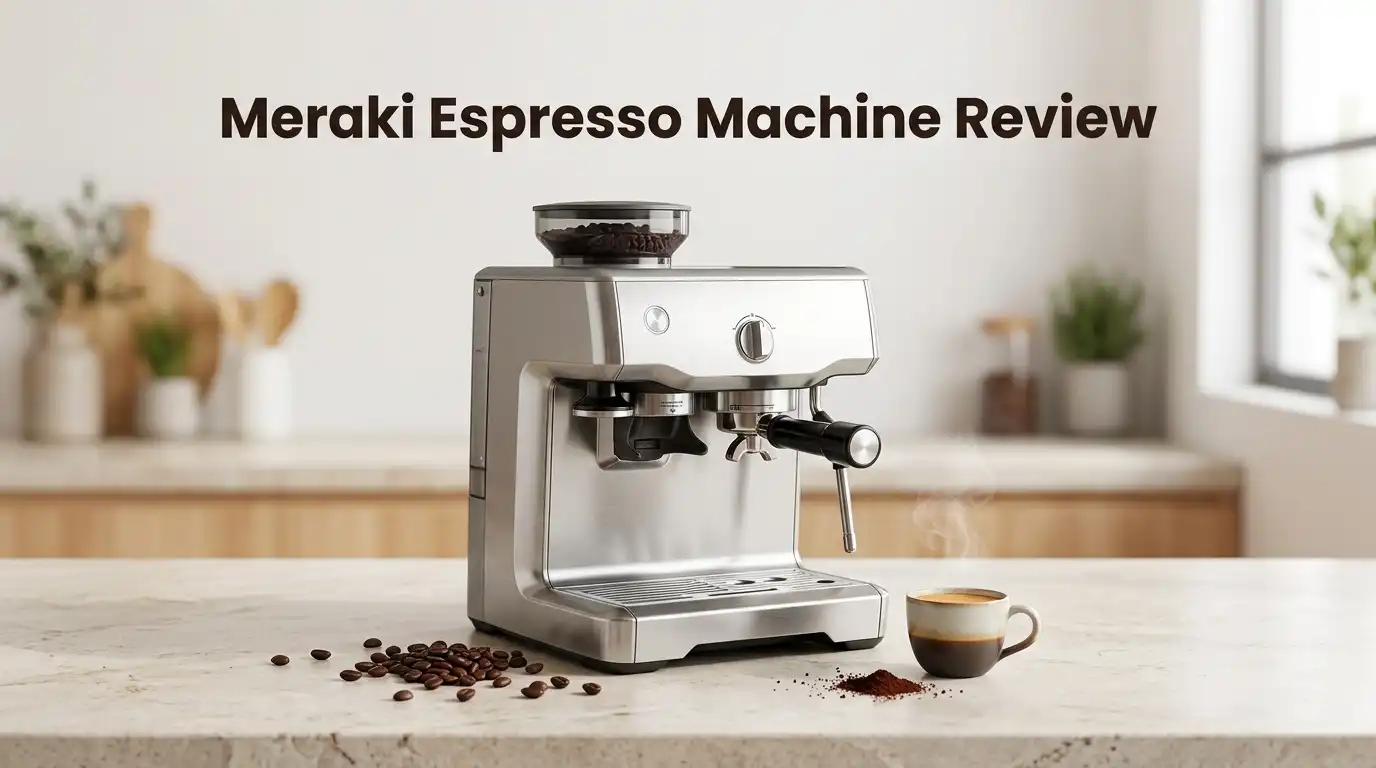
The Meraki is a semi automatic espresso machine with an integrated grinder, and it behaves like three separate appliances sharing one chassis. On the left sits an espresso grinder developed together with Timemore. In the middle sits the brew station with a 58mm E61 compatible portafilter. On the right sits the steam wand and hot water outlet.
Underneath the panels you get two stainless steel boilers, 350ml for brewing and 550ml for steam. A commercial style rotary pump holds a steady 9 bar. PID control and a heated group head keep brew temperature stable across several drinks. The machine measures 370 by 370 by 415mm, weighs 14.5kg, draws 1600W, and holds 2000ml of water.
The headline trick is weight. Two scales, each accurate to roughly 0.2 grams, sit inside the machine. One lives under the grinder and stops grinding at your dose. The other lives under your cup and stops the shot at your yield. No separate scale, no timer guessing, no stopping a shot half a second late.
A touchscreen drives the whole sequence, with a CoffeeSense NFC reader that pulls suggested recipes from compatible coffee bags. WiFi brings software updates and scheduled heat up times. Everything you would normally buy separately arrives calibrated as one system, which is the entire pitch behind the price.
Unboxing The Meraki: First Impressions
The delivery box is heavy enough that you want a second pair of hands. Owners consistently praise the packaging, and it deserves that praise. Dense foam blocks hold the machine in place, the accessories sit in their own compartments, and nothing rattles. For a startup shipping fragile appliances worldwide, the presentation feels closer to a camera brand than a kitchen brand.
Lifting the machine out is the first reality check. At 14.5kg it plants itself on the counter and stays there. That heft pays off later, because locking in the portafilter never shifts the machine. It also means this is not an appliance you tuck into a cabinet between weekends. Choose its spot before you unbox it.
Inside the accessory tray you get a bottomless 58mm portafilter, an attachable two spout adapter, a stainless milk jug, a tamper, a distribution tool, a magnetic dosing cup, a blind basket for backflushing, and a wooden stand that holds the tools upright. Gen 2 adds two spare group head gaskets, which sounds dull until a gasket fails on a Sunday morning.
First setup takes around twenty minutes. You rinse the tank, run water through the group, flush the steam wand, then set your dose and yield. Heat up runs about three to four minutes. My only complaint at this stage is the missing water filter, which matters a lot in hard water areas.
Design And Build Quality On The Counter
The Meraki looks modern rather than retro. Brushed panels, a curved profile, a wooden portafilter handle, and a bright touchscreen give it a confident presence. It won an iF Design Gold award in 2025, and in person you understand why. The three station layout reads clearly, so guests work out what does what without instructions.
Colour choice matters more than you expect. The white version shows every speck of coffee dust and every milk splash. Reviewers who chose white said they regretted it within a month. Black hides daily mess far better and needs less wiping between drinks.
Build feel sits above the plastic heavy consumer machines and slightly below traditional Italian metal boxes. Panels feel solid, the drip tray slides cleanly, and the removable bean hopper twists off with a quarter turn for fast coffee swaps. The tamper and distribution tool have real weight and do not feel like padding for the spec sheet.
There are compromises. Clearance under the group head is low, so tall travel mugs will not fit, especially with the spout adapter attached. The curved gaps between the three stations trap grounds and are awkward to reach with a cloth. Several owners also reported the bean hopper working loose during grinding on earlier units, which Meraki addressed in later revisions.
Top 3 Alternative for Meraki Espresso Machine


Last update on 2026-10-22 / Affiliate links / Images from Amazon Product Advertising API
Breville Oracle Jet Espresso Machine

Last update on 2026-10-22 / Affiliate links / Images from Amazon Product Advertising API
Breville Barista Touch Impress

Last update on 2026-10-22 / Affiliate links / Images from Amazon Product Advertising API
Ninja Luxe Café Premier
Grinder Performance And Grind By Weight Dosing
The grinder is the reason this machine works. Meraki developed it with Timemore, whose standalone electric grinders sell for around 600 dollars, and it sits on the same base plate rather than being squeezed inside the boiler housing. That separation keeps grinder heat away from the burrs and gives the motor room to breathe.
Adjustment is stepless with 45 marked reference points on Gen 2, up from 30 on Gen 1. The range now reaches noticeably finer and coarser. In testing, reviewers dialled in dense light roast single origins that normally defeat machines with built in grinders. That does not make the Meraki a light roast specialist, but it removes the usual ceiling.
Retention is close to zero, static is low, and clumping is minimal. You grind into a magnetic dosing cup that triggers the grind scale automatically, so the machine knows exactly when to stop. Set 18 grams once, and 18 grams is what you get tomorrow and next week.
Two honest limits apply. The burrs are conical, and flat burr fans will still taste a difference on delicate filter style roasts. You also cannot swap the grinder out, so you are committed to this burr set for the life of the machine. A separate 600 dollar grinder still beats it at the extremes.
Espresso Quality And Brew By Weight Yield
Shot quality is strong, and the reason is boring rather than glamorous. Stable temperature, steady 9 bar pressure, controlled preinfusion, and a repeatable dose remove most of the variables that ruin home espresso. Former baristas who tested it reported drinkable shots on the first pull and a recipe they liked by the fourth.
You set your target yield on the screen, and the brew scale stops the shot there. A 1:2 ratio from 18 grams gives 36 grams out. Switch to 54 grams for a longer Americano base and the machine remembers. Brew time appears on screen alongside live weight, so you diagnose problems instead of guessing.
This is where beginners gain the most. Most home espresso frustration comes from an unstable ratio, not bad beans. Lock the ratio, change one variable at a time, and progress stops feeling random. The Meraki shortens the learning curve more than any guided automatic machine I have seen.
Taste ceiling is the fair caveat. Enthusiasts who moved up from a Breville Barista Express Impress mostly reported better cups, but a minority said the difference was smaller than the price gap suggested, and one owner preferred the Breville. The Meraki delivers excellent café standard espresso. It does not replace a 4,000 dollar machine with a flat burr grinder for competition style light roasts.
Dual Boilers, Rotary Pump And Daily Pacing
Two independent boilers are the feature people underrate before buying and praise afterwards. Brewing and steaming happen at once, so a latte takes one continuous minute instead of two stages with a temperature recovery pause in between. Making four drinks for guests becomes realistic rather than stressful.
Last update on 2026-10-22 / Affiliate links / Images from Amazon Product Advertising API
The rotary pump earns its place too. It is quieter than the vibratory pumps found in almost every machine under 3,000 dollars, and it holds pressure evenly from the first drop to the last. The difference is most obvious early in the morning when a vibratory pump sounds like a power tool.
PID control plus a heated group head keeps brew temperature steady across several shots. Owners pulling five to ten drinks a day report consistent results with no noticeable drop off. Heat up takes three to four minutes from cold, and you can schedule heat up over WiFi or trigger it with a smart plug so the machine is ready when you reach the kitchen.
One workflow bug survives. If you steam milk through the touchscreen while a shot runs, the shot timer disappears from the display and you have to click back through menus to see both. Meraki has fixed similar issues through software before, but automatic update delivery is still missing, so you must check for firmware yourself.
Steam Wand And Milk Drinks
The steam wand is genuinely powerful, closer to a café wand than a home one. At full strength it brings a small jug of milk to temperature in under ten seconds, which is thrilling and slightly terrifying. Reviewers with limited steaming practice dropped to the medium setting and immediately produced better texture, because they had time to hear what was happening.
A temperature probe sits inside the wand tip. You choose a target milk temperature, the machine stops at it, and burnt milk stops being possible. Try 130F if you drink your latte straight away, then adjust to taste. Hands free steaming works well with roughly 180ml of milk or more in the supplied jug.
The wand rotates fully, which helps left handed users and anyone working in a tight corner. Only the tip gets hot, so the body stays safe to touch. When steaming ends, the screen prompts you to purge and wipe, and you can trigger the purge from the display or the manual lever.
Two gripes stand out. The included jug is small for anyone making two large milk drinks, and several owners upgraded it. More annoying, purged milk can congeal on the plastic drip tray cover beneath the metal insert, because there is no direct route into the tray. Stay on top of that or it turns unpleasant fast.
Touchscreen, CoffeeSense And Smart Features
The touchscreen is functional rather than flashy, and that is the right call. Icons are large, the sequence runs from grind to brew to steam without menu hunting, and you stop thinking about navigation after three or four sessions. Guided tutorials help new owners, and manual override stays available whenever you want to trust your eyes and ears.
CoffeeSense is the NFC layer. Tap a compatible bag against the reader and the machine suggests a starting grind setting and recipe for that coffee. It works as a useful memory aid when you rotate beans often. The catch is ecosystem dependence, because the feature only reads partnered bags and you cannot program your own NFC stickers.
WiFi handles firmware updates, and Meraki has shipped real improvements this way, including better alignment between physical and digital grind numbers, multi language support, setting retention after unplugging, and PID accuracy tweaks. Gen 1 owners received most of the Gen 2 software gains, which is decent treatment of early buyers.
Two honest weaknesses remain. Updates are not pushed automatically, so you must check manually, unlike Breville machines that handle this quietly. The machine also knows your dose and yield but does not yet use that data to suggest grind changes, which feels like an obvious missed opportunity for beginners.
Cleaning And Maintenance Reality
This is the section most sponsored reviews skip. The Meraki is a higher maintenance machine than a typical consumer espresso maker, and you should decide now whether you accept that.
The bottomless portafilter is the main culprit. When a shot channels or runs too fast, coffee sprays sideways and lands on the machine, the counter, and occasionally the wall behind. One reviewer described wiping specks off the machine after most suboptimal shots. The included two spout adapter solves the spraying, but it steals cup clearance and needs removing every time you knock out the puck.
The curved design that looks so good also traps grounds in the gaps between the three stations. A microfiber cloth reaches most of it, but full cleaning is fiddly enough that few people do it daily. The drip tray, dosing cup, and portafilter are not dishwasher safe. Only the stainless milk jug is.
Then there is water. No water filter is included, which is a genuine oversight at this price. In hard water areas you either buy filtered water, add your own filter, or descale far more often than you would like. Descaling is slow, though the blind basket makes routine backflushing quick. Plan on regular hand washing and a monthly deep clean.
What The Meraki Does Not Do Well
Authentic reviews name the failures, so here they are plainly. The Meraki does not do low effort coffee. There is no automatic milk system, no drink menu of one touch lattes, and no puck prep assistance. You still tamp, still dial in, and still learn technique. A Ninja Luxe Café or a superautomatic gives more convenience per dollar.
It does not do tall drinks. Clearance under the group head is low, and it gets worse with the spout adapter fitted. Travel mug users will brew into a small cup and pour across.
It does not do light roast competition espresso. The conical burrs and the machine’s overall character suit medium roasts best. Gen 2 stretched the range meaningfully, but flat burr setups still win on delicate fruit forward coffees.
It does not do portability. At 14.5kg, this machine claims its counter space permanently.
Most importantly, it does not have a proven long term service record. Owner reports split sharply. Some received replacement machines within a week after a leak or electrical fault. Others waited over a month with poor communication, including buyers in Europe dealing with regional service centres. Reported faults include brew scales reading zero, touchscreen freezes, loose bean hoppers, and boiler leaks. Failure rates look normal for a young hardware company, but recourse is weaker than with Breville or La Marzocco.
Pros And Cons Of The Meraki Espresso Machine
Pros
- Outstanding value. Dual boilers, a rotary pump, a Timemore grinder, and two scales for 1,799 dollars undercuts equivalent setups by well over a thousand dollars.
- Grind by weight and brew by weight together. No other machine near this price locks both ends of your brew ratio, and it removes the most common source of inconsistency.
- Excellent steam performance. The wand textures milk in seconds and the tip temperature probe stops you scalding it, so microfoam becomes achievable for beginners.
- Real dual boiler pacing. Brewing and steaming at once makes multiple milk drinks quick instead of a chore.
- Shorter learning curve. Guided touchscreen steps, live weight, live shot timing, and slow shot warnings teach you as you brew.
- Genuine software support. Wireless updates delivered real fixes, and Gen 1 owners received most Gen 2 improvements.
Cons
- Messy in daily use. The bottomless portafilter sprays coffee when shots run badly, and the curved panels trap grounds.
- No water filter included, which is hard to justify at this price and forces frequent descaling in hard water areas.
- Accessories are mostly not dishwasher safe, so hand washing becomes part of the routine.
- Support is inconsistent. Some owners got fast replacements, others waited weeks with little communication.
- Low cup clearance rules out tall mugs and travel cups.
- Fixed conical grinder. You cannot upgrade the burrs, and flat burr grinders still edge it on light roasts.
- Unproven longevity. There is no decade of reliability data behind this brand yet.
Gen 1 Versus Gen 2: What Changed In 2026
Gen 2 is a refinement, not a reinvention, and it targets the exact complaints reviewers raised about the original. If you are buying new in 2026, this is the version on sale.
The grinder module is the headline change. Reference points went from 30 to 45, and the range now reaches both finer and coarser than before. That finer end is what makes denser light roasts workable. Physical and digital grind numbers also line up properly now, which sounds trivial until you try to repeat yesterday’s setting.
The group head is now E61 compatible, which opens up third party portafilter choice and fixes the tight metal on metal portafilter fit that felt wrong on early units. The optional splitter gasket seats properly instead of dropping off.
Water distribution received a dual stage upgrade inside the group. A new shower screen, a new dispersion plate with a grooved honeycomb pattern, and an extra predistribution chamber spread water more evenly before it hits the puck.
Software gains include multi language support, memory retention after unplugging, PID tuning, and better grind number alignment. Most of these reached Gen 1 machines over WiFi, which is the right way to treat early backers. If you find a discounted Gen 1, it remains a strong buy, though you give up the new grinder range and group head.
Price, Warranty And Support
The Meraki lists at 1,999 dollars and sells at 1,799 dollars through Meraki directly and on Amazon, usually via an applied coupon. Meraki also throws in an upgrader kit of barista tools valued around 210 dollars with the machine. For context, Breville’s Dual Boiler costs 1,599 dollars with no grinder and no scales.
Add a standalone Timemore grinder at roughly 600 dollars to any competing dual boiler machine and the maths swings decisively toward the Meraki. That is the whole reason this machine sold 10,000 plus units so quickly.
The package includes free shipping over 200 dollars, a 30 day home trial from delivery, and a two year warranty with local authorised service and covered repair shipping. On paper that beats plenty of established brands.
In practice, support quality varies by region and by luck. Positive reports describe return labels within three days and a replacement machine in a week, faster than some owners experienced with large brands. Negative reports describe month long waits, repeated promises, and repair offers on machines that failed out of the box. Buy with the 30 day trial in mind and test the machine hard during that window. Use the trial to run daily drinks, steam milk, and check the scales, not to admire the design.
Who Should Buy It, And The Final Verdict
Buy the Meraki if you already make espresso and want a serious upgrade without spending three thousand dollars. It suits people moving up from a Breville Barista Express, a Bambino Plus, or a De’Longhi Dedica who now want dual boilers, a real grinder, and repeatable weights. It also suits anyone who makes several milk drinks a day and hates waiting.
Buy it if you enjoy the process. The Meraki rewards attention and punishes neglect. You get café standard espresso and excellent microfoam, and you accept wiping the machine down and hand washing parts as the cost.
Skip it if you want push button coffee, if you have hard water and no interest in filtration, if you need tall travel mugs, or if a brand with 30 years of service history matters more to you than specification value. The Breville Oracle Jet gives more automation, the Barista Touch Impress gives more guidance for less money, and the Ninja Luxe Café Premier gives far more drink variety for a third of the price.
My verdict: the Meraki is the most interesting espresso machine at this price in 2026, and one of the best value buys in home coffee, with real caveats about mess and support. It earns a strong recommendation for hands on home baristas, and a clear warning for anyone who wants coffee without commitment.
Frequently Asked Questions
Is the Meraki Espresso Machine good for beginners?
Yes, with one condition. The touchscreen guidance, grind by weight, brew by weight, and screen tutorials make it far more approachable than a traditional dual boiler machine, and most owners pull a shot they enjoy within the first week. However, you still tamp, distribute, dial in, and steam milk yourself. Complete beginners who want one touch drinks will be happier with a fully automatic machine.
Does the Meraki come with a grinder?
Yes. The espresso grinder was developed together with Timemore and sits on the same base plate as the machine, physically separated from boiler heat. It offers 45 marked reference points with stepless micro adjustment, low static, near zero retention, and grind by weight dosing accurate to roughly 0.2 grams. You do not need a separate grinder, though a high end flat burr grinder still performs better on light roasts.
Can the Meraki brew and steam at the same time?
Yes. It uses two independent stainless steel boilers, 350ml for brewing and 550ml for steam, so you never wait for the machine to switch modes. This is the main advantage over thermoblock and thermocoil machines in the same price bracket. One small software annoyance remains, because the shot timer disappears from the screen while you operate steaming through the display.
How long does the Meraki take to heat up?
Around three to four minutes from cold. You can schedule heat up over WiFi or use a smart plug, which means the machine is ready before you reach the kitchen. Many owners set it to warm up while they are still upstairs.
Is the Meraki hard to clean?
It needs more attention than a typical consumer machine. The bottomless portafilter sprays coffee when a shot channels, the curved gaps between the three stations trap grounds, and the drip tray, dosing cup, and portafilter are not dishwasher safe. Only the stainless milk jug is. Purged milk can also congeal on the plastic drip tray cover, so wipe it regularly.
Does the Meraki include a water filter?
No, and that is a real omission at this price. If you live in a hard water area, plan on using filtered or bottled water and descaling regularly. The included blind basket makes routine backflushing easy, but full descaling takes a long time.
Is the Meraki reliable?
Reports are mixed. Many owners run it daily for months without issue and praise the build quality. Others experienced brew scales reading zero, touchscreen freezes, loose bean hoppers, leaks, or electrical faults. Meraki offers a two year warranty and a 30 day trial, and some customers received replacements within a week, while others waited over a month. Test the machine thoroughly inside the trial window.
Is Gen 2 worth waiting for over a discounted Gen 1?
If you are buying new, Gen 2 is clearly the better machine thanks to the wider grinder range, the E61 compatible group head, and the improved water distribution. A heavily discounted Gen 1 still makes excellent coffee, and most Gen 2 software improvements arrived on Gen 1 machines through wireless updates, so it remains a fair value buy while stock lasts.

Hi, I’m Emma Lee — the coffee-obsessed creator behind Morning Drip Vault. I spend my days testing coffee machines, exploring brewing techniques, and reviewing the latest coffee gear. My mission is simple: helping you find the perfect machine to brew your best cup, every single morning.