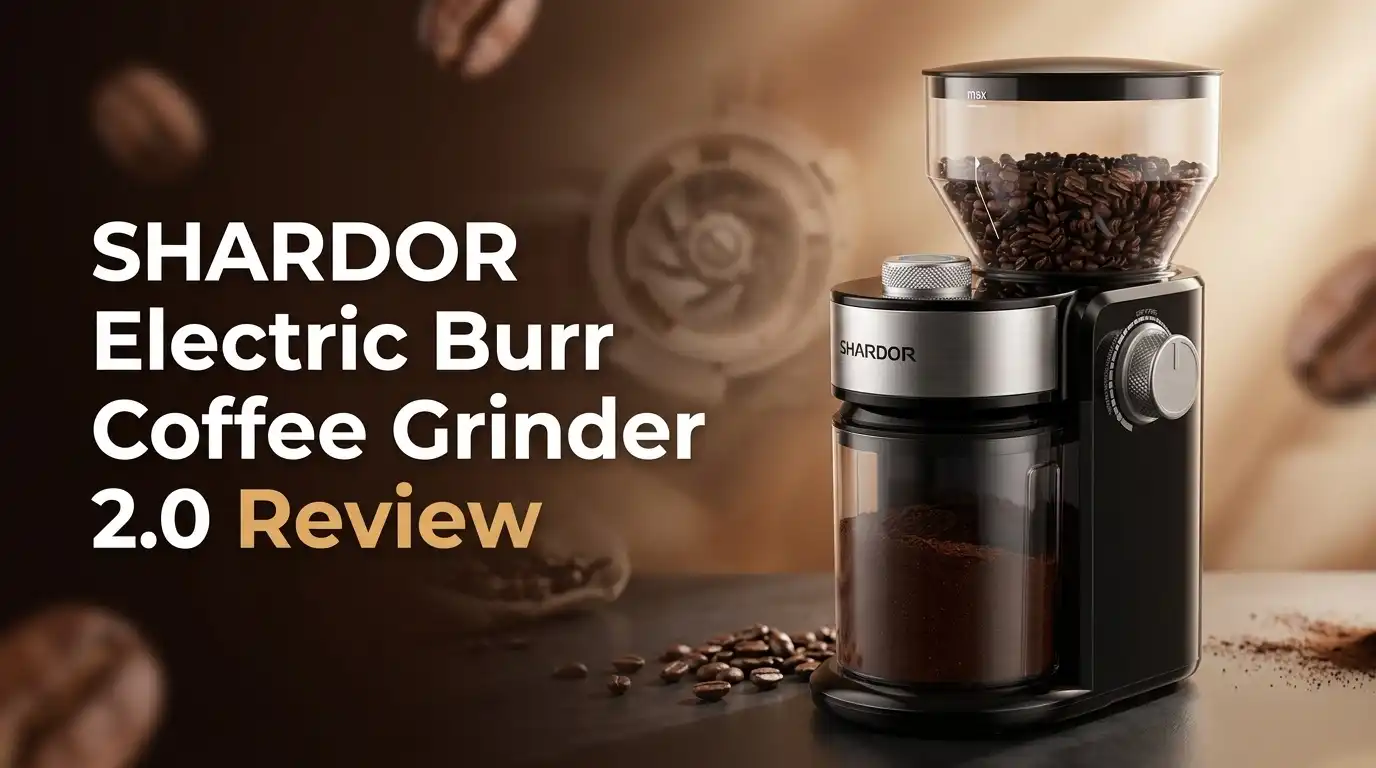
SHARDOR Electric Burr Coffee Grinder 2.0 Review 2026: Worth Buying?
Fresh coffee starts with a good grind. Most home brewers learn this the hard way after years of blade grinder dust. The SHARDOR Electric Burr Coffee Grinder 2.0 promises burr quality at a blade grinder price. That claim sounds great on a product page. Real kitchens tell a different story.
I spent weeks running beans through this machine. I brewed drip, pour over, French press, cold brew, and Moka pot. I measured noise. I weighed retention. I took it apart and cleaned it. This review shares the full picture, including the parts SHARDOR would rather skip.
You will learn what the grinder nails, where it stumbles, and who should actually buy it. No marketing fluff. Just honest notes from daily use.
In a Nutshell:
- Grind consistency punches above its price. The stainless steel conical burrs produce even particles on medium settings. Your drip coffee will taste noticeably cleaner than blade ground coffee. The difference shows up in the first cup.
- It is quiet for a burr grinder. Expect roughly 65 to 70 dB during a run. That equals normal conversation volume. A blade grinder screams at 85 dB or more. Early morning grinding will not wake the house.
- Espresso is a weak spot. The finest setting does not reach true espresso fineness. You will get channeling and bitter shots in a portafilter. Moka pot works fine. Real espresso does not.
- Cleaning takes about two minutes. The hopper twists off. The upper burr lifts out. No tools needed. A small brush sits inside the hopper lid for daily sweeps.
- The plastic body feels budget in places. The grounds container is lightweight. The dial clicks feel soft. These are honest tradeoffs at this price, not deal breakers for most buyers.
- Best value sits between $70 and $110. Buyers who brew drip, pour over, or French press get the most from it. Daily espresso drinkers should spend more elsewhere.
SHARDOR Electric Burr Coffee Grinder 2.0


Last update on 2026-11-19 / Affiliate links / Images from Amazon Product Advertising API
The SHARDOR Burr 2.0 is a conical burr grinder built for home kitchens. It uses a 40mm stainless steel conical burr set driven by a 150W motor. The hopper holds roughly 100g of whole beans. The grounds container catches about 60g.
The 2.0 name signals a refresh of SHARDOR’s older burr model. SHARDOR tightened the burr tolerances and added an anti static chamber. Depending on the variant you buy, you get either a simple dial with six positions or a wider 16 to 35 setting range.
The machine targets one buyer clearly: the home brewer leaving a blade grinder behind. It does not chase barista level precision. It chases consistent daily coffee at a fair price. Understanding that focus changes how you judge every feature below.
Unboxing Experience and What Comes Inside
The box arrives small and light. Lift the lid and you find the motor body wrapped in thin foam. Nothing rattles. Nothing feels loose. The packaging is plain cardboard with no plastic clamshell to fight.
You get five items total. The motor body sits at the bottom. The bean hopper and lid come packed separately. The grounds container nests inside. A small cleaning brush hides in a clip under the hopper lid, and many owners miss it entirely on day one.
Setup takes under two minutes. Twist the hopper onto the body until it clicks. Slide the grounds container into its slot. Plug it in. That is the whole process.
Notice what is missing. There is no portafilter holder, no scale, and no printed brew chart beyond a thin manual. The manual is short and a little stiff in its English.
Build Quality and Everyday Design
The grinder has a compact footprint of roughly 5 inches wide by 9.5 inches tall. It slides under most standard kitchen cabinets without a fight. The matte black finish hides fingerprints well.
The good parts feel genuinely good. The stainless steel burr set matches grinders costing 30 percent more. The hopper locks with a firm click. Thick rubber feet keep the base planted during a run. All food contact surfaces use BPA free plastic that meets FDA standards.
The weaker parts are easy to spot. The grounds container uses thin plastic that flexes under thumb pressure. The grind dial clicks softly, so a bump can shift your setting without you noticing. The power cord runs only about three feet, which limits where you can place it on a long counter.
Top 3 Alternative for SHARDOR Electric Burr Coffee Grinder 2.0

Last update on 2026-11-19 / Affiliate links / Images from Amazon Product Advertising API
Baratza Encore Conical Burr Coffee Grinder

Last update on 2026-11-17 / Affiliate links / Images from Amazon Product Advertising API
OXO Brew Conical Burr Electric Coffee Bean Grinder

Last update on 2026-11-19 / Affiliate links / Images from Amazon Product Advertising API
Cuisinart DBM 8 Supreme Grind Automatic Burr Mill
Grind Settings Explained in Plain English
The dial controls burr gap distance. A smaller gap means finer grounds. SHARDOR ships this model in a few variants, so check your box before assuming a number range.
The simplest variant uses six marked positions. Settings 1 and 2 give a fine powder suited to a Moka pot. Settings 3 and 4 produce a table salt texture for drip machines, pour over cones, and reusable Keurig pods. Settings 5 and 6 deliver coarse grounds for French press and cold brew.
One rule matters more than any other. Always change the dial with an empty hopper and a stopped motor. Adjusting mid grind traps beans between the burrs and can jam the unit.
Dial in by taste, not by chart. Bitter coffee means go one click coarser. Sour coffee means go one click finer.
Grind Consistency Test Results
I ran 20g batches of medium roast through three settings and inspected the output by eye and by feel.
At setting 2, the grind came out mostly uniform with roughly 15 to 20 percent fines mixed in. It felt like soft powder with a hint of grit. Moka pot brewing handled it well.
At setting 4, the machine did its best work. Particles looked remarkably even with no clumping. The texture matched dry table salt exactly. Brewed through a drip machine, the cup tasted clean and balanced.
At setting 6, I saw more variation under bright light. The texture resembled rough sea salt with a few stray fines. French press hides this flaw well because the fines settle at the bottom of the carafe.
Medium settings are this grinder’s real strength.
Noise Level and Counter Vibration
Every grinder makes noise. The question is how much and for how long.
I measured roughly 65 to 70 dB from one meter away during a normal run. That sits at conversation volume. A 20g medium grind finishes in about 15 seconds, so the noise ends quickly. A Cuisinart DBM 8 runs closer to 72 dB. Cheap blade grinders hit 85 to 90 dB.
The sound character matters as much as the volume. You hear a steady mid pitch hum rather than the sharp whine of a blade unit. Apartment dwellers will appreciate that difference at 6 AM.
Vibration is mostly controlled. On tile or granite the base stays put. On smooth laminate at coarse settings, it can creep a half inch during a long run.
Brew Method Performance Across Six Methods
Drip coffee is the clear winner. Setting 4 feeds a standard 12 cup machine perfectly and produces a clear, aromatic cup with no muddy sediment.
Pour over performs nearly as well. Setting 3 or 4 works for a V60 or Chemex. I add about 15 seconds to my bloom to account for a few fines. Extraction stays even across the bed.
French press scores a solid good at setting 6. The grounds are coarse enough to avoid sludge, though not laboratory uniform.
Cold brew handles setting 6 beautifully because a 12 hour steep forgives small inconsistencies.
Reusable Keurig pods work great at settings 3 and 4.
Espresso fails. The finest setting is simply not fine enough for nine bars of pressure.
The Espresso Problem You Should Know About
SHARDOR markets some listings with the word espresso. That word sets a false expectation on this particular model.
I tested setting 1 and 2 in a standard 58mm portafilter with 18g doses. Every shot ran fast and thin. Water found channels through the puck instead of saturating it evenly. The result tasted sour and watery, then bitter at the tail.
Two problems cause this. The burr gap at the fine end stays too wide for true espresso. The grind also carries too many fines, which clog in spots while leaving gaps elsewhere.
Moka pot is the fine grind ceiling here. That method uses low pressure and tolerates uneven particles.
Buyers who pull daily shots should look at the Baratza Encore or a SHARDOR 64mm flat burr model instead.
Cleaning, Maintenance, and Grind Retention
Disassembly impressed me more than I expected. Twist the hopper counterclockwise and lift it off. Twist the upper burr and pull it straight out. Slide out the grounds container. The whole process takes under two minutes with no tools.
The included brush clears the burr teeth and chute quickly. Never rinse the burrs or motor body under water. Moisture rusts the steel and ruins the bearing.
Grind retention measured between 0.5g and 1g per use. Commercial grinders stay under 0.3g, so this is average for the category. Run a 3g purge of fresh beans before your real dose if you want zero stale grounds.
Clean weekly with the brush. Run a grinder cleaning tablet monthly if you brew dark oily roasts.
Pros and Cons After Weeks of Daily Use
Here is the honest scorecard.
Pros
- Grind consistency on medium settings rivals grinders costing $40 to $50 more
- Significantly quieter than any blade grinder at roughly 65 to 70 dB
- Tool free disassembly makes weekly cleaning fast and painless
- Compact footprint fits under standard kitchen cabinets
- BPA free food contact materials with a stainless steel burr set
- Safety interlock prevents the motor from running with loose parts
- Strong price to performance ratio under the $110 mark
Cons
- Limited grind settings on the base variant compared to rivals offering 15 or more
- Cannot grind fine enough for true espresso extraction
- Coarse setting shows visible particle variation
- Grounds container plastic feels thin and flexes easily
- Dial clicks are soft, so settings shift when bumped
- Short three foot power cord restricts placement
- No timer, scale, or dosing function on this model
What This Grinder Does Not Do Well
Authentic reviews name the failures clearly, so here they are without softening.
It does not make espresso. Full stop. No workaround fixes the burr gap limitation.
It does not hold a grind setting under rough handling. I shifted mine twice by accident while wiping the counter.
It does not grind oily dark roasts cleanly over time. Oils coat the burrs within a week and force extra cleaning sessions. Flavored beans are worse and will gum the chute quickly.
It does not give you repeatable doses. Without a timer or scale, you measure beans yourself every single morning.
It does not feel premium in the hand. The motor body is plastic and the container flexes.
None of these flaws ruin daily drip coffee. They just define the ceiling.
Price and Value in 2026
Street pricing moves between roughly $70 and $110 depending on variant and sales events. Holiday discounts push it lower. Always check current pricing before buying since SHARDOR runs frequent promotions.
At that price, the comparison set includes the Cuisinart DBM 8 at a similar cost and the OXO Brew Conical Burr near $100. The Baratza Encore sits well above at $170 or more.
Against the Cuisinart, SHARDOR wins on grind quality, noise, and cleaning ease. Cuisinart wins on setting count and brand familiarity.
Against the Encore, SHARDOR loses on everything except price. The Encore grinds finer, holds settings better, and lasts longer.
Value is strongest for buyers upgrading from a blade grinder. The jump in cup quality feels dramatic for the money spent.
Who Should Buy This Grinder
Buy it if you currently use a blade grinder and want a real upgrade without spending $200. The quality jump is immediate and obvious.
Buy it if you brew drip coffee, pour over, French press, cold brew, or reusable Keurig pods. These methods sit inside the machine’s sweet spot.
Buy it if counter space is tight and noise matters in your home.
Skip it if espresso is your daily ritual. You will be frustrated within a week.
Skip it if you want many precise settings for manual brew dialing. Six positions feel limiting to detail focused brewers.
Skip it if you grind large volumes several times daily. The small motor is built for light home use, not heavy cycles.
Match the machine to your routine and you will be happy with it.
Final Verdict
The SHARDOR Electric Burr Coffee Grinder 2.0 earns a solid 8 out of 10 for home brewers on a budget. Grind consistency scores highest. Build quality scores lowest.
This machine does one job very well. It turns whole beans into even grounds for drip and pour over coffee at a price most households can justify. The quiet operation and fast cleaning make it easy to use every single morning.
The flaws are real and predictable. Thin plastic parts, limited settings, and no espresso capability define the ceiling. SHARDOR built this for the mainstream American coffee drinker, not for the barista.
Buy it for better daily coffee. Do not buy it expecting cafe quality espresso. With that expectation set correctly, it delivers exactly what it promises.
Frequently Asked Questions
Is the SHARDOR Burr 2.0 good for beginners?
Yes. The single button operation and clear dial markings make it simple from day one. Cleaning requires no tools and no technical knowledge. Beginners upgrading from a blade grinder will notice better coffee immediately with almost no learning curve.
Can it grind fine enough for espresso?
No. The finest setting does not reach true espresso fineness and produces too many fines. Shots channel badly in a portafilter and taste sour or bitter. It handles a Moka pot well at the finest setting, which is the practical limit here.
How loud is it compared to a blade grinder?
It runs at roughly 65 to 70 dB versus 85 to 90 dB for a typical blade grinder. The tone is a steady hum rather than a sharp whine. A 20g grind finishes in about 15 seconds, so the noise ends fast.
How often should I clean the burrs?
Brush the hopper and chamber after each use. Do a full disassembly and burr brush once a week. Run a grinder cleaning tablet monthly if you brew oily dark roasts. Dark and flavored beans need more frequent attention than light or medium roasts.
Why will my grinder not turn on?
Check the hopper and grounds container first. A safety interlock blocks the motor when either part is not seated fully. Twist the hopper until it clicks and push the container firmly into its slot. This fixes the problem in most cases.
Does it grind spices too?
You can grind hard dry spices, but it is not recommended. Spice oils cling to the burrs and transfer flavor to your coffee for weeks afterward. Use a dedicated blade grinder for spices and keep this unit for beans only.

Hi, I’m Emma Lee — the coffee-obsessed creator behind Morning Drip Vault. I spend my days testing coffee machines, exploring brewing techniques, and reviewing the latest coffee gear. My mission is simple: helping you find the perfect machine to brew your best cup, every single morning.