Kismile Automatic Espresso Machine with Grinder Review 2026
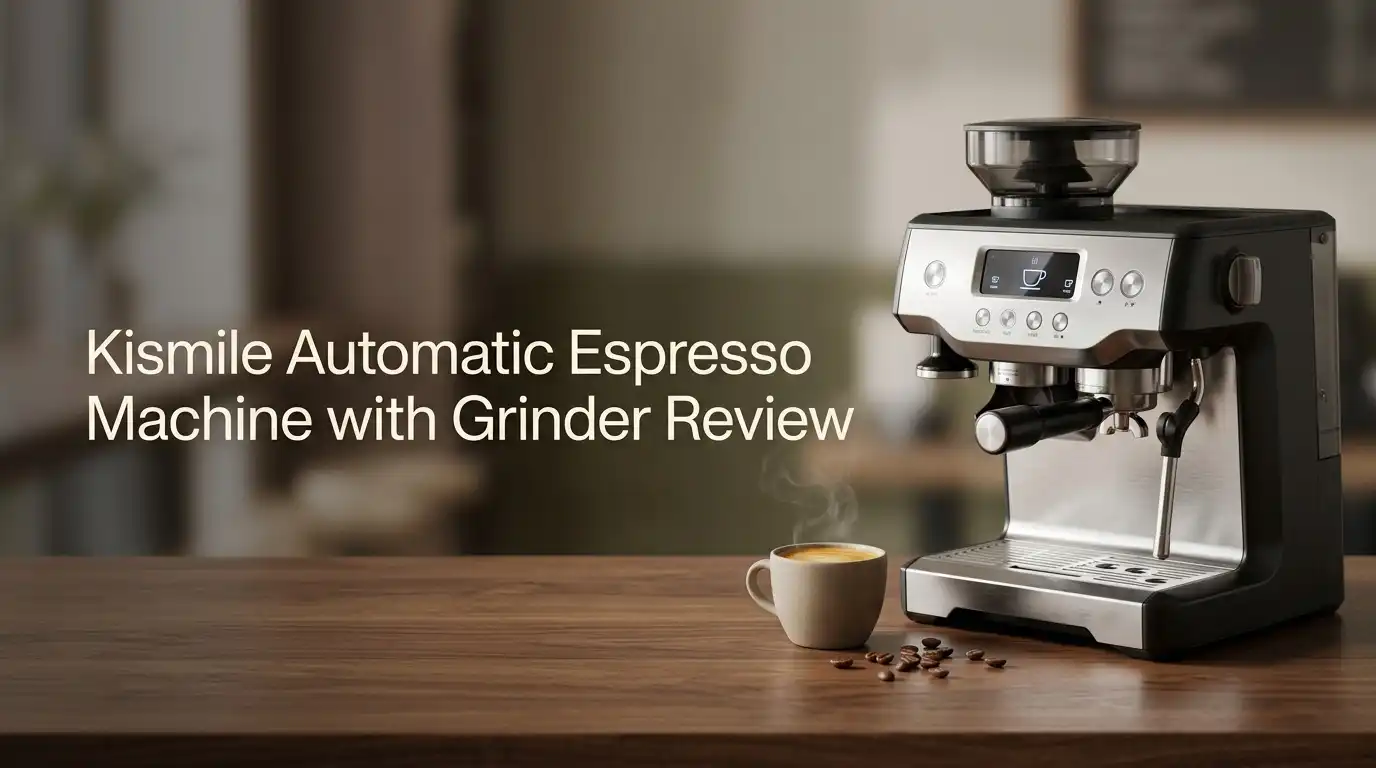
Home espresso used to mean two machines, two counters full of clutter, and a lot of guesswork. The Kismile Automatic Espresso Machine with Grinder promises to fold all of that into one stainless steel box that costs far less than the big name brands.
That promise is bold. It is also the reason this machine keeps showing up in kitchen upgrade lists and late night shopping carts.
I spent weeks pulling shots, steaming milk, cleaning baskets, and making mistakes with this machine so you do not have to. This review covers the unboxing, the grinder, the pressure gauge, the steam wand, and the parts that genuinely annoyed me.
In a Nutshell:
- The value is the whole story. The Kismile packs a conical burr grinder, a 20 bar pump, a pressure gauge, PID temperature control, and a 58mm portafilter into one unit. That feature list normally sits in the $600 to $900 range. Kismile sells it for a fraction of that.
- The grinder is good, not great. Thirty grind settings give you real control, and the grind on demand function drops coffee straight into the basket. Retention is noticeable though, and the finest settings can choke your shot.
- Milk steaming surprised me. The steam wand builds thick microfoam fast enough for latte art practice. It is the single most impressive part of the machine.
- The learning curve is real. This is a semi automatic machine wearing an automatic label. You still tamp, you still dial in, and you still clean by hand.
- Quality control is the weak spot. Some owners report leaks, loose knobs, or grinder jams within months. Buy from a seller with easy returns.
- Best for curious beginners. If you want cafe style drinks without a $700 commitment, this works. If you want push button coffee with zero effort, look at a true bean to cup machine instead.
Why the Kismile Espresso Machine with Grinder Gets So Much Attention


Last update on 2026-10-29 / Affiliate links / Images from Amazon Product Advertising API
Kismile is a younger kitchen appliance brand that sells fans, freezers, and coffee gear direct to shoppers. This espresso machine is their flagship product, and it competes by undercutting everyone on price while matching them on spec sheets.
The pitch works because the numbers look serious. A 1500W motor, a 20 bar Italian pump, a 2.8 liter removable tank, and a full size 58mm portafilter are features you normally find on machines costing triple. Kismile built a product that reads like a Breville Barista Express on paper.
People notice that gap instantly. The real question is whether the parts behind those numbers hold up in daily use. Spec sheets are easy. Consistent espresso is hard. That is what the rest of this review tests.
Unboxing the Kismile Automatic Espresso Machine
The box arrives heavy. At roughly 18 pounds, you feel the metal before you see it. Kismile packs the machine in thick molded foam with the accessories tucked into a separate cardboard tray on top.
Inside you get the machine, a 58mm portafilter, four filter baskets covering single wall and double wall options for one or two cups, a stainless steel tamper, a milk frothing jug, a coffee spoon, a cleaning brush, and a pin for clearing the steam wand.
The tamper feels better than most included tampers, which usually disappoint. The milk jug is thin but usable. The manual is clear enough, though the English reads slightly translated in places.
Setup took me about fifteen minutes. Rinse the tank, run water through the group head, purge the steam wand, and you are ready to grind.
Build Quality and How It Looks on Your Counter
The front panel and the drip tray are stainless steel. The side panels and the bean hopper lid use plastic, which is where the cost savings become visible.
At 16 inches tall and roughly 13 inches wide, this is not a small appliance. Measure your cabinet clearance before ordering, because the hopper needs vertical room for refilling beans.
The pressure gauge sits front and center with a chrome bezel. Controls use simple rotary knobs and backlit buttons. It looks far more expensive than it is, and guests consistently assume it cost several hundred dollars more.
The knobs do feel light when you turn them. They work fine, but they lack the damped, mechanical feel of premium machines. That is the honest trade for the price.
Top 3 Alternative for Kismile Automatic Espresso Machine with Grinder

Last update on 2026-10-28 / Affiliate links / Images from Amazon Product Advertising API
Breville Barista Express Espresso Machine BES870XL

Last update on 2026-10-27 / Affiliate links / Images from Amazon Product Advertising API
CASABREWS CM5418 Compact Espresso Machine with Milk Frothing Steam Wand

Last update on 2026-10-29 / Affiliate links / Images from Amazon Product Advertising API
De’Longhi Magnifica Start Automatic Espresso Machine with Milk Frother
Testing the Built In Conical Burr Grinder
The grinder is the headline feature, so I pushed it hard. It uses conical burrs rather than blades, which matters because burrs produce consistent particle sizes and blades do not.
You get 30 grind settings controlled by a dial on the hopper. Setting 8 to 12 worked best for medium roast beans in my testing. Darker roasts needed a coarser setting around 14 to avoid choking the pump.
Grind on demand works well. You lock the portafilter into the grinding cradle, press the button, and ground coffee lands directly in the basket. Mess is minimal compared to transferring grounds from a separate grinder.
The weakness is retention. A small amount of coffee stays trapped in the chute between shots, so your first pull after switching beans tastes slightly off.
Espresso Extraction and What 20 Bar Really Means
Marketing loves big pressure numbers. Here is the truth: espresso extracts best at around 9 bar, not 20. The 20 bar figure describes the maximum capability of the pump, not the pressure hitting your coffee.
Kismile includes a pressure gauge so you can watch what actually happens. With a proper dose of 18 grams in the double basket, my shots settled between 8 and 10 bar on the gauge. That is exactly where it should sit.
Shot quality was genuinely good once dialed in. I pulled 36 grams of liquid in about 28 seconds with real crema on top.
The catch is consistency. Small changes in tamping pressure moved my results more than they should. This machine rewards careful technique.
PID Temperature Control in Plain Language
PID stands for proportional integral derivative, which sounds complicated but describes something simple. It is a system that keeps water temperature steady instead of letting it swing up and down.
Cheap espresso machines overheat and then cool off between shots. That swing burns your coffee or under extracts it. Kismile claims accuracy within 3 degrees Fahrenheit of your target.
In practice, back to back shots tasted similar, which is the real test. The second and third cups did not turn bitter, a common failure on budget machines.
Heat up time runs about 45 seconds from cold, which is fast. The portafilter itself stays cool though, so I recommend running a blank shot through it first to warm the metal.
Steam Wand and Milk Frothing Performance
This part impressed me most. The steam wand uses a single hole tip and produces strong, dry steam almost immediately after the ready light appears.
I steamed 8 ounces of whole milk to 140 degrees Fahrenheit in roughly 35 seconds. The foam came out glossy and tight rather than bubbly. That texture is good enough to pour basic latte art once your technique improves.
The wand articulates on a ball joint, so positioning the jug is easy. Rotating the knob also switches the wand to hot water mode for Americanos or preheating cups.
Clean the wand immediately after every use. Dried milk hardens inside the tip, and the included pin exists precisely because that happens.
Daily Use, Water Tank and Cleaning Routine
The 2.8 liter tank is large for this price bracket. It lifts out from the rear, which means you need clearance behind the machine or you must slide it forward to refill.
Daily cleaning takes about three minutes. Knock out the puck, rinse the basket, wipe the group head, purge and wipe the steam wand, and empty the drip tray.
The drip tray has a float indicator that pops up when it fills, which is a thoughtful touch.
Descaling matters more than people expect. Hard water will destroy this machine faster than anything else. I recommend filtered water and descaling every two months in hard water areas, or every three months otherwise.
What the Kismile Does Not Do Well
Honest reviews need this section. Start with the name. This machine is marketed as automatic, but it is semi automatic. You tamp manually, you time shots yourself, and you steam milk by hand.
Grinder retention is real and slightly annoying. Expect to lose a gram or so per dose and to purge when changing beans.
Quality control is inconsistent. Owner reports include water leaks from the tank seal, grinder jams with oily dark roast beans, and loose steam knobs appearing within the first year.
The plastic portafilter handle and hopper lid feel cheap. Long term durability is the biggest unknown here, since Kismile lacks the twenty year track record that established brands carry.
Finally, parts availability is limited. Replacement gaskets and baskets are easier to source for Breville or De’Longhi.
Pros and Cons of the Kismile Espresso Machine
Here is the balanced breakdown after extended testing.
Pros
- Outstanding price to feature ratio with a burr grinder, PID control, and a pressure gauge all included
- Full size 58mm portafilter accepts widely available third party baskets and tampers
- Steam wand produces genuinely good microfoam, fast enough for cappuccinos and lattes
- Large 2.8 liter removable tank means fewer refills for households with multiple coffee drinkers
- Fast 45 second heat up gets you caffeinated quickly on busy mornings
- Generous accessory bundle including tamper, milk jug, and four filter baskets
Cons
- Not truly automatic, despite the product name suggesting otherwise
- Noticeable grind retention requires purging between different beans
- Quality control varies, with leaks and grinder jams reported by some owners
- Plastic components lower the perceived durability over several years
- Large footprint needs real counter and cabinet clearance
- Limited replacement part availability compared to established brands
Who Should Buy This Machine
This machine fits a specific person. You want to learn espresso properly, you enjoy the hands on process, and you are not ready to spend $700 finding out if the hobby sticks.
It also suits households that drink milk based drinks daily. The steam wand alone justifies much of the price if lattes and cappuccinos are your routine.
It does not suit people who want one button convenience. If you expect to press a single button and receive a finished cappuccino, a super automatic machine serves you far better.
Serious enthusiasts chasing competition level shots will outgrow this machine within a year. The grinder becomes the bottleneck first, then the single boiler design.
Kismile vs Breville Barista Express
This comparison comes up constantly, so let us address it directly.
The Breville Barista Express costs roughly three times more. It earns that with better burr alignment, a more refined grinder, superior build materials, and a reputation built over two decades.
The Kismile matches it on headline specs and beats it dramatically on price. For a beginner, the flavor difference in the cup is smaller than the price difference suggests.
Where Breville wins is longevity and support. Parts are everywhere, repair guides are everywhere, and resale value stays strong.
My honest take: buy the Kismile if your budget is tight or your commitment is uncertain. Buy the Breville if you already know espresso is a long term habit.
Price and Value in 2026
Pricing moves often, and Kismile runs frequent promotions. The machine typically lands well below comparable grinder equipped competitors, which is the entire appeal.
Run the math on your coffee habit. Two cafe drinks per week at $6 each costs over $600 annually. This machine pays for itself in months, not years, for regular coffee shop customers.
Factor in ongoing costs though. Quality beans, descaling solution, and replacement gaskets add up. Budget roughly $25 monthly for beans if you drink two shots daily.
Also consider the warranty. Kismile offers a standard limited warranty with an extended option. Register your purchase immediately, because that paperwork matters if a leak appears.
Tips to Get Better Shots From This Machine
A few adjustments transformed my results, and they will help you too.
Start at grind setting 10 and adjust in single steps. Change only one variable at a time or you will never identify what fixed the shot.
Use 18 grams in the double basket and aim for 36 grams of liquid espresso in 25 to 30 seconds. That ratio is the standard starting point.
Run a blank shot of hot water through the portafilter before brewing. Cold metal steals heat from your coffee and flattens the flavor.
Use beans roasted within the last four weeks. Stale beans ruin good machines, and no amount of dialing in fixes them. Finally, distribute grounds evenly before tamping to prevent channeling.
Final Verdict: Is the Kismile Worth Buying?
Last update on 2026-10-29 / Affiliate links / Images from Amazon Product Advertising API
The Kismile Automatic Espresso Machine with Grinder delivers far more than its price suggests. The grinder works, the pressure gauge is accurate, the PID control keeps shots consistent, and the steam wand genuinely excels.
It is not flawless. The automatic label oversells a semi automatic experience, grind retention is irritating, and quality control varies between units.
I would recommend it to beginners and value hunters without hesitation. For roughly a third of the cost of a Breville, you get eighty percent of the experience.
Just buy it with returns available and register the warranty on day one. Treat it well, descale it on schedule, and it will serve you excellent coffee while you learn whether espresso becomes a lasting hobby.
Frequently Asked Questions
Is the Kismile espresso machine fully automatic?
No. Despite the name, this is a semi automatic machine. The grinder operates automatically and doses into the portafilter, but you tamp the coffee, start the shot, and steam the milk yourself. A fully automatic bean to cup machine handles all of those steps with one button.
What grind setting should I start with?
Begin at setting 10 of 30 for medium roast beans. Move coarser if your shot runs too slowly or the pressure gauge spikes above 12 bar. Move finer if espresso gushes out in under 20 seconds. Adjust one setting at a time.
Can I use pre ground coffee in this machine?
Yes. Simply add pre ground espresso directly to the filter basket and skip the grinder step. Use the double wall pressurized baskets for pre ground or supermarket coffee, since they compensate for less than ideal grind consistency.
How often should I descale the Kismile?
Every two months in hard water areas and every three months in soft water areas. Use filtered water to extend that interval. Scale buildup is the leading cause of failure in home espresso machines, so do not skip this step.
Does it make regular drip coffee?
No. This machine produces espresso only. You can make an Americano by adding hot water from the steam wand to a shot of espresso, which tastes close to black coffee but with a different body and flavor profile.
Is the portafilter a standard size?
Yes. It uses a 58mm portafilter, the same size found on commercial machines. That means you can buy aftermarket baskets, bottomless portafilters, and tampers from third party sellers without compatibility problems.

Hi, I’m Emma Lee — the coffee-obsessed creator behind Morning Drip Vault. I spend my days testing coffee machines, exploring brewing techniques, and reviewing the latest coffee gear. My mission is simple: helping you find the perfect machine to brew your best cup, every single morning.