Philips 3300 Espresso Machine Review 2026: Worth Buying?
Coffee at home should feel easy. You press one button, and a real espresso lands in your cup. That promise is exactly what Philips sells with the 3300 Series, and it is why this machine keeps showing up in kitchens, dorm rooms, and small offices across the country.
But easy does not always mean excellent. I spent weeks pulling shots, steaming milk, cleaning parts, and reading flashing lights on this machine. Some moments impressed me. Some moments annoyed me. A few made me want to push the box back across the counter.
This review covers everything honestly. You will read about the unboxing, the grinder, the milk foam, the strange break in period, and the stuff Philips really does not want in the marketing copy.
In a Nutshell:
- The Philips 3300 is one of the quietest super automatic machines you can buy. The ceramic grinder measures around 63 decibels in testing, which is dramatically softer than older Philips models. Early risers in shared apartments will notice the difference immediately.
- The LatteGo milk system is the real star here. It has only two parts, no tubes, and no hidden channels. You rinse it in about thirty seconds or drop it in the dishwasher. Milk foam comes out thick, glossy, and sweet.
- The espresso is good, but it is not best in class. After the machine settles in, shots taste nutty and sweet with surprising crema. Competitors at the same retail price still pull slightly better shots.
- You must brew 10 to 20 throwaway coffees first. This “calibration” phase is real, and nobody warns you at checkout. Buy cheap beans for the break in period so you do not waste your favorites.
- The feature list has marketing fluff. There is no true touchscreen, the app is basically a digital manual, and the “iced coffee” is lukewarm coffee you pour over ice.
- Price decides everything. At full price near $900, skip it. Discounted under $600, it becomes a genuinely smart buy.
Philips 3300 Series Fully Automatic Espresso Machine


Last update on 2026-10-22 / Affiliate links / Images from Amazon Product Advertising API
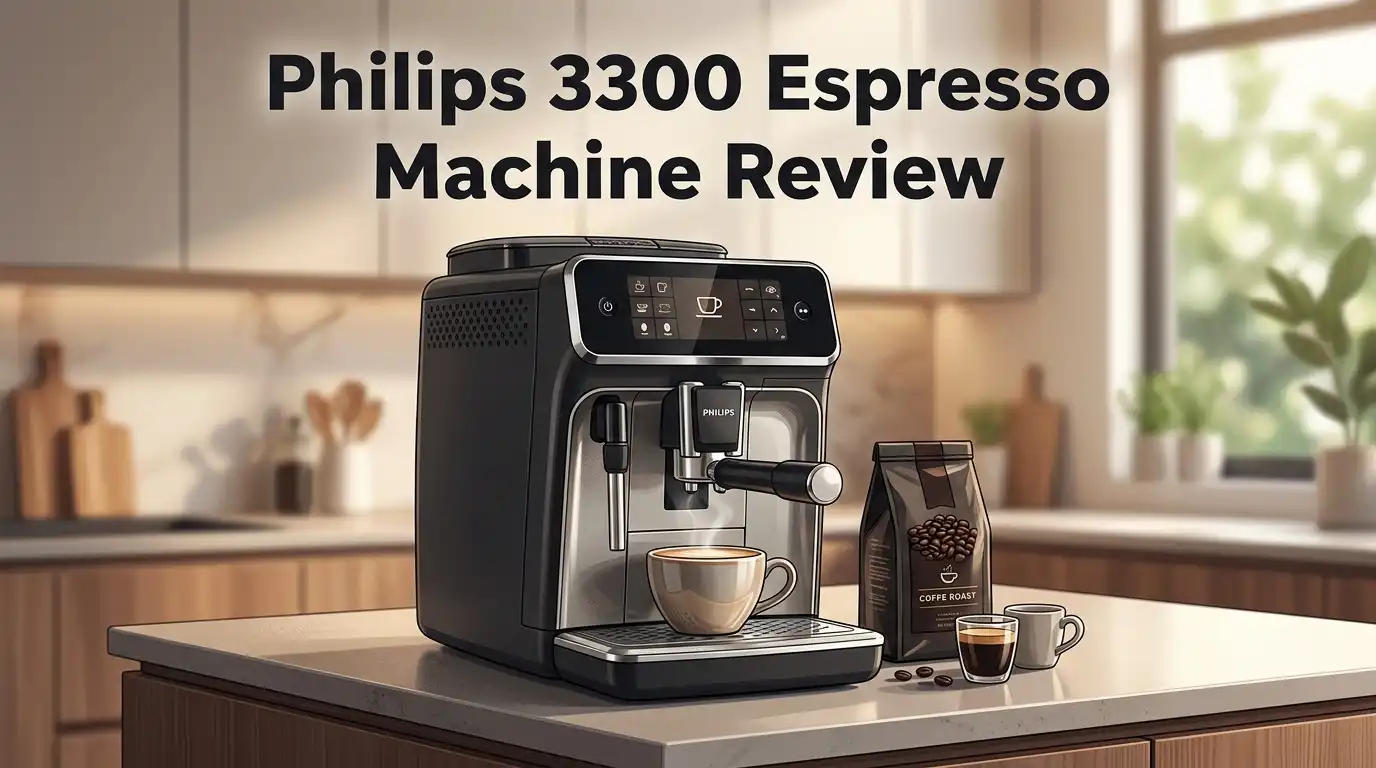
The Philips 3300 Series, model EP3347/90, sits in the middle of the Philips lineup. It replaced the hugely popular 3200 Series and brings a quieter grinder, a color icon display, and a refreshed LatteGo frother. The machine weighs 17.6 pounds and measures roughly 9.6 inches wide, 14.6 inches deep, and 17 inches tall.
Inside, you get a ceramic flat burr grinder with 12 grind settings, a 15 bar pump, a 1.8 liter side mounted water tank, and a removable brew group. The bean hopper holds about 9.9 ounces. Philips includes an AquaClean filter, a measuring scoop, lubricant, a water hardness strip, and a storage lid for the milk jug.
This is a machine built around convenience. Philips did not chase barista control. It chased simplicity, and in that single goal, it mostly succeeds.
The Unboxing Experience
The box arrives heavier than you expect for a plastic bodied machine. Philips packs the 3300 in molded cardboard instead of foam, so the whole thing feels tidy and recyclable. You lift the machine out by two side cutouts, and it slides free without a fight.
Peeling the protective film off the front panel takes about a minute. Underneath sits a surprisingly cheerful control face with colored drink icons. The LatteGo jug comes separately, wrapped in its own sleeve, and clips onto the machine with a satisfying click that takes zero instructions to figure out.
Setup took me under fifteen minutes. You rinse the water tank, dip the hardness strip, prime the AquaClean filter by shaking it in water, then run the startup rinse cycle. The quick start guide uses pictures instead of paragraphs. Honestly, this is one of the friendliest first hours I have had with any espresso machine.
Design and Build Quality
Let me be direct. The Philips 3300 will never win a design award. The body is mostly plastic with a few chrome accents, and the button heavy front panel looks more like an office appliance than a kitchen showpiece. Sleek machines from Breville and Jura make this one look dated.
That said, the build feels genuinely solid. The drip tray slides in cleanly. The water tank seats without wiggling. The brew group pops out and back in with a firm snap. Nothing creaks or flexes when you move the machine.
The slim 9.6 inch width matters more than looks for most buyers. This machine fits in tight counter spots where wider models cannot go. Just measure your upper cabinets first. You need vertical clearance to open the bean hopper lid and pour.
Philips backs it with a two year warranty, which is better than much of the field.
Top 3 Alternatives for Philips 3300 Espresso Machine

Last update on 2026-10-22 / Affiliate links / Images from Amazon Product Advertising API
Gaggia Magenta Prestige Super Automatic Espresso Machine

Last update on 2026-10-20 / Affiliate links / Images from Amazon Product Advertising API
De’Longhi Magnifica Evo Automatic Espresso Machine

Last update on 2026-10-22 / Affiliate links / Images from Amazon Product Advertising API
Philips 4400 Series Fully Automatic Espresso Machine
Ceramic Burr Grinder Performance
The grinder is the quiet hero of this machine. Philips uses ceramic flat burrs instead of steel, and that choice pays off twice. Ceramic stays cooler during grinding, which protects the aromatic oils in your beans. Ceramic also holds its edge far longer than steel, so the grinder should outlast the rest of the machine.
You get 12 grind settings adjusted by a dial inside the hopper. Always change the setting while the grinder is running. Turning the dial on a stopped grinder can damage the burrs.
In practice, settings 2 through 5 cover almost everyone. Fresh beans like a slightly coarser grind, so start around 4. Older beans brew better around 3. Finer than 2 risks clogs and bitter shots.
One warning: never put oily dark roasts or flavored beans in the hopper. Use the pre ground bypass chute for those.
The LatteGo Milk System Explained
LatteGo is why many people pick Philips over everyone else. The system uses just two plastic parts and no tubes at all. Milk flows through a wide channel, mixes with high speed air in a mixing chamber, and pours straight into your cup.
No tube means no hidden milk residue. No hidden residue means no sour smell three weeks later. You snap the two pieces apart, rinse them under the faucet, and you are done in half a minute. The whole jug goes in the dishwasher too, or straight into the fridge with the included lid.
Foam quality is excellent. It comes out dense, stable, and fine textured, with a glossy surface that holds its shape.
Here is the honest limitation. LatteGo makes exactly one style of foam, and that style is thick. Cappuccino and latte macchiato shine. Flat white and cortado fans will be disappointed.
Espresso Taste and the Break In Period
Nobody mentions this at checkout, so I will. Your first 10 to 20 coffees will likely taste weak and watery. This is normal for Philips machines. The brew group needs cycles to settle, the springs need to seat, and the grinder needs to clear its path. It feels like a defect. It is not.
Buy a cheap bag of beans purely for breaking in. Pull shot after shot and dump them. By cup fifteen or so, the drinks transform.
After that phase, the espresso genuinely satisfies. Shots arrive nutty and slightly sweet with a respectable crema layer. It is clean, balanced, and very drinkable.
Is it the best espresso near this price? No. De’Longhi, Gaggia, and Breville all pull slightly richer, more complex shots. The 3300 lands at good, not spectacular.
Drink Menu and Customization Options
The drink lineup is short. You get espresso, coffee, cappuccino, latte macchiato, iced coffee, and hot water for tea. That is it. Six options, and one of them is plain water.
Customization works through three simple sliders of light. You adjust aroma strength across three levels, coffee volume across three levels, and milk volume across three levels. Press and hold a drink button for three seconds to save a new volume for that drink.
Strength level 3 hits hard, maybe too hard for dark roasts. Level 2 suits most medium and dark beans nicely.
The big gap is user profiles. The 3300 stores only one set of preferences. If your partner likes mild coffee and you like strong, somebody loses. The Philips 4400 and 5500 solve this. This machine does not.
SilentBrew: How Quiet Is It Really?
Philips claims the 3300 runs 40 percent quieter than earlier models. Marketing numbers usually deserve suspicion, but this one holds up.
Older Philips grinders screamed above 70 decibels, and the original LatteGo frother pushed past 90. Testing on the 3300 registers around 63 decibels during grinding. That is the difference between a dishwasher and a chainsaw in your kitchen at 6 a.m.
The grind cycle is short too, lasting only a few seconds. You hear a muted crunch instead of a shriek. Nearby conversations continue normally.
The milk frother is still the loudest moment of any drink. It hisses and buzzes while whipping air into milk. It is noticeably softer than the old version, but it is not silent.
If you live in an apartment with thin walls or wake up before your family, this quietness alone may justify the purchase.
Cleaning and Maintenance Routine
Cleaning the 3300 takes less effort than most machines in this class. The daily routine is short. Rinse the two LatteGo parts, empty the drip tray, and dump the puck container. Total time is under two minutes.
Weekly, pull out the brew group and rinse it under warm water. Let it air dry completely before reinserting it. Never wipe it with a cloth or paper towel, because stray fibers can clog the internal screen. A drop of the included lubricant on the rails every month or two keeps it moving smoothly.
The AquaClean filter is the headline maintenance feature. Philips claims up to 5,000 cups without descaling when you replace filters on schedule. That number assumes soft water. Hard water areas will descale far sooner, probably every several months.
Descaling itself is simple but clumsy, since you read blinking lights instead of screen instructions.
What the Philips 3300 Does Not Do Well
Authentic reviews cover the bad parts, so here they are plainly.
The marketing oversells the machine. Philips advertises a touchscreen. You get backlit touch buttons with colored pictures, which is not the same thing. Philips advertises app control. The app is mostly a manual and some recipe tips. Philips advertises refreshing cold drinks. You get mildly cool coffee that needs ice and still tastes flat.
Volume adjustment is clumsy. You can only customize the largest size setting, and the press and hold method feels imprecise.
There are no user profiles. One household member sets the preferences, and everyone else adapts.
The foam is one note. Lattes and flat whites come out too foamy.
And the break in period remains the biggest frustration. Twenty wasted coffees is a strange thing to ask of a new owner.
Pros and Cons of the Philips 3300
Pros
- Extremely quiet operation thanks to SilentBrew, measuring around 63 decibels during grinding, which makes early morning coffee possible without waking the household.
- Ceramic flat burr grinder with 12 settings that stays cooler and sharper than steel burrs, protecting both flavor and long term durability.
- LatteGo cleans in thirty seconds because it uses only two parts and zero tubes, removing the worst chore of automatic milk systems.
- Genuinely simple controls with lit icons on the front panel, so you never dig through menus or read a manual twice.
- Compact 9.6 inch width that fits tight counters, plus a removable brew group and a side loading 1.8 liter water tank.
Cons
- Espresso quality trails rivals at the same retail price, delivering good shots rather than outstanding ones.
- The 10 to 20 cup break in period wastes beans and patience before the machine performs properly.
- Only six drink options and no cortado, flat white, or americano button.
- Single user profile makes shared households compromise on strength and volume settings.
- Misleading feature claims around the touchscreen, the app, and the iced coffee function.
Philips 3300 vs Philips 3200
The 3200 is discontinued, but retailers still dump old stock at tempting prices. So is the upgrade worth it?
On paper, the two machines look nearly identical. Both use the same ceramic grinder with 12 settings, the same three aroma levels, the same three temperature levels, the same LatteGo frother, and the same removable brew group. Both offer a two cup function for drinks without milk.
Visible differences are small. The 3300 adds color drink icons instead of monochrome symbols, and its dispensing spout adjusts across a wider height range. The 3200 came in more color choices.
The real upgrade hides inside. The 3300 runs significantly quieter, produces better milk foam, and pulls noticeably better coffee. If the price gap is small, take the 3300. If the 3200 costs hundreds less, it still makes a fine cup.
Philips 3300 vs De’Longhi Magnifica Evo
These two machines compete directly, often at the same retail price and often in the same sales events.
The Magnifica Evo with LatteCrema matches the Philips on drink count and adds a programmable “My Latte” button. Its milk system produces more varied foam textures, which helps latte and flat white drinkers. The De’Longhi also pulls slightly better espresso, with a bit more body and sweetness.
The Philips wins on cleaning speed and quietness. LatteGo is simpler than LatteCrema, and nothing in this price bracket grinds as softly as the 3300. The Philips interface is also marginally easier for complete beginners.
My practical advice is unromantic. Both machines are frequently discounted. Buy whichever one is cheaper on the day you shop. If the Philips drops under $600, it becomes the better value.
Who Should Buy the Philips 3300
Last update on 2026-10-22 / Affiliate links / Images from Amazon Product Advertising API
Buy this machine if you are upgrading from a pod machine. The jump in quality from Nespresso or Keurig to fresh ground espresso is enormous, and the 3300 delivers that jump without asking you to learn anything.
Buy it if milk drinks are your daily habit. Cappuccino and latte macchiato come out beautifully, and cleanup never becomes a reason to skip coffee.
Buy it if noise matters in your home, or if counter space is tight.
Skip it if espresso quality is your highest priority, because Gaggia, De’Longhi, and Breville all brew better at similar money. Skip it if you share the machine with someone who wants different settings. Skip it if flat whites and cortados are your drinks, since the foam is simply too thick.
Price and Value in 2026
Pricing is the deciding factor for this machine, more than any feature. The LatteGo version carries a suggested price near $900, and at that number the Philips 3300 struggles to justify itself. Competitors at $800 to $900 brew better coffee and offer more drinks.
The good news is that Philips discounts constantly. Prime Day, Black Friday, and random seasonal sales routinely knock hundreds off. Street prices near $549 appear regularly, and anything under $600 flips the whole conversation.
At $550, the 3300 becomes one of the smartest value buys in the super automatic category. You get a ceramic grinder, a dishwasher safe milk system, genuinely quiet operation, and a two year warranty.
My rule is simple. Watch the price, set an alert, and buy only during a real discount. Full retail is the wrong moment.
Final Verdict
The Philips 3300 is a likable machine wrapped in frustrating marketing. Strip away the false touchscreen claims and the imaginary cold brew function, and what remains is a quiet, dependable, easy to clean espresso maker that makes very good milk drinks and solid espresso.
It will not satisfy a coffee obsessive. The shots are good rather than memorable, the drink list is short, and the single profile limitation stings in shared homes. The break in period is a genuine annoyance that Philips should have solved at the factory.
But for the right buyer, this machine fits perfectly. Somebody leaving pod coffee behind, somebody who wants one button simplicity, somebody who values a thirty second cleanup, and somebody who shops a sale will be very happy here.
Rating: 8 out of 10, with the caveat that value depends entirely on the price you pay.
Frequently Asked Questions
Does the Philips 3300 have a real touchscreen?
No. Philips markets a touch display, but you get backlit touch buttons with colored icons instead of a smartphone style screen. The buttons work well and respond quickly, and many users actually prefer them because every option stays visible. Still, the marketing language is misleading, and buyers expecting a glass touchscreen will feel shortchanged.
Why does my Philips 3300 make weak coffee at first?
This is the calibration or break in period. Philips super automatic machines need roughly 10 to 20 brew cycles before the brew group seats properly and the grinder clears its path. Early shots taste thin and watery. Keep brewing with inexpensive beans and the quality improves sharply. If coffee stays weak after 20 cups, adjust the grind finer and raise the aroma strength.
Can the Philips 3300 make a flat white or latte?
Not well. The LatteGo system produces one foam texture, and that texture is thick and airy. It suits cappuccino and latte macchiato perfectly. Flat whites and cortados need silky microfoam with minimal bubbles, and this machine cannot deliver that. If those drinks are your daily order, consider the Gaggia Magenta Prestige or a De’Longhi with LatteCrema instead.
How often do I need to descale the Philips 3300?
With AquaClean filters installed and replaced on schedule, Philips claims up to 5,000 cups before descaling. That figure assumes soft water. In hard water regions, expect to descale every few months regardless of the filter. The machine signals you with a flashing light when descaling is due. Ignoring that warning shortens the life of the heating system.
Is the LatteGo system dishwasher safe?
Yes. Both LatteGo parts, plus the drip tray, go in the dishwasher. The system uses no tubes, so milk cannot hide in narrow passages. Most owners simply rinse the two pieces under the faucet in about thirty seconds. You can also snap on the included lid and store the jug full of milk in the refrigerator between drinks.
Is the Philips 3300 worth it in 2026?
At full retail near $900, no. Competing machines from Gaggia, De’Longhi, and Breville brew better espresso for the same money. At a discounted price under $600, the answer flips to a clear yes. You get a quiet ceramic grinder, excellent milk foam, effortless cleaning, and a two year warranty. Watch for sales and buy at the dip.
Hi, I’m Emma Lee — the coffee-obsessed creator behind Morning Drip Vault. I spend my days testing coffee machines, exploring brewing techniques, and reviewing the latest coffee gear. My mission is simple: helping you find the perfect machine to brew your best cup, every single morning.