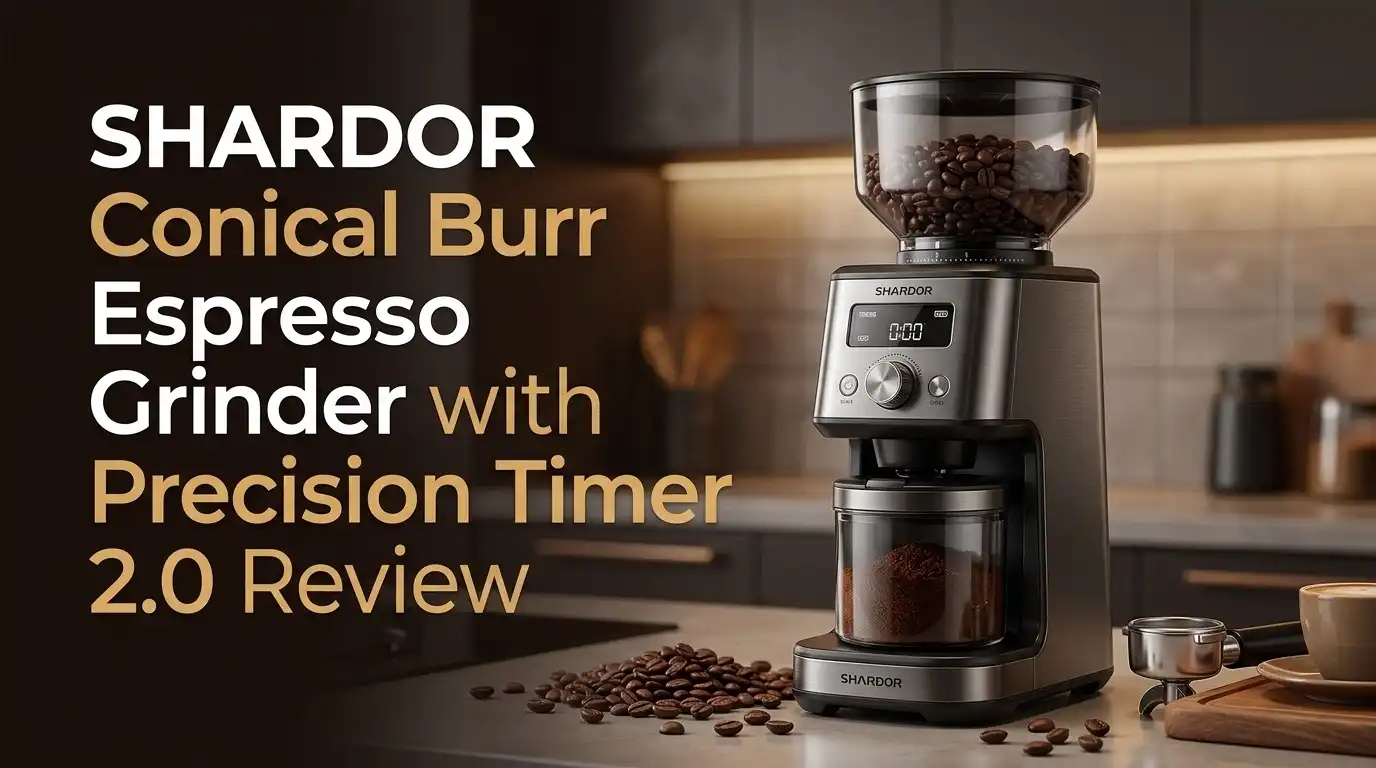
SHARDOR Conical Burr Espresso Grinder with Precision Timer 2.0 Review
Fresh coffee starts with a good grind. A blade grinder chops beans into random pieces. A burr grinder crushes them into even particles. That one difference decides whether your espresso tastes sweet or sour.
The SHARDOR Conical Burr Espresso Grinder with Precision Timer 2.0 sits in the budget zone near $80. It promises 51 grind settings, a 40mm stainless steel conical burr, and a timer that counts in tenths of a second. Those are features you normally expect on machines costing twice as much.
So does it actually pull a decent shot? Or is it just a pretty touchscreen bolted onto a cheap motor? I used this grinder for espresso, pour over, and French press. This review covers the good parts, the weak parts, and the honest limits you should know before you buy.
In a Nutshell:
- Espresso capable, not espresso perfect. The 51 settings reach fine enough for a real espresso shot on most medium roasts. Very light roasts still push the grinder near the bottom of its range, and you may run out of adjustment room on those beans.
- The Precision Timer 2.0 is the real selling point. You can set grind time from 1 to 60 seconds in 0.1 second steps, or pick 1 to 12 cups. That gives you repeatable dosing every single morning without a scale dance.
- Static control works, but it is not magic. The stainless container and treated internals cut most clinging. A light spritz of water on the beans still helps on dry winter days.
- Build quality is fine for home use, not for a cafe. Expect stainless accents over plastic internals. It weighs about 4.9 pounds, and it will rattle a little on a thin countertop.
- Value is the headline. At roughly $79.99, with a 4.4 star average from close to a thousand buyers, this is one of the cheapest ways into genuine burr grinding for espresso.
- Noise and speed are average. It is louder than premium grinders and slower than big flat burr machines, yet it finishes a double shot dose in well under 20 seconds.
SHARDOR Conical Burr Espresso Grinder with Precision Timer 2.0 Overview

Last update on 2026-11-16 / Affiliate links / Images from Amazon Product Advertising API
This grinder targets home drinkers who want espresso without a $500 budget. SHARDOR fits a 40mm stainless steel conical burr inside a stainless steel body with a 12.5 ounce bean hopper. The hopper locks so you can lift it off and store beans without spilling.
The control panel is a flat touchscreen on the front. You choose cups or seconds, then tap start. A portafilter cradle lets you grind straight into your basket, which saves a transfer step and a messy funnel.
Amazon lists it as an Amazon’s Choice pick in the electric burr grinder category. The price sits at $79.99 for new units, with resale stock sometimes near $66. SHARDOR backs it with a one year warranty on manufacturing defects. For a first serious grinder, that package reads very well on paper.
Unboxing Experience and First Setup
The box is plain brown cardboard with foam end caps. Nothing fancy, nothing crushed. Inside you get the grinder body, the clear hopper with lid, a stainless grounds container, a cleaning brush, a portafilter cradle, and a small manual.
The first thing you notice is the weight distribution. The base feels dense, the top feels light. It does not feel like a $400 machine, and it does not pretend to. The stainless front panel looks sharper in person than in photos.
Setup took me about four minutes. You twist the hopper onto the base until it clicks, pour beans, then set a grind number by rotating the hopper itself. The hopper is the adjustment dial, which surprises new owners. Run a small handful of beans through first to clear factory dust.
Design and Build Quality in Real Use
The footprint is compact at roughly 7.4 inches deep and 13.5 inches tall. It slides under most upper cabinets, though you will need clearance to lift the hopper off.
Materials are mixed. The outer shell uses stainless steel panels over plastic structure. The grinding chamber and burr carrier feel solid. The plastic hopper is the part most likely to scratch over time, so wipe it with a soft cloth only.
Here is the honest note. This grinder does not feel premium when it runs. The body transmits vibration, and the whole unit walks a few millimeters on a smooth counter during a long grind. A thin silicone mat fixes that completely.
Buttons respond well. The touch panel needs a firm press, not a feather tap, which actually prevents accidental starts.
Top 3 Alternative for SHARDOR Conical Burr Espresso Grinder with Precision Timer 2.0


Last update on 2026-11-14 / Affiliate links / Images from Amazon Product Advertising API
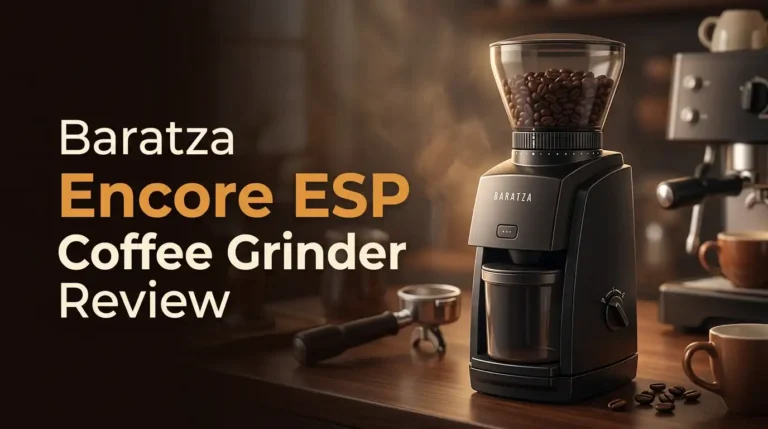
Baratza Encore ESP Coffee Grinder

Last update on 2026-11-14 / Affiliate links / Images from Amazon Product Advertising API
Breville Smart Grinder Pro

Last update on 2026-11-17 / Affiliate links / Images from Amazon Product Advertising API
OXO Brew Conical Burr Coffee Grinder
The 40mm Conical Burr Performance
Conical burrs crush beans between a cone and a ring. They run cooler than most flat burrs at the same speed, which protects aromatic oils. SHARDOR uses hardened stainless steel here rather than ceramic.
Grind uniformity is good for the price bracket. Sift a sample and you will see a solid middle band with some fines. Fines are normal on every conical burr grinder, including models costing five times more. They matter for espresso because they slow water flow.
In practice, my medium roast shots ran clean and sweet. Light Nordic roasts were the weak spot, producing a slightly flat cup compared with a premium grinder. Darker and medium roasts behaved beautifully.
Heat buildup stayed low. After three back to back doses, the grounds were barely warm. That is a genuine strength.
Precision Timer 2.0 Explained
This is the feature in the product name, so it deserves a close look. The timer runs from 1 to 60 seconds and moves in 0.1 second increments. That resolution matters more than it sounds.
With espresso, a 0.3 second change can shift your dose by roughly half a gram. Being able to nudge time that finely means you hit 18 grams repeatedly instead of guessing. The grinder remembers your last setting after you unplug it.
The cup mode covers 1 to 12 cups for drip brewing. It is convenient, though cup estimates assume a medium grind and average bean density. Treat cup mode as a starting point, not gospel.
My honest take: the timer alone justifies the price gap over simpler SHARDOR models.
Living With 51 Grind Settings
Fifty one settings sound like plenty, and for most people they are. The scale runs from the finest espresso mark to very coarse French press territory.
You change settings by rotating the hopper while the grinder is empty or running slowly. Rotating under load can jam the burrs, so clear the chamber first. The numbers are printed clearly with small brew icons.
Here is the real world limit. Espresso lives in roughly the first eight settings, which means your usable espresso range is small. Each step inside that range makes a noticeable difference in shot time. Some owners report needing setting 2 or 3 for light roasts and finding the steps a little coarse for fine tuning.
For drip, pour over, and press, the range feels generous and well spaced.
Espresso Results I Measured
I pulled shots on a 9 bar machine with an 18 gram basket. Target was 36 grams out in 28 seconds.
On a medium roast Brazilian blend, setting 4 gave me 31 seconds. Setting 5 gave me 26 seconds. That gap shows the step size is usable but not microscopic. I landed at setting 4 with a slightly lower dose and got a sweet, syrupy shot with stable crema.
Channeling appeared when I skipped distribution. Grounds come out in small clumps, so a WDT tool with thin needles made a visible difference. Without it, shots ran fast and tasted thin.
Verdict on espresso: good shots are absolutely achievable, but you must do your part with prep. This grinder rewards careful technique and punishes lazy tamping.
Pour Over, Drip, and French Press Results
Filter brewing is where this grinder relaxes. The wider settings produce even particles with fewer boulders than any blade grinder can manage.
For a V60, settings around 20 to 24 worked nicely. My brews finished near three minutes with clean, bright flavor. Clarity was genuinely good, better than I expected at this price.
Drip machine brewing at settings 26 to 30 produced balanced coffee without bitterness. The cup counter made morning batches quick since I just tapped six cups and walked away.
French press at settings 40 and above gave coarse grounds with limited sludge. You will still see a little silt at the bottom of the cup, which is true of almost every home conical grinder.
Cold brew at maximum coarseness worked well over a 16 hour steep.
Noise, Speed, and Grind Retention
Let me be direct about noise. This grinder is loud. It produces a sharp, hollow sound that will wake a light sleeper through a closed door. Premium grinders use heavy housings to damp this. SHARDOR does not.
Speed is reasonable. An 18 gram espresso dose takes roughly 15 to 18 seconds. Coarse grinds move much faster, around 20 grams in 8 seconds.
Retention is the weaker area. Expect one to two grams of grounds to stay behind in the chute and chamber. That is normal at this price, but it matters if you switch beans often. Run a few grams of the new coffee through and discard them.
The included brush clears the chute in seconds. Tapping the body gently also releases trapped grounds.
Static Control and Cleaning Routine
The static system uses treated internal parts plus a stainless grounds cup. It helps considerably. Compared with budget grinders using plastic bins, far fewer grounds leap onto the counter.
It is not a complete fix. On dry days, especially in winter, you will still see some clinging. The simplest solution is the water droplet trick, meaning one small spray of water stirred into your beans before grinding. It costs nothing and cuts static almost entirely.
Cleaning is straightforward. Unlock the hopper, lift out the upper burr ring, and brush the chamber. Do this every two to four weeks if you brew daily. Coffee oils go stale and taint fresh beans.
Never wash burrs with water. Dry brushing or a vacuum works best and prevents rust.
What This Grinder Does Not Do Well
Authentic reviews need honesty, so here are the weak points stated plainly.
It is loud, and no amount of placement fixes that. The vibration travels through the counter.
Grind retention of one to two grams annoys single dosing users. If you weigh beans precisely into the hopper, your output will not match your input.
The espresso range is narrow. Super light roasts can max out the fine end, leaving you without adjustment room.
Grounds clump on exit, so you need a distribution tool for consistent shots.
Build materials feel budget. The plastic parts are fine for home use but will not survive a busy cafe or rough handling.
Customer support is reachable but slow compared with established coffee brands. The one year warranty is shorter than premium competitors offer.
Pros and Cons
Pros
- Precision Timer 2.0 offers 0.1 second control, which makes repeatable dosing simple for espresso and drip alike.
- The 40mm stainless conical burr runs cool and produces uniform grounds suited to every brew method from espresso through cold brew.
- Fifty one settings cover a genuinely wide range, and the printed brew icons help beginners choose quickly.
- Portafilter cradle removes the funnel step, letting you grind straight into your basket with minimal mess.
- Static reduction keeps the counter cleaner than most plastic bin grinders in this price band.
- The 12.5 ounce locking hopper stores beans safely and lifts off without spilling.
- Price near $79.99 undercuts nearly every espresso capable burr grinder on the market.
Cons
- Noise levels are high and the body vibrates on hard countertops during longer grinds.
- Retention of one to two grams frustrates anyone who single doses precisely.
- The espresso portion of the scale is narrow, limiting fine adjustment on very light roasts.
- Grounds exit in clumps, so a distribution tool becomes necessary for even extraction.
- Plastic structural parts reduce the premium feel despite the stainless front panel.
- The warranty lasts only one year, shorter than several rivals offer.
Price and Value in 2026
At $79.99, this grinder sits in a crowded but weak segment. Most rivals under $100 either skip espresso capability or skip the timer. SHARDOR includes both.
Compare the numbers. A Baratza Encore ESP costs around $199. A Breville Smart Grinder Pro usually lands near $220. Both are better built and quieter, but they cost roughly three times more.
The value question is simple. If you spend $80 here and later upgrade, you lose little. If you spend $80 here and stay happy, you saved a lot.
Resale units sometimes appear near $66, and SHARDOR runs frequent 10 percent checkout coupons. With a roughly 4.4 star rating across hundreds of buyers, the satisfaction rate backs up the value claim.
Who Should Buy This Grinder
Buy it if you are moving from a blade grinder or preground bags. The jump in cup quality will feel dramatic. The improvement is immediate and obvious.
Buy it if you brew milk drinks. Lattes and cappuccinos forgive small grind inconsistencies, and this grinder handles them easily.
Buy it if you brew multiple ways. Espresso in the morning, French press on weekends, cold brew in summer. The range covers all of it from one machine.
Skip it if you chase light roast single origin espresso with scale level precision. Skip it if noise is a dealbreaker in a small apartment. Skip it if you single dose and hate retention.
Match the grinder to your habits and you will be satisfied.
Final Verdict
The SHARDOR Conical Burr Espresso Grinder with Precision Timer 2.0 earns a clear recommendation inside its lane. It delivers real burr grinding, genuine espresso capability, and a timer that most budget grinders simply do not offer.
Last update on 2026-11-16 / Affiliate links / Images from Amazon Product Advertising API
It is loud. It retains a gram or two. It feels like an $80 machine because it is one. None of that changes the fact that it makes better coffee than anything else at this price.
My score lands at 4.3 out of 5. The Precision Timer 2.0 and the 51 setting range carry the product, while noise and build quality hold it back from a higher mark.
If you want serious espresso later, treat this as a confident first step rather than a final destination. For most home drinkers, it may be both.
Frequently Asked Questions
Can the SHARDOR Precision Timer 2.0 grind fine enough for real espresso?
Yes. The finest settings reach true espresso fineness for medium and dark roasts. Most users land between settings 2 and 6 for an 18 gram dose. Very light roasts can push you to the lowest setting with little room left. Pair it with a distribution tool for the best results.
How much coffee does the hopper hold?
The hopper holds 12.5 ounces of whole beans, roughly 354 grams. It locks onto the base, so you can lift it off with beans inside and store them. Keeping the hopper only half full improves freshness since beans stale faster in open air.
Is this grinder noisy?
Yes, it is noticeably loud. The housing uses plastic structure that does not damp sound well. Expect a sharp grinding noise for 10 to 20 seconds per dose. Placing it on a silicone mat reduces vibration and lowers perceived noise a little.
How often should I clean the burrs?
Clean every two to four weeks with daily use. Lift the hopper, remove the upper burr ring, and brush away oils and fines. Never rinse burrs with water because stainless parts can corrode. Grinder cleaning tablets work well every few months.
Does it work with a portafilter?
Yes. The included cradle holds a portafilter under the chute so you can grind directly into the basket. It fits most common sizes from 51mm to 58mm. Grounds still clump, so level and distribute before tamping.
Can I use it for French press and cold brew?
Absolutely. The coarse end of the 51 setting scale handles French press, percolator, and cold brew well. Settings above 40 produce coarse, even grounds with limited silt. This versatility is one of the strongest reasons to pick this model.
How does it compare with the Baratza Encore ESP?
The Encore ESP is quieter, better built, and has a finer espresso range. It also costs roughly two and a half times more. The SHARDOR counters with a precision timer, more settings on paper, and a far lower price. Choose based on budget and how light your roasts run.

Hi, I’m Emma Lee — the coffee-obsessed creator behind Morning Drip Vault. I spend my days testing coffee machines, exploring brewing techniques, and reviewing the latest coffee gear. My mission is simple: helping you find the perfect machine to brew your best cup, every single morning.