
Bodum Chambord French Press Review 2026: Still Worth It?
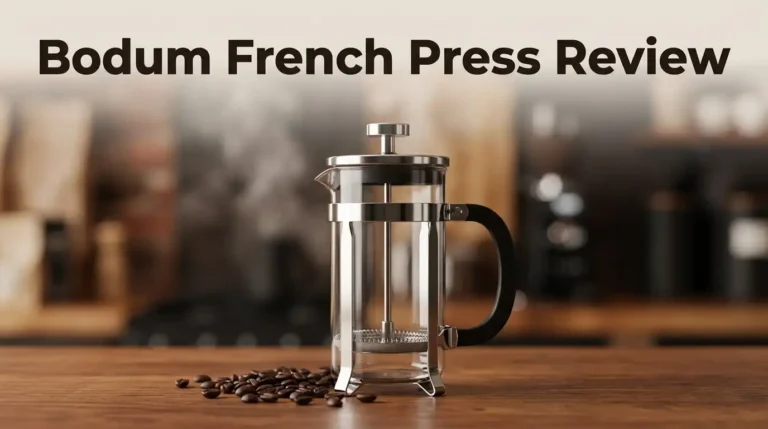
Coffee lovers keep coming back to one shape. The tall glass beaker, the shiny steel cage, the little domed lid with a knob on top. That silhouette belongs to the Bodum Chambord, and it has barely changed since the 1970s.
I have brewed with this press almost every morning for months. I have also dropped a beaker, replaced a filter, and left coffee sitting far too long inside it. So this review covers the good mornings and the annoying ones.
You will learn how the Chambord actually tastes, how it feels in the hand, and where it falls short. You will also see three solid alternatives if the glass beaker makes you nervous. Let us get into it.
In a Nutshell:
- The coffee tastes rich and full. The Chambord produces a heavy, syrupy cup with real body. It will not give you the bright clarity of a pour over, but it delivers warmth and depth that many drinkers prefer at 7 a.m.
- Build quality feels better than the price. The steel frame is stamped, polished, and solid. The little feet lift the beaker off the counter. Nothing rattles, and the plunger glides smoothly instead of scraping.
- Glass is the obvious weakness. Borosilicate glass handles heat well, but it does not handle a hard knock against a faucet. Expect to replace a beaker eventually, and budget roughly fifteen dollars when you do.
- Heat retention is poor. Single wall glass loses temperature fast. Your third cup will be lukewarm unless you decant into a thermal carafe.
- Some fine sediment always gets through. The mesh screen is good, not perfect. A coarse grind fixes most of this, but silt lovers and silt haters should both know what they are getting.
- Made in Portugal, priced around forty dollars. For a classic design with replaceable parts, that remains fair value in 2026.
Bodum Chambord French Press: The Quick Verdict


Last update on 2026-10-20 / Affiliate links / Images from Amazon Product Advertising API
The Bodum Chambord is the reference point for every other French press on the market. Jørgen Bodum introduced this design in 1974, and the shape stuck. Most presses you see today are copies of it.
The 34 ounce model is the one most people buy. It holds one liter of water and yields roughly three large mugs, or eight small servings using the traditional four ounce cup measurement.
The build is honest. You get borosilicate glass, stainless steel, and a plastic handle. Bodum makes the glass in Portugal, and the fit and finish look sharp under kitchen light.
My verdict is simple. If you want great coffee with almost no fuss and you can treat glass gently, the Chambord is an easy recommendation. If you are clumsy, live with roommates, or need coffee to stay hot for an hour, a steel press suits you better.
Unboxing Experience: What Actually Arrives
The box is smaller than you expect. Mine came in a slim printed carton with the press photographed on the front and a red Bodum logo on the side panel.
Inside, the beaker sits inside the steel frame already assembled. Two cardboard inserts hold everything still. The plunger unit rests separately inside the beaker, wrapped in a thin paper sleeve.
There is no plastic clamshell and no foam. The packaging is mostly cardboard, which feels appropriate in 2026 and also means you should carry the box upright.
You get the beaker, the steel frame with handle, the lid and plunger rod, the three part filter assembly, and a short instruction card. No scoop, no extra filters, no carry bag.
Setup takes about thirty seconds. Screw the filter parts onto the plunger rod, rinse everything with warm water, and you are ready. My first impression was that the steel felt heavier and cooler than the photos suggested. That was a good sign.
Design and Build Quality: Old School Done Right
The frame is the star. Bodum stamps it from stainless steel with a polished chrome look finish that reflects light nicely on a counter.
Four small feet raise the glass about half an inch off the surface. This detail matters more than it sounds. It stops the hot base from touching a cold countertop, and it absorbs a careless set down.
The handle is plastic, and that is the one visible compromise. It stays cool while the beaker is full of boiling water, so the tradeoff works in daily use. It does feel slightly cheap next to the steel.
The lid rotates to open or close the pour spout. The knob is metal, the dome is metal, and the rod feels stiff with no wobble.
Weight distribution is excellent. A full press pours without tipping forward. Compare that to many budget presses where a full liter makes the whole thing feel unbalanced and nervous in the hand.
Top 3 Alternatives for Bodum Chambord French Press

Last update on 2026-10-21 / Affiliate links / Images from Amazon Product Advertising API
ESPRO P3 French Press

Last update on 2026-10-21 / Affiliate links / Images from Amazon Product Advertising API
Frieling Double Walled Stainless Steel French Press

Last update on 2026-10-21 / Affiliate links / Images from Amazon Product Advertising API
Secura Stainless Steel French Press
Brewing Performance: How the Coffee Tastes
This is where the Chambord earns its reputation. Full immersion brewing means the grounds sit in water for four minutes with nothing filtering out the oils.
The result is a thick, rounded, slightly sweet cup with visible body. Dark roasts shine here. A Sumatran or a Brazilian bean turns into chocolate and toasted nut flavors that a paper filter would strip away.
Light roasts are trickier. Delicate floral Ethiopian coffees can taste flat and muddy in any French press, and the Chambord is no exception. Match the bean to the method and you will be much happier.
My standard ratio is 60 grams of coarse ground coffee to one liter of water at roughly 200 degrees Fahrenheit. Steep four minutes, break the crust, skim the foam, then plunge slowly.
Cup after cup, the flavor stays consistent. That reliability is the quiet strength of this press. There is no technique to master and no timing window to miss.
The Filter System Explained
The Chambord filter has three parts that screw together on the plunger rod. A perforated steel plate sits on top, a fine mesh screen sits in the middle, and a cross plate with a coiled spring edge sits underneath.
That spring coil presses against the glass wall and scrapes grounds down as you plunge. It works reasonably well.
Compared to modern double basket filters, this design is basic. The Espro system traps far more fines. The Chambord lets a small amount of silt through on every brew, which settles at the bottom of your mug.
Some drinkers call that sludge. Others call it texture. I fall in the middle. With a properly coarse grind, the sediment is minor and only shows in the final sip.
The good news is that the filter breaks down completely for cleaning. Three pieces, no hidden crevices, and replacement screens cost a few dollars. That repairability is rare at this price.
Sizes and Capacity Options
Bodum sells the Chambord in four main sizes, and picking correctly matters more than most buyers realize.
The 12 ounce model makes one mug. The 17 ounce makes two small cups or one generous mug. The 34 ounce is the standard household choice. The 51 ounce serves a crowd or a household of heavy drinkers.
Remember that Bodum measures total beaker volume, not brewed output. A 34 ounce press gives you closer to 30 ounces of drinkable coffee once the grounds absorb their share.
Finishes include polished chrome, brushed steel, copper, gold, and black. The polished version is the classic and the cheapest. Copper looks stunning but shows fingerprints constantly.
One practical tip. You can brew smaller batches in a large press without any problem, which is not true of every competitor. If you are unsure, size up. The 34 ounce model handles a single mug just fine.
Heat Retention: The Honest Weak Spot
Single wall glass does not hold heat. That is physics, not a design flaw, but it still affects your morning.
In my kitchen at normal room temperature, coffee in the Chambord drops noticeably within ten minutes. By twenty minutes it is pleasant but no longer hot. By forty minutes it is distinctly lukewarm.
Bodum sells a knit cozy for this reason, and it does help a little. Preheating the beaker with hot water before brewing helps more.
The real solution is to decant. Pour your entire batch into a thermal carafe or insulated mug right after plunging. This also stops over extraction, because coffee left sitting on the grounds turns bitter fast.
If you want coffee that stays hot in the vessel, you need a double wall steel press. The Frieling and the Espro P6 both handle this properly. Just know you are paying double or triple the Chambord price for that insulation.
What the Bodum Chambord Does Not Do Well
An honest review needs a section like this, so here it is without softening.
The glass breaks. Not during brewing, but during washing. A tap against the sink edge is enough. I cracked mine while rinsing, and that was entirely my fault, which is exactly the point.
Sediment gets through. If you hate silt at the bottom of your cup, this press will irritate you. Pre ground supermarket coffee makes it much worse.
The plastic handle and lid collar feel budget. They function well but they clash with the polished steel.
It stains. Coffee oils build a brown film on the glass over time. Regular scrubbing or a soak with baking soda handles it, but neglect shows quickly.
Plunging can splash. Push too fast and hot coffee sprays past the lid. This happens most when the beaker is filled near the top line.
None of these are dealbreakers. All of them are real.
Cleaning and Maintenance
Cleanup is the least charming part of any French press, and the Chambord is average here.
My routine takes two minutes. Fill the beaker halfway with water, swirl, and pour the slurry into a compost bin or a strainer over the trash. Never pour grounds down a sink drain.
Then rinse the beaker, unscrew the three filter pieces, and scrub the mesh with a soft brush. Oils cling to that screen and turn rancid within days if you skip this.
The whole press is dishwasher safe, including the frame. I still hand wash the glass because repeated dishwasher cycles seem to dull the polished finish over time.
Once a month, soak everything in warm water with a scoop of baking soda. This lifts the brown film off the glass and restores the shine.
Replace the mesh screen roughly once a year. A bent or stretched screen lets far more grounds escape, and people often blame the coffee when the filter is the real problem.
Replacement Parts and Long Term Value
This is the argument that keeps the Chambord relevant in 2026. It is repairable.
Bodum sells spare beakers, spare filter assemblies, spare lids, and spare screens through its own site and through major retailers. A replacement 34 ounce beaker runs around fifteen dollars.
Think about what that means. Break the glass and you are not throwing away the press. You slide in a new beaker and keep the frame you already own.
Compare that to many sealed steel presses where a damaged filter or a failed weld ends the product. Repairability is a real sustainability feature, not a marketing line.
The steel frame itself lasts for decades with basic care. I have seen Chambord frames from the 1980s still in daily service with a modern beaker fitted inside.
Over five years, a Chambord plus two replacement beakers costs about seventy dollars. That is still cheaper than most premium steel presses, and the coffee quality difference is small.
Pros and Cons
Here is the summary in plain terms.
Pros
- Rich, full bodied coffee with excellent consistency across brews
- Classic design that looks good on any counter or breakfast table
- Solid stainless steel frame with protective feet under the beaker
- Borosilicate glass made in Portugal, not cheap soda lime glass
- Every part is replaceable, including beaker, filter, and lid
- Smooth plunger action with less resistance than most steel presses
- Available in four sizes and several finishes
- Fair price around forty dollars for the standard 34 ounce model
- Dishwasher safe for people who dislike hand washing
Cons
- Glass beaker breaks easily with rough handling
- Almost no heat retention, so coffee cools within fifteen minutes
- Fine sediment passes through the mesh on every brew
- Plastic handle and lid collar feel cheaper than the steel frame
- Coffee oils stain the glass and need regular scrubbing
- Fast plunging can splash hot liquid
- No included scoop, spare screen, or accessories in the box
- Filtration lags behind modern double basket designs
Who Should Buy the Bodum Chambord
Last update on 2026-10-20 / Affiliate links / Images from Amazon Product Advertising API
Buy this press if you drink dark or medium roast coffee and want a full flavored cup with almost no learning curve. It rewards simple habits.
It suits people who value how a kitchen looks. The Chambord earns its place on an open shelf in a way that plastic presses never will.
It also suits people who drink their coffee quickly. If your pot empties within fifteen minutes, the weak insulation never becomes a problem.
Skip it if you live in a busy shared kitchen where glass gets knocked around. Skip it if you take coffee to a desk and sip for an hour. Skip it if sediment genuinely bothers you.
Students, campers, and families with young children should probably choose a steel press instead. The Frieling and the Secura both survive drops that would end a Chambord.
For everyone else, this remains one of the best value coffee purchases available. Fifty years of unchanged design tells you something real about how well the original idea worked.
Frequently Asked Questions
Is the Bodum Chambord worth the money in 2026?
Yes, for most home coffee drinkers. At roughly forty dollars you get Portuguese borosilicate glass, a genuine stainless steel frame, and full parts availability. Cheaper presses cut corners on glass thickness and filter quality.
Does the Bodum Chambord leave grounds in your coffee?
It leaves a small amount of fine sediment. A coarse, even grind from a burr grinder reduces this dramatically. Pre ground supermarket coffee produces the most silt.
Can you put the Bodum Chambord in the dishwasher?
Yes, all parts are dishwasher safe. I still recommend hand washing the beaker and frame to protect the polished finish over years of use.
What grind size works best?
Coarse, similar to raw sugar or breadcrumbs. Fine grinds clog the mesh, make plunging difficult, and push bitter sediment into your cup.
How long should you steep coffee in a French press?
Four minutes is the standard. Break the crust at four minutes, skim the foam, then plunge slowly and pour immediately.
Where is the Bodum Chambord made?
The glass beakers are manufactured in Portugal. Bodum remains a Danish and Swiss family owned company founded in 1944.

Hi, I’m Emma Lee — the coffee-obsessed creator behind Morning Drip Vault. I spend my days testing coffee machines, exploring brewing techniques, and reviewing the latest coffee gear. My mission is simple: helping you find the perfect machine to brew your best cup, every single morning.